


Quick Answer: What Is Ambush from Ten Sides?
Ambush from Ten Sides, or Shi Mian Mai Fu (十面埋伏, Shímiàn Máifú), is a traditional Chinese martial suite for the pipa (琵琶, pípá). Its sections dramatize the struggle between the forces of Liu Bang and Xiang Yu.[5]
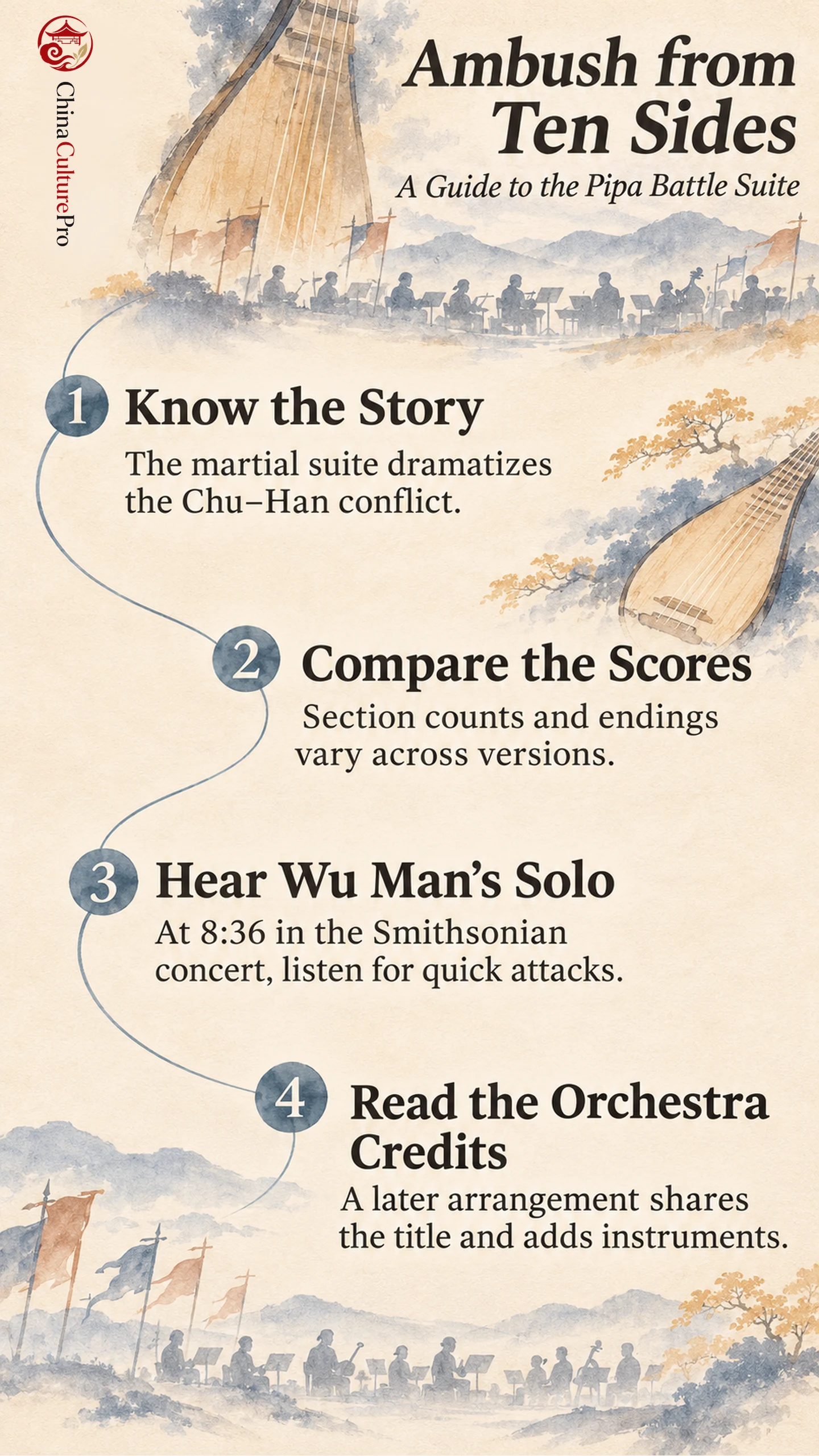
- Listen first: The Smithsonian’s recording of Wu Man’s pipa solo starts at 8:36 in its concert program.[1]
- Check the ending: Pipa players may use different sections or omit part of the closing sequence.[3]
- Check the credits: An orchestral track can share the title with a pipa solo.[4]
Start with the instrument and performer listed for your recording.
One player can suggest several scenes in Ambush from Ten Sides. Close, rapid attacks, a fuller sweep across the strings and abrupt changes of pace let the same pipa shift from preparation to confrontation.[5]
The Story Behind the Martial Suite
The suite looks back to the conflict between Chu and Han. In the performance tradition, Liu Bang’s side prevails and Xiang Yu is defeated in the struggle that precedes the Han dynasty. The titles of the sections tell the listener how to connect the musical episodes to that story.[1]
The companion pipa work King Chu Doffs His Armor treats the same conflict through Xiang Yu’s fall. Ambush puts more of its energy into the unfolding confrontation and its outcome.[4][5]
Why the Scores and Endings Vary
Hua Qiuping’s early nineteenth-century Pipa Scores records the piece under the short title Shi Man, or Ten Sides. The Hong Kong Education Bureau dates that published collection to 1819. Li Fangyuan’s 1895 collection includes the piece under the title Huaiyin Ping Chu.[2][3]
The Hong Kong Chinese Orchestra describes a 13-section sequence moving from an encampment and preparations through the ambush and defeat to a victorious return. Some performers leave out the final three episodes. Check the performer’s section list before using the last episode to identify a version.[3]
What to Listen For in Wu Man’s Solo
The Smithsonian’s March 1999 concert recording places the solo between 8:36 and 14:43. Notice when separated plucks give way to runs of closely spaced attacks. The program describes drumlike sounds and a range of moods, all made by one plucked lute. A rapid succession of short notes can feel very different from a single attack allowed to ring.[1][5]
In that same concert, Wu Man also played another work from the pipa repertoire, Flute and Drum Music at Sunset. The Moonlit River in Spring guide follows that other work’s transmission. Comparing the two pieces in one recital makes the range of pipa tone easier to hear.[1]
How the Orchestra Changes the Sound
The Hong Kong Chinese Orchestra’s 2019 tour program credits an orchestration by Chew Hee Chiat, drawing on Li Cangsang and China Magpie’s arrangement. It lists gehu, pipa, sheng and zhongruan with orchestra. It also names the xun among additional instruments. These are credits for a particular arrangement.[4]
When comparing it with a solo, listen for the change from one plucked instrument’s shifts of color to colors distributed across several instruments. Start from each version’s own section order and instrumentation.
FAQs About Ambush from Ten Sides
Is Ambush from All Sides the same piece?
It is another English title for Shi Mian Mai Fu. Check the named performer or arranger to distinguish versions.[1][3]
Is the pipa solo the original recording?
The work is transmitted in early scores and later performances. A recording such as Wu Man’s documents one performance of the traditional pipa suite.[2]
Is it the same as King Chu Doffs His Armor?
They are separate pipa works drawn from the same conflict. The armor piece focuses on Xiang Yu’s defeat and its aftermath.[4][5]
資料來源
[1] Smithsonian National Museum of Asian Art. Master of the Chinese Pipa: Wu Man
[2] Hong Kong Education Bureau. Listening to Chinese Music
[3] Hong Kong Chinese Orchestra. Ambush from All Sides, Program Notes
[4] Hong Kong Chinese Orchestra. 2019 Mainland Tour Programme Notes
[5] University of North Texas Digital Library. Expanding the Violin’s Possibilities in Chinese Music