


Quick Answer: What Is The White-Haired Girl?
The White-Haired Girl (Bai Mao Nü, 白毛女, Báimáo Nǚ) is a story about Xi’er (喜儿, Xǐ’ér), a young woman who escapes a landlord’s household and takes refuge in the mountains. It appeared as an opera in Yan’an in 1945 and later as a film and several stage adaptations.[1][3][6]
- Opera: Wang Kun played Xi’er at the Yan’an premiere.[1]
- Film: The early feature stars Tian Hua and was completed in 1950.[1][2]
- Ballet: Tokyo’s Matsuyama production and the Shanghai Dance School’s adaptation have separate histories.[4][6]
Identify the version by its cast and medium before comparing a song or scene.
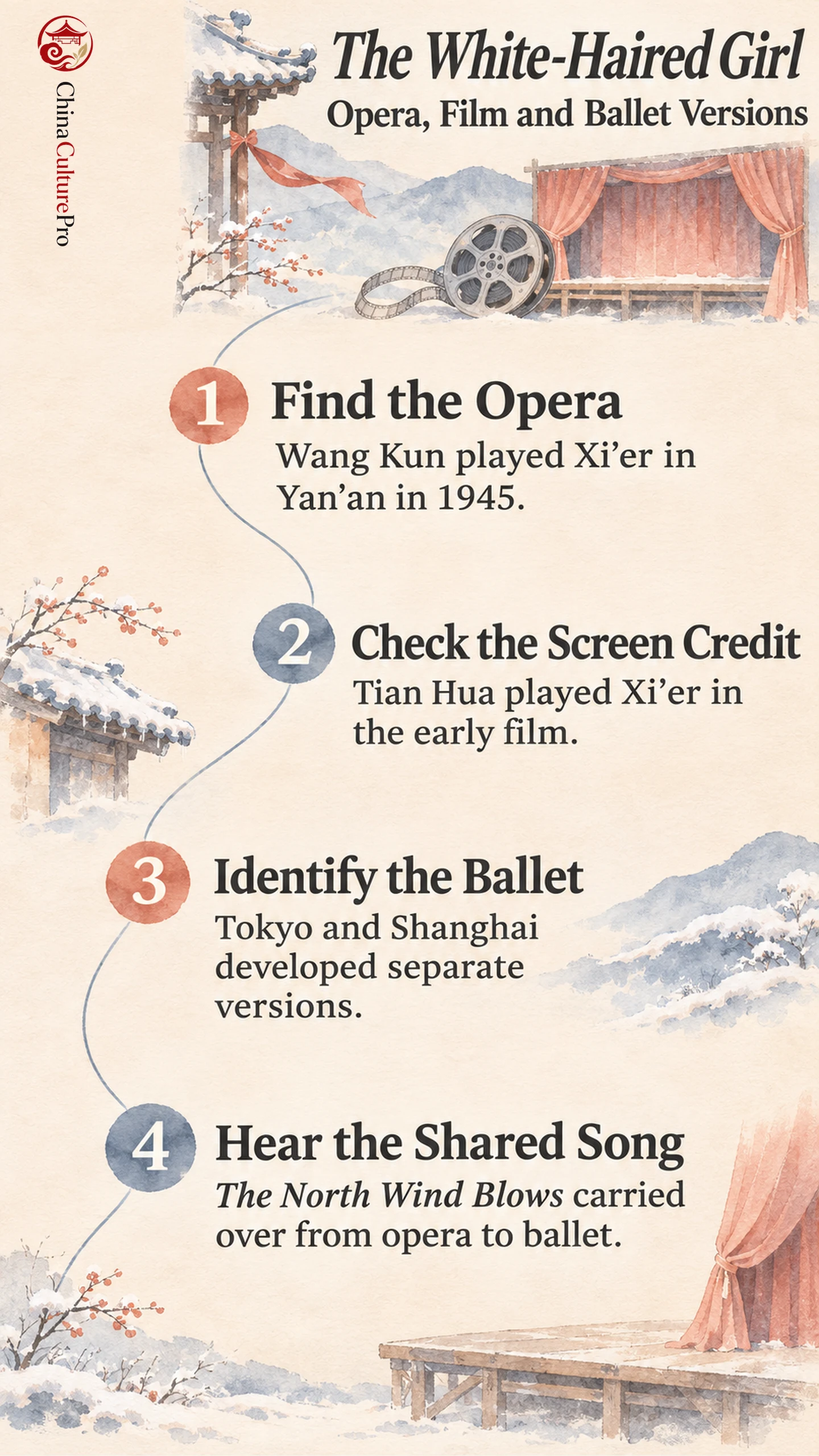
One recognizable song can help you find the same moment in different versions. In an opera, it tells you what a character is thinking. A ballet can keep the tune and give some of that work to movement, scenery or a prop.
The Yan’an Opera and Its Songs
The opera was a collective work at the Lu Xun Academy of Arts. Its modern musical theater drew on regional folk melodies and helped tell a story about class and power. It is a modern musical theater work in the wider history of 中國戲曲.[3][7]
Bei Feng Chui (北风吹, Běifēng Chuī), often translated as The North Wind Blows, accompanies the snowy New Year setting. The holiday marks Xi’er’s hope for her father’s return. For wider musical context, see Chinese New Year celebration music.[4][7]
The Film and the Matsuyama Ballet
Wang Bin and Shui Hua directed the narrative film. Sources catalog the film as a 1950 production, with the screen adaptation also dated to 1951 in Chinese accounts. Tian Hua plays Xi’er. The Modern Chinese Literature and Culture Resource Center points readers to a subtitled edition and a translation of the film script.[1][2][3]
The Matsuyama Ballet adapted the story after seeing the Chinese film. Its production premiered in Tokyo in February 1955. Use the Matsuyama name to locate the Japanese production.[1][6]
The Shanghai Ballet and Its Credits
Shanghai’s municipal account describes a 1964 trial version and a 1965 Shanghai Spring festival performance. The National Ballet of China also records a March 1966 Shanghai Ballet premiere at Yunfeng Theatre and its own 1968 Beijing staging. Use the venue and company alongside the date.[4][5]
The repertory entry credits Yan Jinxuan, Chen Benhong and Zhang Hongxiang for composition and orchestration. It identifies The North Wind Blows as music retained from the opera. Compare the use of individual movement here with The Red Detachment of Women or the ensemble tableaux of The East Is Red.[5]
How to Identify a Performance
Look for whether sung words, dialogue or choreography carries the scene. The story also appeared in Beijing opera, where the conventions of stage makeup and masks belong to a separate performance vocabulary.[7]
FAQs About The White-Haired Girl
Who played Xi’er in the early opera and film?
Wang Kun played Xi’er in the 1945 opera, and Tian Hua played her in the early narrative film.[1][2]
Which ballet came first, Tokyo or Shanghai?
The Matsuyama Ballet premiered its Tokyo production in 1955. Shanghai Dance School developed its own adaptation in the following decade.[4][6]
What song carries over from the opera to the Shanghai ballet?
The National Ballet of China credits The North Wind Blows as one of the songs retained from the opera.[5]
資料來源
[1] China Federation of Literary and Art Circles. Unforgettable Story of White-Haired Girl
[2] Ohio State University Modern Chinese Literature and Culture Resource Center. Subtitled Version of The White-Haired Girl
[3] China Writers Association. The Making of The White-Haired Girl
[4] Shanghai Municipal Government. The 60th Anniversary of The White-Haired Girl Ballet
[5] National Ballet of China. The White-Haired Girl: Historical Repertory
[6] Adaptation, Oxford University Press. Ballet Diplomacy and the Japanese Adaptation
[7] Wuhan Song and Dance Theatre. The Return of a Classic