

Quick Answer: Is Beijing Opera Makeup a Mask?
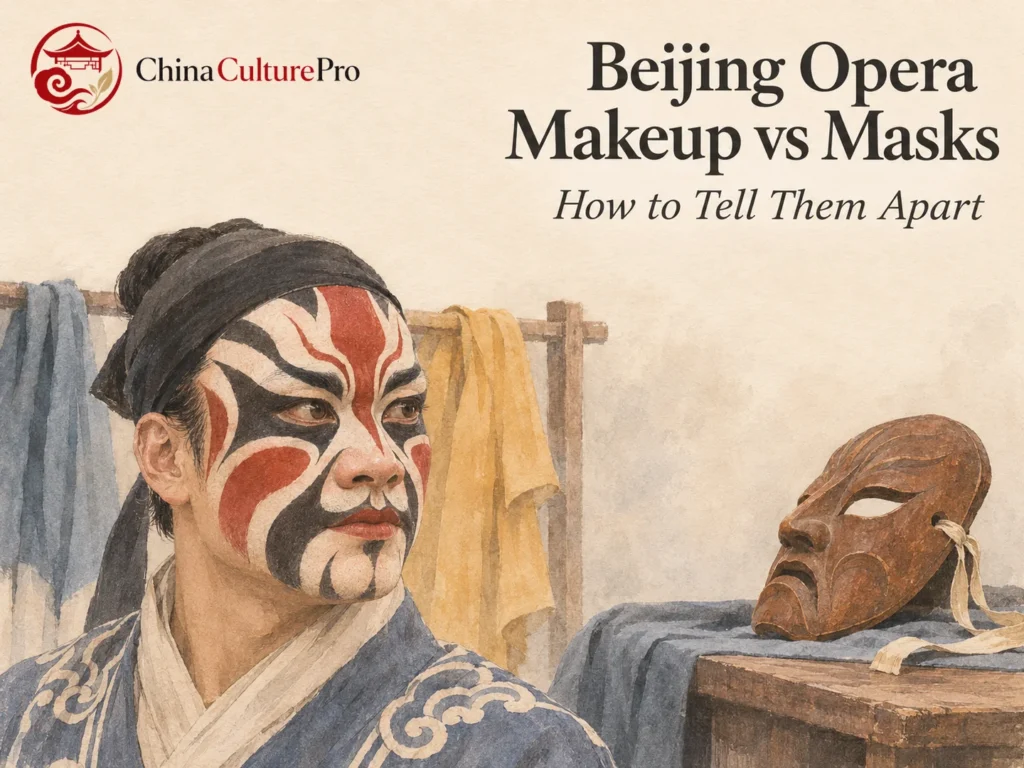
In Beijing opera, lianpu (脸谱, liǎnpǔ) is a patterned design painted directly on a performer’s face. A wearable mask is a separate object covering some or all of the face. The painted patterns often associated with Beijing opera appear most prominently on jing (净, jìng) and chou (丑, chǒu) roles.[1][2][3]
- Jing: Painted-face roles can use bold patterns across much of the face.[3]
- Chou: A comic role often has a smaller white patch around the nose.[3]
- Masks: Sichuan face changing, Nuo and Tibetan opera use wearable objects in their own performance contexts.[5][6][7]
Read the role, character and scene together before interpreting a color.

A still picture can make a painted face look like a mask. In performance, the lines move with the cheeks and brow. A separate object has edges of its own. Listen and watch beyond that first visual clue, because the music and gesture also tell you how a character enters the scene.
Paint on the Face and Objects Worn Over It
In Li Zhiyuan’s account for the ICH Courier, the design is outlined and pigments are applied to the performer’s face. The pigment follows the performer’s brows, cheeks and nose. A museum display or souvenir can present a similar pattern on a rigid object. The guide to Peking opera mask designs covers their character associations in more detail.[2]
The Metropolitan Museum of Art catalogs an album of portraits that documents the makeup and costumes of one hundred characters from nine plays. Its labels illustrate why the character name is useful context for a painted pattern.[4]
Read the Role Before the Color
A broad pattern can signal a jing role, while a small white area around the nose can signal a chou role. The small comic patch is a role clue. A largely white face can identify a different role or named character. Read the shape and placement of the color alongside the opera role type.[3]
How Music Frames the Entrance
UNESCO describes Peking opera as a blend of singing, recitation, movement and music. A high-pitched jinghu (京胡, jīnghú) or winds can accompany the voice, while drums and gongs can punctuate an entrance or a turn. Watch what the performer does when a drum or gong punctuates the movement.[1]
For a contrasting regional example, Chang Xiangyu’s performances offer a way into the vocal style of Yu opera.
Compare Mask Traditions by Region
In Sichuan opera face changing, bian lian (变脸, biànliǎn) can involve the rapid substitution of masks during a scene. A carved wood example from Guangxi illustrates one kind of Nuo mask. Tibetan opera uses masks within a different tradition of storytelling, singing and dance.[5][6][7]
FAQs About Beijing Opera Makeup and Masks
What is lianpu in Beijing opera?
It is a patterned facial makeup design that helps identify a role or character.[1][2]
Do all Beijing opera actors have a fully painted face?
The full painted face is strongly associated with jing roles. Chou makeup often uses a smaller white area, and other roles have their own makeup conventions.[2][3]
Is Sichuan face changing the same as Beijing opera face painting?
Sichuan face changing can use wearable masks that change during a scene. Beijing opera lianpu is painted onto the face.[2][5]
資料來源
[1] UNESCO Intangible Cultural Heritage. Peking Opera
[2] UNESCO ICH Courier and Li Zhiyuan. Beijing Opera, Embodying Harmonious Beauty of Chinese Tradition
[3] ChinaCulture.org. The Colors of Peking Opera
[4] Metropolitan Museum of Art. One Hundred Portraits of Peking Opera Characters
[5] Smithsonian National Museum of Asian Art. Face Changing
[6] Second Face Museum of Cultural Masks. Maonan Nuo Mask
[7] UNESCO Intangible Cultural Heritage. Tibetan Opera