
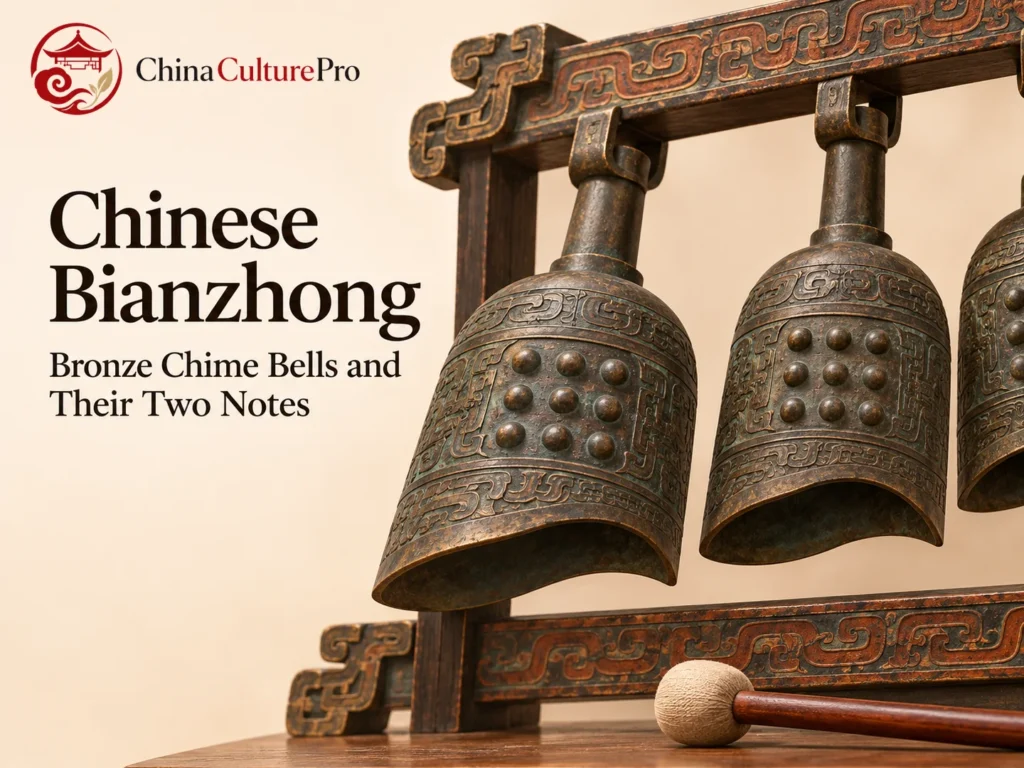

Quick Answer: What Is a Bianzhong?
A bianzhong (编钟, biānzhōng) is a set of tuned Chinese bronze bells. The bells hang on a rack and are struck from the outside. On many examples, including bells made for Marquis Yi of Zeng, striking the front center and striking closer to the side produce different notes.[1][2][3]
- Material: The cast bronze body itself vibrates.[1][3]
- Layout: Bells of different sizes and pitches form a set.[1][4]
- Famous example: The Marquis Yi set from Suizhou has 65 bells on a three-tier rack.[1]
The number of bells and their pitch relationships depend on the particular set.[1][4]

A player facing a rack can choose between bells and between different points on some bells. Those two choices help explain how a row of cast bronze objects can carry a melody.
How One Bell Can Sound Two Pitches
A strike near the front center makes the wall of the bell vibrate in one pattern. A strike nearer the side can favor another pattern with a different pitch. The inscriptions on Marquis Yi’s bells identify pitches at different strike locations. The Hubei Provincial Museum describes pairs of notes separated by a major or minor third.[1][3]
A bronze bell in the Metropolitan Museum of Art shows the form of an individual instrument away from its set. This Eastern Zhou object has a long handle and groups of raised bosses across the surface. The Met describes these bells as producing a focused note that fades quickly. See the guide to Chinese bronze bells for the range of bell shapes and mountings outside the Zeng set.[4]
The 65 Bells of Marquis Yi of Zeng
The bells were excavated in 1978 from the marquis’s tomb in Suizhou, Hubei. The top tier is easy to distinguish from the lower two by the shape of the mounts. The museum identifies three types on the L-shaped rack.[1][5]
- 19 loop-knob bells (niuzhong, 钮钟, niǔzhōng): These hang from the upper tier.[1]
- 45 stemmed bells (yongzhong, 甬钟, yǒngzhōng): These hang at an angle on the middle and lower tiers.[1]
- One gift bell (bozhong, 镈钟, bózhōng): This bell was given by King Hui of Chu. Its inscription dates the gift to 433 BCE.[1][5]
The set’s total span is about five and a half octaves, according to the museum. The central register includes twelve semitones. Other instruments in the same tomb include a set of bianqing stone chimes.[1][5]
What the Inscriptions and Recordings Can Tell Us
The inscriptions on the bells, hooks and rack total 3,755 characters. They give information including pitch names, tuning relationships and the ownership of the set. UNESCO entered the inscriptions and musical information in the Memory of the World Register in 2025.[1][2][3]
Modern performances also offer a way to hear the type of sound these bells can produce. A project documented by the Wuhan municipal government recorded strikes on replica bells with the Hubei Provincial Museum Chime Bell Orchestra. Such a recording documents the sound of those replicas. A useful first comparison is to hear a center strike and a side strike on the same bell before listening to a full piece.[2][6]
FAQs About Chinese Bianzhong
Did every bianzhong have 65 bells?
The 65-bell count belongs to the Marquis Yi set. Other sets were made with different numbers of bells and different pitch ranges.[1][4]
Are bianzhong the same as bianqing?
Bianzhong are sets of bronze bells. Bianqing are sets of suspended stone plates. The two types could appear in the same ensemble.[1][5]
資料來源
[1] Hubei Provincial Museum. Chime-Bells From the Tomb of Marquis Yi of Zeng
[2] UNESCO Memory of the World. The Suizhou Bianzhong of Marquis Yi of Zeng
[3] UNESCO Memory of the World Programme. Bianzhong Inscriptions and Dual Tones
[4] The Metropolitan Museum of Art. Eastern Zhou Yongzhong, Object 13.220.86
[5] Hubei Provincial Museum. Introduction to the Tomb of Marquis Yi of Zeng
[6] Wuhan Municipal Government. Recording the Sound of Replica Chime Bells