

Quick Answer: Who Was Zeng Jize?
Zeng Jize (曾纪泽, Zēng Jìzé, 1839–1890) was a Qing diplomat. He represented the court in talks with Russia over Ili (伊犁, Yīlí) and signed the revised Treaty of Saint Petersburg in 1881. The agreement returned most of the occupied territory on revised terms.[1][2][3]
- Earlier proposal: The Qing court rejected the 1879 agreement negotiated by another envoy.
- Revision: Zeng renegotiated territory, trade terms and compensation.
- Public voice: His English-language writing addressed readers outside China.
The revision improved some terms while leaving financial and territorial concessions in place.
One treaty gave the Qing court more territory back at a higher financial cost. That exchange helps explain Zeng Jize’s work as an envoy. His reports and the treaty show which terms he treated as lasting and where he had room to bargain.
From a Qing Official Family to Overseas Diplomacy
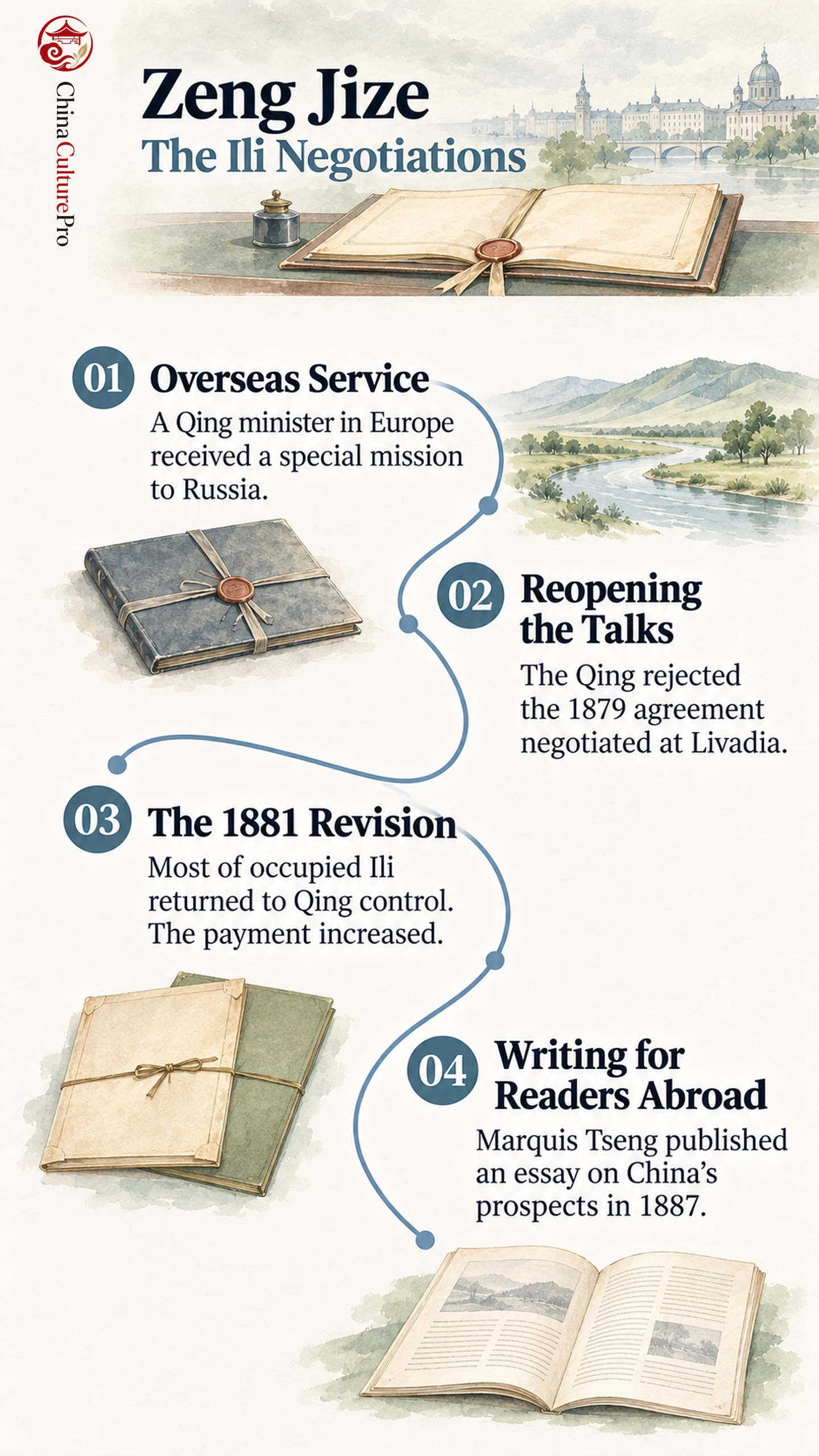
Zeng was the eldest son of Zeng Guofan (曾国藩, Zēng Guófān). His own career took him into the diplomatic service of the Qing dynasty as minister to Britain and France. The court subsequently appointed him to negotiate in Russia. A minister stationed in Europe could receive a specific mission beyond his existing responsibilities.[1][2][4]
His appointment illustrates how late Qing diplomatic missions could combine a continuing presence abroad with a commission to settle a particular dispute. The treaty identifies him as the representative authorized to sign for the Qing court.[1][3]
Why the Qing Reopened the Ili Negotiations
Russia occupied Ili in 1871 during upheaval in the Qing northwest. The Qing envoy Chonghou (崇厚, Chónghòu) negotiated the Livadia agreement in 1879. The Qing government refused to approve it and sent Zeng to reopen the talks. The dispute covered boundaries, trade and money, with each issue creating a different kind of obligation.[1][2][4]
The Draft History of the Qing reproduces a memorial in which Zeng gives the boundary special weight. He saw the division of territory as harder to revisit than commercial rules, which might be amended later. His position left room to bargain on compensation and selected trade provisions while continuing to press for land.[2]
What the 1881 Treaty Changed
Zeng signed the revised treaty in Saint Petersburg on February 24, 1881, alongside Russian representatives Nikolay Giers and Yevgeny Byutsov. The revised settlement returned most of the occupied Ili region to the Qing, including the Tekes River valley that the earlier agreement would have left to Russia. Russia retained a western strip. The treaty connected that strip to the settlement of inhabitants who opted for Russian allegiance.[1][2][3]
The payment rose from five million to nine million rubles. The negotiators also revised provisions on trade and consulates. The later Qing account describes the deletion of proposed access to Hankou and a change from Ürümqi to Turpan for a proposed consulate. The comparison depends on which term is in view. More land was returned, compensation increased, and the commercial relationship remained subject to negotiated rules.[2][3]
Zeng Jize’s Argument to an English-Language Audience
In 1887, the Asiatic Quarterly Review carried Zeng’s essay China: The Sleep and the Awakening under the byline Marquis Tseng. A U.S. diplomatic dispatch circulated the text as an enclosure. Zeng challenged the idea that nations necessarily follow an irreversible course of decline. He used the argument to ask foreign readers to reconsider predictions of permanent Chinese decline.[5][6]
The essay and the treaty speak in different registers. The treaty establishes what two governments agreed to. The essay shows how one Qing official wanted readers to think about his country. Read the treaty for enforceable provisions between the two governments and the essay for the public case Zeng wanted to make.[3][5][6]
FAQs About Zeng Jize
Was Zeng Jize related to Zeng Guofan?
Yes. Zeng Jize was Zeng Guofan’s eldest son. He is also known in English-language sources as Tseng Chi-tse.
Are the Livadia and Saint Petersburg treaties the same agreement?
No. Chonghou negotiated the Livadia agreement in 1879. The court rejected it and commissioned Zeng to renegotiate. The revised treaty was signed at Saint Petersburg in 1881.
Did the 1881 treaty restore all of Ili to the Qing?
Most of the occupied region was returned, including the Tekes River valley. A western portion remained with Russia under the revised agreement.
Источники
[1] National Palace Museum, Taiwan, diplomatic treaty archive. Treaty of St. Petersburg between China and Russia
[2] Draft History of the Qing. Chapter 153: Foreign relations with Russia
[3] The World and Japan Database. Revised treaty between China and Russia, February 24, 1881
[4] Chinese Text Project. Zeng Jize
[5] Office of the Historian, U.S. Department of State. 1887 diplomatic dispatch enclosing China: The Sleep and the Awakening
[6] Bavarian State Library, via Google Books. Asiatic Quarterly Review, Volume 3