
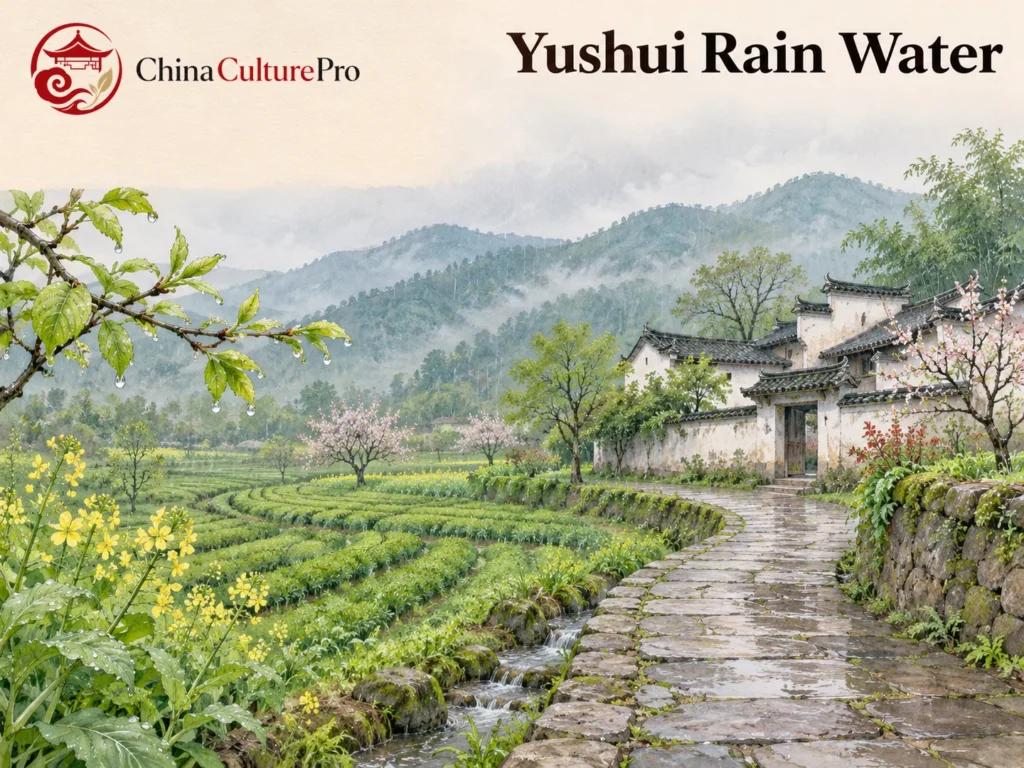

Quick Answer: What Is Yushui?
Yushui (雨水, Yǔshuǐ), or Rain Water, is the second of China’s 24 Solar Terms. It began on February 18 in 2026 and falls on February 19 in 2027 in UTC+8. The name refers to the traditional early-spring shift toward more rain and thawing.[1][2][3]
- Calendar: The term begins when the Sun’s apparent longitude reaches 330°.[1]
- Farming: Spring precipitation matters for crops as the growing season resumes.[3]
- Customs: Western Sichuan accounts describe visits to parents and the practice of finding a godparent.[4][5]
Rain Water has a calendar date even where that day is dry, cold or snowy.

An English almanac may call this point Rain Water or Spring Showers. Both labels refer to the same point in the calendar. In western Sichuan, the season also has a family meaning, with stories about gifts to parents and new ties between households.[2][4][5]
When Is Yushui?
In 2026, Rain Water began at 23:52 on February 18 in UTC+8, the time used in mainland China and Hong Kong. The 2027 calendar puts it on February 19. Because the term begins at an astronomical instant, a calendar in another time zone may show a different civil date.[1][2]
The 24 Solar Terms divide the Sun’s apparent annual circuit into segments. At Rain Water, the reference longitude is 330°. An almanac can show a different lunar date alongside it each year because the lunar months track the Moon’s phases.[1][2]
What Rain Water Means for the Season
Yushui’s name reflects a seasonal pattern: as conditions grow milder, ice and snow can melt and light rain becomes more familiar in some places. The saying that spring rain is as precious as oil points to the value of moisture when crops start growing again. It describes an agricultural concern. A grower still has to judge the actual soil and weather.[3]
The name works better as a clue to a season than as a forecast for a city. A cold spell can persist after the date, and the same spell of weather can bring snow in one place and rain in another. A weather report answers a different question from the almanac.[1][3]
Rain Water Customs in Western Sichuan
One western Sichuan custom is hui niangwu (回娘屋, huí niángwū), in which a married daughter visits her parents. In accounts from Dujiangyan, daughters and sons-in-law bring a pair of bamboo chairs as a wish that the parents will have support in old age. The gift thanks the parents for raising their daughter.[4]
Another custom is la baobao (拉保保, lā bǎobao), forming a godparent relationship for a child. The traditional hope was that another adult would help the child grow up well, an idea associated with rain nourishing plants. The family visit recognizes an existing relationship. The godparent custom adds a new one.[5]
How Yushui Fits Into the Spring Calendar
In the order of the spring solar terms, Rain Water follows Начало весны (立春, Lìchūn) and precedes Awakening of Insects (惊蛰, Jīngzhé). Start of Spring opens the traditional season. The next two names call attention to moisture and then to the return of activity associated with warming. Read together, the names show which signs people used to describe the progress of spring.[2][3]
FAQs About Yushui
Is Rain Water always on February 19?
The date can vary. In UTC+8 it was February 18 in 2026 and is February 19 in 2027.[1][2]
Does Rain Water mean it will rain that day?
The calendar entry marks a position of the Sun. To know whether to expect rain at a specific place, check the local forecast.[1][3]
Why do some families look for a godparent at Yushui?
The tradition expresses a hope for the child’s well-being through a new family tie. It is documented in parts of Sichuan.[5]
Источники
[1] Hong Kong Observatory. Almanac 2026
[2] Hong Kong Observatory. 2027 Gregorian–lunar calendar
[3] Confucius Institute. Yushui and spring rain
[4] Sichuan Online. Rain Water customs in Sichuan
[5] People’s Daily Online. Rain Water and local traditions