


Quick Answer: Who Are the Yugur People?
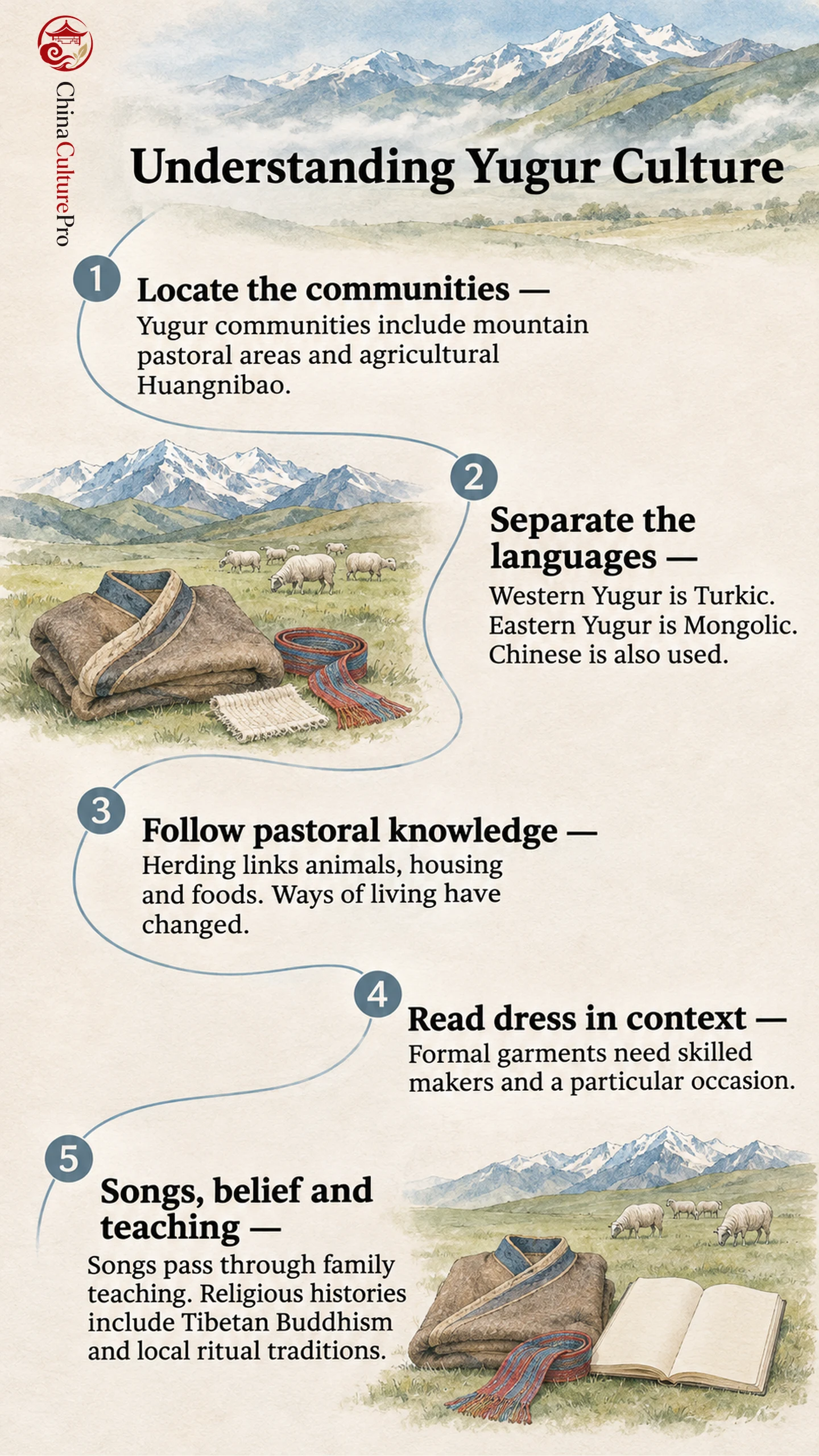
The Yugur people(裕固族,Yùgùzú) are an officially recognized ethnic group in China, concentrated in Sunan and the Huangnibao area of Gansu. Their culture includes two heritage languages from different language families, pastoral knowledge, distinctive ceremonial clothing and oral traditions. The Qilian Mountains and the Hexi Corridor provide the setting for these connected but locally varied practices. Community identity extends across the differences in language and livelihood. [1]
A herding song and a set of long beaded ornaments preserve different kinds of knowledge. One carries words and a way of singing through a task or ceremony. The other requires materials, skilled hands and an understanding of how it is worn. The singer and maker each pass on skills that connect the object or song with its occasion.
Sunan, Huangnibao and the Qilian Landscape
Sunan Yugur Autonomous County lies along the northern slopes of the Qilian Mountains in the central Hexi Corridor. Its mountain grasslands support herding, while Huangnibao near Jiuquan has a different setting associated with agriculture. The community’s geography therefore contains both pastoral and farming histories. [1]
The official name Yugur was adopted in 1953 after consultation. Historical records and linguistic works also contain other names and spellings, including forms related to Yellow Uighur or Yellow Uyghur. Those names can help locate an older account, but the modern Yugur ethnic category has its own community history in Gansu. [1]
A useful reading of this landscape keeps the smaller places visible. An account from a mountain herding area may emphasize livestock and seasonal work. Another from an agricultural settlement can foreground crops and different household routines. Both belong within the wider subject, with each explaining a particular setting.
Western and Eastern Yugur Languages
The two heritage languages belong to different families. The eastern and western labels describe where they are used. Their language families identify different linguistic relationships. A shared ethnic name can therefore cover a multilingual population. [2]
| Two Yugur Heritage Languages | Language family | Main community setting |
|---|---|---|
| Western Yugur(西部裕固语,Xībù Yùgùyǔ) | Turkic | Western parts of Sunan, including Minghua and Dahe |
| Eastern Yugur(东部裕固语,Dōngbù Yùgùyǔ) | Mongolic | Eastern parts of Sunan, including Kangle and Huangcheng |
Chinese is also widely used, and it has long been the everyday language in Huangnibao. Some people speak more than one of the community’s languages. When comparing recordings or song texts, identify which language the speaker is using and where the recording was made. The distinction provides a specific example of why languages in China extend beyond a simple Mandarin-and-dialects framework. [1]
Pastoral Work, Homes and Food
Traditional herding involves sheep, goats, cattle and horses, with particular livestock associated with different local areas. Such work draws on knowledge of pasture, weather, animals and household needs. The agricultural life recorded at Huangnibao adds another strand to the community’s economic history. These differences matter when discussing pastoral cultures in China. [1]
Housing has also changed. Older accounts describe tents made from animal-hair cloth, with a central hearth used for cooking and warmth. Permanent homes and different kinds of seasonal accommodation have become part of later pastoral life. A historical tent description should be read alongside its date and use, especially when looking at a present-day settlement. [3]
Food offers a more familiar view of the relationship between work and household life. Documented pastoral meals include buttered milk tea, dairy foods, roasted grain preparations and mutton dishes. These ingredients link livestock products with grains obtained or grown in the region. They describe a food tradition whose range has expanded as households’ living and working conditions have changed. [3]
Ceremonial Dress and the People Who Make It
Yugur ceremonial clothing includes long robes, belts, hats and elaborate ornaments. Some women’s ensembles feature tou mian(头面,tóumiàn), long decorative pieces attached to braids. The documented ornaments use metal connections and materials such as silver plaques, beads, shells and coral. Their length is fitted to the wearer. Yugur dress entered the national heritage list in 2008. [4]
These garments are especially visible at celebrations, ceremonies and cultural events. Ordinary daily clothing has changed, so a photograph of a formal outfit gives evidence of an occasion as well as a tradition. Looking at its fastenings, materials and arrangement can reveal more than treating it as a single unchanging ethnic costume. [3]
The maker Ke Cuiling learned techniques from her mother and elder sister, then collected garments and studied examples from different local groups. Her heritage profile describes recording complete sets of patterns and investigating their shared features and differences. Her collection work helps retain the knowledge needed to make and distinguish those garments. [5]
Songs, Beliefs and Family Teaching
Yugur songs have distinct functions. The repertoire includes narrative and love songs, as well as songs for feasts, felt making and tending young livestock. These connections help explain why a melody or text benefits from information about when it is sung. Yugur folk song entered China’s first national intangible cultural heritage list in 2006. [6]
Du Xiulan’s documented learning began with parents who taught songs, stories, rhymes and proverbs. Wedding songs formed another part of the knowledge she acquired. The example brings language, memory and performance together through a family relationship. A recorded song preserves sound, while learning from a singer can also pass on phrasing and the occasion in which it belongs. [7]
Religious histories of the region describe Tibetan Buddhism alongside older local ritual traditions. Their importance and practice have varied across places and periods. Songs, stories and ceremonial objects can enter these settings as well as family events, so their context deserves attention when they appear in a recording or display. [2]
FAQs About Yugur Culture
Are Western and Eastern Yugur dialects of one language?
They are distinct languages. Western Yugur belongs to the Turkic family, while Eastern Yugur belongs to the Mongolic family.
Do Yugur people always wear traditional dress?
Formal outfits are particularly associated with ceremonies and celebrations. Everyday clothing varies with the person, setting and activity.
Are Yugur and Uyghur the same ethnic group?
They are distinct recognized groups in China. Historical names and connections can resemble one another, which makes the date and context of a source important.
Источники
[1] National Ethnic Affairs Commission. Overview of the Yugur People
[2] David Somfai Kara. The Last Yugur Shaman from Sunan, Gansu, Shaman Volume 24
[3] National Ethnic Affairs Commission. Yugur Customs
[4] China Intangible Cultural Heritage. Yugur Dress
[5] China Intangible Cultural Heritage. Ke Cuiling
[6] China Intangible Cultural Heritage. Yugur Folk Songs
[7] Китайское нематериальное культурное наследие. Du Xiulan