


Quick Answer: What Is Kyrgyz Culture in China?
Kyrgyz(柯尔克孜族,Kē’ěrkèzīzú)culture in China connects communities, oral literature, music and material skills across different environments.
- Communities: Most live in Xinjiang; a smaller community lives in Fuyu, Heilongjiang. [1]
- Language: Xinjiang communities use a Turkic language with regional varieties and an Arabic-based writing system. [2]
- Oral arts: Heroic storytelling and customary songs have different performers, occasions and musical settings. [3][5]
- Material life: Felt, embroidery, clothing and pastoral knowledge connect cultural expression with household needs. [6][8]
Ethnic identity does not prescribe one occupation, home or performance style. Shared traditions also extend across China’s borders.
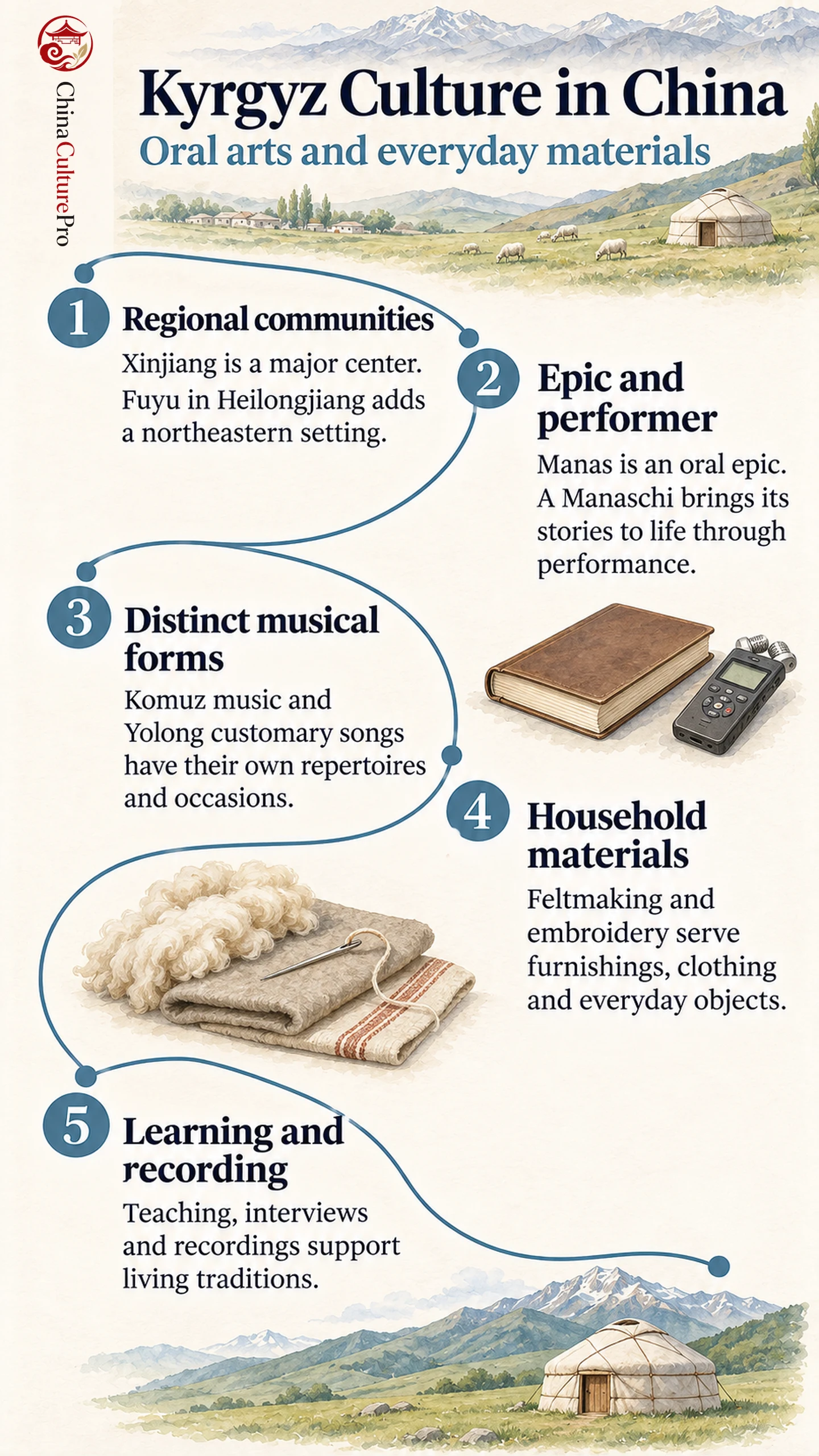
An epic singer’s changing voice, a plucked melody and a stitched household textile reveal different parts of Kyrgyz cultural life. Understanding the connections begins with separating a story from its performance, and a widely recognized tradition from the experiences of every community.
Where Kyrgyz Communities Live in China
Kizilsu(克孜勒苏,Kèzīlèsū)Kyrgyz Autonomous Prefecture in southwestern Xinjiang is a major population center. Communities also live elsewhere in southern Xinjiang and around the Ili region farther north. Fuyu in Heilongjiang adds a northeastern setting to this geography. [1]
Within China’s official ethnic categories, Kyrgyz is an ethnic identity; Kyrgyzstan names a neighboring country. The categories overlap culturally without being interchangeable statements of citizenship. The Fuyu community also belongs within the history of northeastern China, rather than an exclusively Pamir account. [1]
Language, Writing and Regional Differences
The Kyrgyz language belongs to the Turkic family. Language documentation in Xinjiang distinguishes northern and southern varieties, including a separate survey location in Tekes. A writing scheme based on Arabic letters was formulated in China in 1954. [2]
These details concern different things: language is spoken communication, varieties describe regional differences, and an alphabet is a way of representing speech. Writing practices in China and Kyrgyzstan need to be identified separately. Nor should a survey of selected Xinjiang communities stand in for the language experience of every Kyrgyz household. [2]
Neighboring Kazakh communities in China have their own linguistic and cultural traditions. Similar pastoral environments do not make the two ethnic identities synonyms.
Manas: An Epic and a Living Performance
Manas(玛纳斯,Mǎnàsī)is a heroic epic centered on its named hero and later generations. In China, an eight-part telling is associated with this wider narrative tradition. Different singers and regions preserve different versions, so a printed volume represents a particular telling and editorial history. [10]
A Manaschi(玛纳斯奇,Mǎnàsīqí)is an epic performer. Traditionally, a singer performs without instrumental accompaniment, varying melody and delivery with the characters and unfolding events. Gatherings, ceremonies and dedicated concerts provide different settings for hearing the narrative. In 2009, China’s Manas tradition entered UNESCO’s Representative List of the Intangible Cultural Heritage of Humanity. [3]
The story carries memories, values and imaginative accounts of the past. Heroic narrative preserves cultural memory without establishing each event as historical fact. Oral-history research on singers uses interviews, audio and video, manuscripts and photographs to investigate how particular people learned and performed it. [10]
Komuz Music and Yolong Songs
The komuz(库姆孜,kùmǔzī)is a wooden, three-stringed plucked instrument with a shallow, broadly pear-shaped body and a long neck. Its repertoire includes instrumental pieces, improvisation and accompaniment; performances may be solo or involve several players. Recognizing the instrument does not identify every piece being played. [4]
Yolong(约隆,yuēlóng)customary songs, documented among Pamir Kipchak communities, have another social purpose. At weddings, singers can welcome guests, advise a couple, exchange questions and answers, or improvise verses about the occasion. This tradition joined the national heritage list in 2008. [5]
These distinctions help listeners approach Chinese performing arts: an instrument, a customary song and an epic are different kinds of cultural expression, even when musicians bring them together.
Feltwork, Embroidery and Clothing
Feltmaking creates a textile from matted fibers; embroidery adds stitched decoration to a support. Kyrgyz households have used felt furnishings, curtains and other textiles in domestic spaces. Craft is therefore connected to furnishing and carrying belongings as well as public display. [8]
The embroidery tradition registered nationally through Wensu in 2008 decorates garments, belts, pillows, felt carpets and door curtains. Its repertoire includes plants, animals, celestial subjects and geometric designs. These uses connect embroidery to familiar objects rather than a single ceremonial outfit. [6]
Clothing records from Wuqia include white felt men’s hats, long outer garments, boots and several forms of women’s dresses and headwear. That local tradition received national recognition in 2014. The record describes a repertoire shaped by age, occasion and material; it does not establish a uniform worn by everyone today. [7]
Homes, Food and Community Life
Housing reflects work and place. Agricultural villages include courtyard homes with flat roofs and brick-and-timber construction. In pastoral settings, felt-covered dwellings can accompany seasonal movement between cooler highland grazing areas and sheltered winter valleys. Settled housing and seasonal pastoral practice can coexist. [8]
Pastoral food traditions include meat, fermented dairy, butter, dried curds and grain-based foods. Their availability and use differ across seasons. This explains the prominence of livestock products without turning an older account of pastoral food into a complete contemporary menu. [9]
How Oral Traditions Are Being Carried Forward
Learning an epic involves more than memorizing a fixed text. Singers develop poetic language and a repertoire through relationships with earlier performers and their own practice. Interviews reveal individual learning histories that a short stage appearance cannot show. [10]
Digital preservation is also an active area of work. At an April 2, 2026 consultation, researchers discussed approaches to digitizing Manas, interpreting different media and supporting transmission. This documents an ongoing research program, rather than proof that every version has been digitized or that recordings can replace performers. [11]
FAQs About Kyrgyz Culture in China
Are Kyrgyz and Kirgiz Different Peoples?
These are English spelling variants used for the same ethnic name in this context. Neither spelling means that every person described is a citizen of Kyrgyzstan. [1]
Is Manas Always Accompanied by the Komuz?
No. Traditional epic performance is generally unaccompanied. The instrument has a wider musical repertoire, while contemporary presentations may combine forms. [3][4]
Do All Kyrgyz People in China Live in Yurts?
No. Housing includes settled village homes as well as felt dwellings connected with pastoral activity. A dwelling type does not define an entire population. [8]
Источники
[1] National Ethnic Affairs Commission. Kyrgyz overview
[2] Minzu University language center. Kyrgyz language and writing
[3] UNESCO. Manas
[4] China ICH Network. Kyrgyz komuz art
[5] China ICH Network. Kyrgyz Yolong
[6] China ICH Network. Kyrgyz embroidery
[7] China ICH Network. Kyrgyz clothing
[8] National Ethnic Affairs Commission. Kyrgyz customs
[9] Kizilsu government. Kyrgyz food
[10] Zhang Yun. Collective oral history of Manas singers
[11] Minzu University. Manas digital safeguarding consultation