
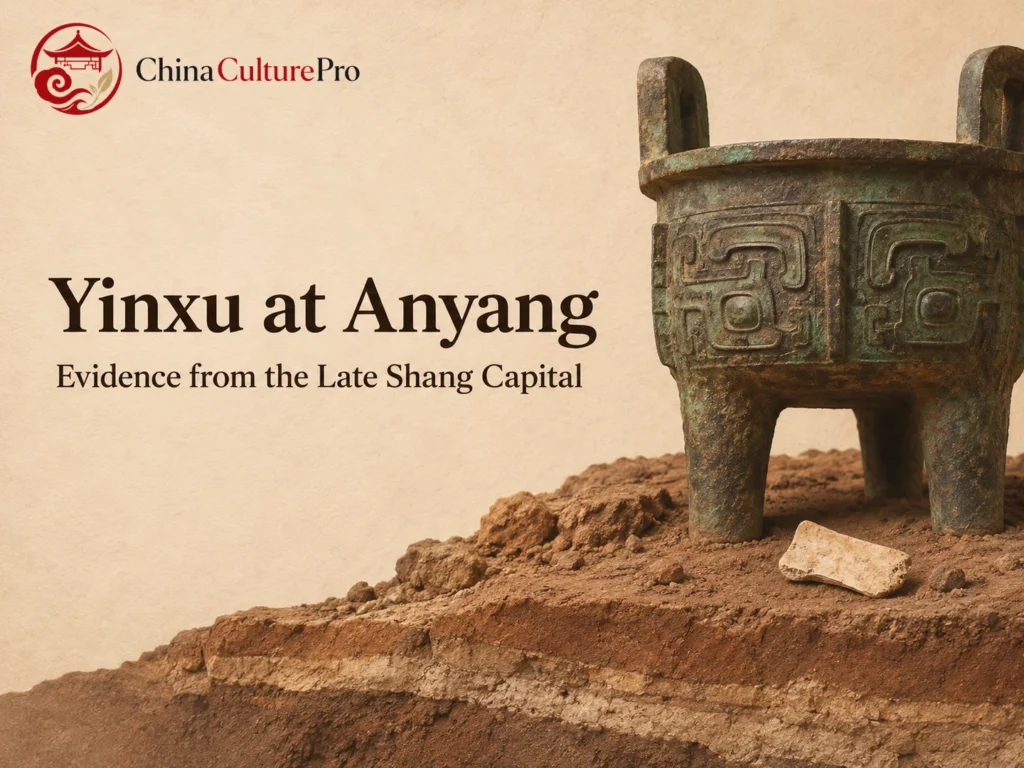

Quick Answer: What Is Yinxu at Anyang?
Yinxu (殷墟, Yīnxū), the Ruins of Yin, is a late Shang capital site beside the Huan River near Anyang in Henan. UNESCO dates its capital period to approximately 1300–1046 BCE. Its foundations, burials, carved bones and objects give archaeologists different ways to study the city. [1][2]
- Court and ritual: At Xiaotun (小屯, Xiǎotún), rammed-earth foundations mark the palace and royal ancestral-shrine area. [1]
- Royal burial: The royal cemetery is a separate area. The intact tomb of Fu Hao (妇好, Fù Hǎo) was found near the palace precinct. [1][3]
- Writing and craft: Oracle bones (甲骨, jiǎgǔ) preserve early writing, and vessels and mould fragments preserve evidence of specialized work. [1][4][5]
Connect each find to its excavation context to see what it says about the city.

A bronze vessel can tell you what a craftsperson made. A record of where it was buried helps explain how people placed and valued that object. Yinxu matters because excavators can study both kinds of evidence, alongside inscribed bones and the foundations of the buildings where court life took place. [1][2][4][5]
Where the Palace, Shrines and Tombs Sat
The World Heritage property covers two areas on both banks of the Huan River. Around Xiaotun, the palace and royal ancestral-shrine area preserves more than 80 foundations made of rammed earth. Archaeologists use the surviving bases and layout to study buildings that originally included timber elements. The positions and sizes of the foundations help archaeologists work out how the buildings and courts were grouped. [1]
The large royal cemetery occupied a different area on the other side of the river. Large tombs, pits and associated objects give different information from a building platform. Putting the precincts on the same map helps show where the court gathered and where it buried its dead during the late Shang dynasty. The listed areas preserve only a portion of the wider archaeological landscape around Anyang. [1][2][5]
What the Oracle Bones Tell Us
The palace area yielded inscribed oracle bones, including animal bones and turtle shells. Diviners used them in inquiries, and some records preserve the questions or details of a consultation. The excavated collections help establish royal names, aspects of belief and the concerns of the court. They also contain some of the earliest surviving evidence of mature Chinese writing. [1][2][6]
In an excavation report, note both the place where the pieces were found and the words scholars read on them. A pit containing inscribed bones and a tomb containing a named vessel each preserve a different part of the city’s activity. For character forms and how scholars interpret them, see oracle bone script. [1][2][4][6]
What Fu Hao’s Tomb and Workshops Add
Excavators found the intact burial of Fu Hao in 1976. It lay in the Xiaotun area, apart from the large royal cemetery. The National Museum of China identifies a bronze owl-shaped wine vessel from the tomb, a type called a zun (尊, zūn). The vessel has an inscription associated with Fu Hao. The find brings together an object, a name and a recorded burial context. [1][3][4]
Other finds help explain how bronze vessels were produced. Researchers have examined fragments of ceramic moulds and cores from the Xiaomintun foundry site at Yinxu. Those pieces preserve manufacturing evidence that a finished vessel alone cannot provide. Tombs and workshops answer separate questions about the same craft, from production to use and deposition. [4][5]
How Excavation Changed the Picture of the Shang
From 1928 to 1937, the Institute of History and Philology of Academia Sinica carried out 15 excavation seasons in the Anyang area. The work documented more than individual objects: it linked finds with their locations and layers. Later work, including the discovery of Fu Hao’s tomb, added relationships that could be compared with the earlier record. [2][3]
The excavation evidence matters because knowledge of the Shang had also been passed down in historical texts written much later. A dated archaeological layer gives historians another chronology to compare with those accounts. A name repeated in inscriptions and later king lists can support an identification. A particular building’s precise use may still be uncertain if its surviving evidence consists mainly of foundations. The agreement of several kinds of evidence makes the identification of Yinxu as the late Shang capital strong. [1][2][6]
When reading a museum label, ask where the object was found, what the record actually identifies, and which interpretation comes from comparison. Those questions also guide object-based lessons about Chinese culture. An inscription, a foundation and a mould fragment are sources with different limits. [1][2][4][5]
FAQs About Yinxu at Anyang
What is the difference between Yinxu and Anyang?
Anyang is the modern city. Yinxu refers to the late Shang archaeological site and is also written Yin Xu. [1][2]
When was Yinxu the Shang capital?
UNESCO dates the capital site to about 1300–1046 BCE. Excavation studies may assign narrower dates to particular contexts or finds. [1][5]
Where was Fu Hao’s tomb found?
It was found at Xiaotun in the palace and royal ancestral-shrine area, separate from the larger royal cemetery. [1][3]
Источники
[1] UNESCO World Heritage Centre. Yin Xu
[2] Institute of History and Philology, Academia Sinica. Anyang
[3] People’s Government of Henan Province. Tomb of Fu Hao
[4] National Museum of China. Fu Hao owl-shaped vessel
[5] Journal of Cultural Heritage. Luminescence study of clay moulds and cores used for bronze casting at Yinxu
[6] Смитсоновский национальный музей азиатского искусства. Anyang: China’s Ancient City of Kings