

Quick Answer: What Is Chinoiserie?
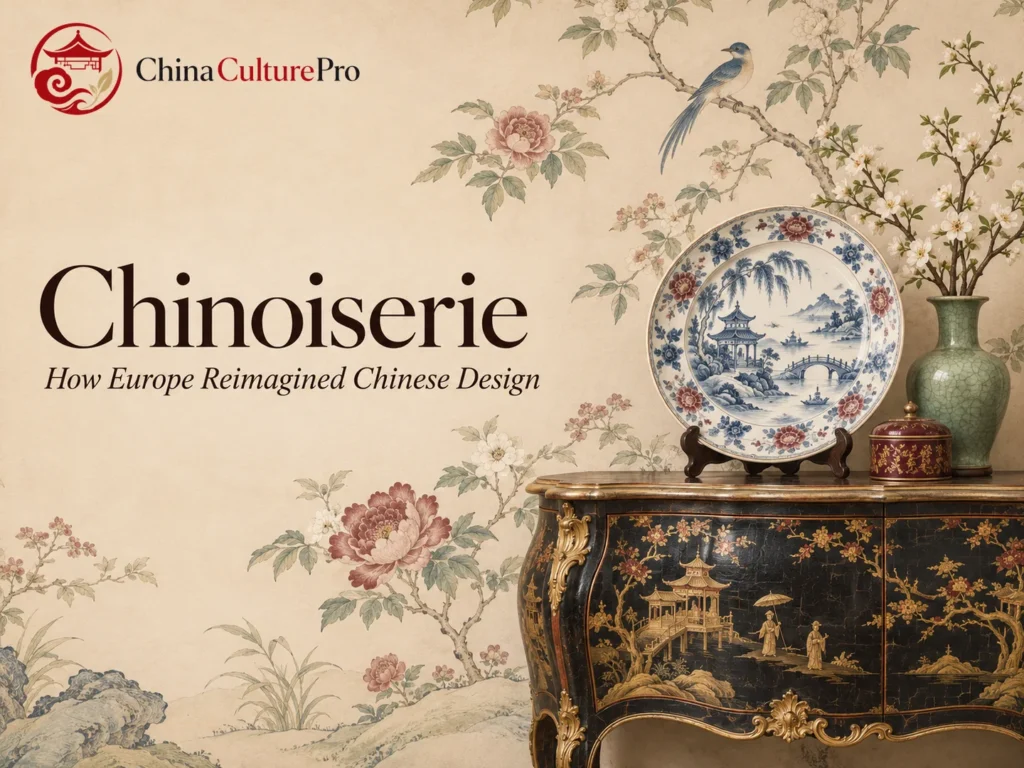
Chinoiserie is a European decorative style that reworked ideas about Chinese and other Asian art. It became especially visible in the eighteenth century, when imports such as porcelain and wallpaper circulated alongside European adaptations. A Chinese-made export dish and a British plate inspired by Chinese imagery can therefore belong to the same story while having different places of manufacture. [1][2][3]
- Name: The term comes from the French word for Chinese. [7]
- Common forms: Wallpaper, furniture, ceramics and garden buildings all carried the style. [1][2]
- How to identify it: Start with where an object was made and for whom, then look at motifs and materials. [1][3]
Pagoda roofs, flowers and birds can be clues. The collection record gives them context.
A wallpaper panel with birds among blossoms could have been painted in Guangzhou for sale abroad or made in England for a similar room. Both might look at home in an eighteenth-century European interior. The image alone can leave you unsure who made it, who bought it, and what another maker learned from it. [1][4]
How Chinese Exports Reached European Designers
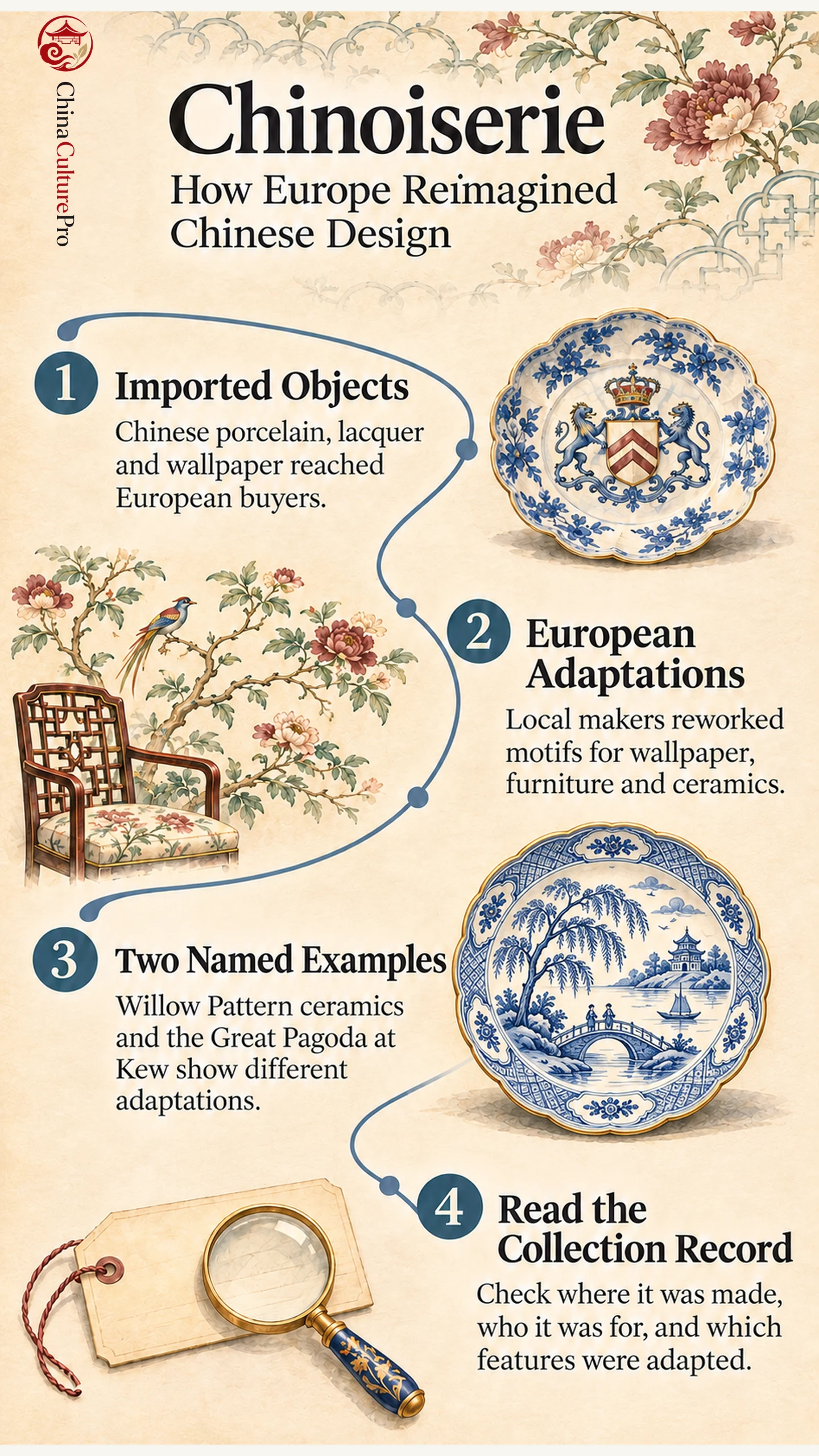
Merchants brought porcelain, lacquerware, silk and wallpaper from Asia into European markets. Collectors could furnish a room with imported goods, and designers had physical models to study. The materials mattered along with the motifs. The look of Chinese lacquerware and the familiar blue decoration of Chinese blue-and-white porcelain were among the effects European makers adapted. [1][2][3]
Chinese producers also designed objects for foreign buyers. The Met’s dish for the Dutch market, dated about 1710–25, is one example of Chinese export porcelain. The catalog associates it with a set bearing coats of arms. The motif speaks to the intended market, while the manufacturing origin remains Chinese. Commissions could involve drawings or prints sent to the workshop. [3][5]
How European Makers Adapted the Materials and Motifs
Hand-painted wallpaper from China arrived for sale in London by the late seventeenth century. Later, English and French makers produced papers inspired by imports. The Victoria and Albert Museum gives two useful anchors: a paper showing everyday scenes, made in Guangzhou around 1720–50, and an English wallpaper panel around 1770. The catalog identifies the place of manufacture for each object. A wall of flowering branches or figures can appear in both traditions. [1][4]
Design books gave furniture makers another route into the style. Thomas Chippendale’s 1754 Director presents designs that combine decorative forms associated with China with other English tastes, including Gothic and Rococo details. An open lattice or pagoda-shaped outline might come from a pattern circulating among local workshops. The design book makes those combinations visible before the piece was built. [1]
Prints also separated a motif from the object that had inspired it. The V&A lists Jean-Baptiste Pillement’s 1755 book of Chinese ornaments, a set of designs engraved in London. Such a publication let a designer encounter a Chinese-style idea on a printed page. The print gives you evidence of the European market for these motifs. [7]
What Willow Pattern and Kew’s Great Pagoda Reveal
The Willow Pattern on European ceramics is an example of how a repeated design can make an invented scene feel familiar. The National Museum of China traces the composition to Europe. Its blue-and-white appearance and landscape motifs draw on imported ceramics. Similar color and subject matter can therefore appear on objects with very different histories of production. [2][3]
The Great Pagoda at Kew in London carries the exchange into architecture. William Chambers designed it for the royal garden, and it was completed in 1762. Chambers had visited China. At Kew he brought architectural forms he had observed into the design of a British royal garden. To compare how those forms developed in their original settings, see Chinese pagoda types and history. [1][6]
How to Read a Chinoiserie Object in a Collection
Read the collection label for the place of manufacture, the date, and any intended market. Then inspect what the maker adapted: an imported shape, a decorative technique, or an imagined setting. Finally, look for parts assembled in different places. A European room could put imported Chinese wallpaper beside locally made furniture, and an export dish could carry a European coat of arms. Those records make the exchange visible in ways that a style label alone cannot. [1][3][4][5]
FAQs About Chinoiserie
Does chinoiserie refer to a place of manufacture?
It describes an approach to decoration. For a museum object’s manufacturing place, start with its catalog record. [1][5]
What motifs often appear in chinoiserie?
Pagodas, flowering branches, birds, dragons and fanciful landscapes appear in a variety of objects. The motif itself cannot establish who made an item. [1][2]
Is all chinoiserie Rococo?
Rococo designers used chinoiserie motifs, but the style also appears in other forms and periods. Chippendale’s work gives an example of motifs shared with Gothic and Rococo design. [1]
Источники
[1] Victoria and Albert Museum. Chinoiserie: an introduction
[2] National Museum of China. Chinoiserie, Passion for Porcelain
[3] The Metropolitan Museum of Art. Chinese Export Porcelain at The Metropolitan Museum of Art
[4] Victoria and Albert Museum. Chinese wallpapers and the chinoiserie style
[5] The Metropolitan Museum of Art. Dish for the Dutch market, object 24.80.151
[6] Royal Botanic Gardens, Kew. Great Pagoda
[7] Victoria and Albert Museum. Chinoiserie collection highlights