


Quick Answer: Who Was Xuanzang?
Xuanzang (玄奘, Xuánzàng, died 664 CE) was a Buddhist monk of the Tang dynasty (唐朝, Táng cháo) who travelled through Central Asia to India for Buddhist study and texts. His pilgrimage became the historical starting point for Journey to the West (西游记, Xīyóu Jì), a novel written centuries later.[1][3][4]
- Pilgrimage: He studied at Nalanda and returned to Chang’an in 645 with manuscripts.[1][3]
- Travel record: The Great Tang Records on the Western Regions (大唐西域记, Dà Táng Xīyù Jì) describes places, customs and religious institutions.[1][7]
- Literary afterlife: The novel’s Tang Sanzang (唐三藏, Táng Sānzàng) travels with supernatural disciples.[4]
The travels and translations belong to Xuanzang’s seventh-century career. The stories about his companions belong to the novel’s imagined world.[3][4]
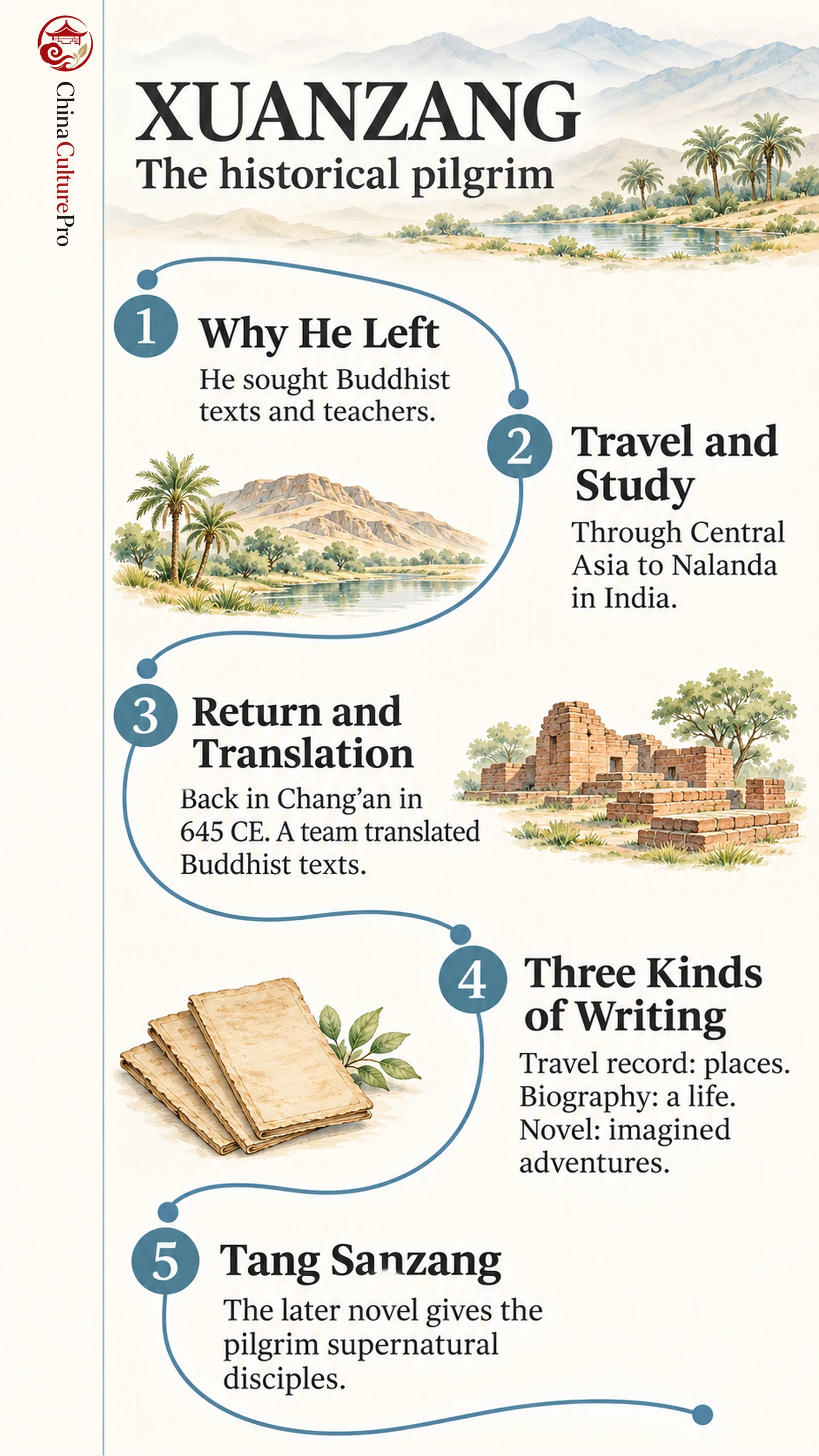
A route through deserts and mountain passes was only the beginning of Xuanzang’s work. The questions he took to India became a translation programme back in China. They also help explain why his journey was remembered long enough to become a different kind of story. Among Chinese historical figures, his career shows how religious scholarship, court patronage and popular literature can preserve different versions of one life.
Why Xuanzang Left Tang China
Xuanzang trained in Buddhist study in China before setting out. He encountered disagreements that he could not resolve from the translations available to him. In particular, he sought fuller texts and instruction in Yogācāra (瑜伽行派, Yújiāxíng Pài), a tradition that examines how consciousness shapes experience. Finding manuscripts mattered, but so did access to teachers who could explain how to read them.[2][3]
The journey began under difficult political circumstances. Xuanzang left Chang’an without official permission, according to the biographical tradition. The commonly used departure date is 629 CE. Some chronologies place it in 627, while 645 is the established return year in both accounts.[1][2][7] His later reception at the Tang court shows how much his position had changed in the intervening years.
The Route Through Central Asia to Nalanda
The westbound journey ran through oasis corridors on the northern side of the Tarim Basin. Turfan and Kucha were among its major stops. Beyond the basin, Xuanzang passed through Central Asian centres including Samarkand before crossing the Hindu Kush toward the Indian subcontinent. These passages place the pilgrimage within the wider Silk Road network, where the ability to obtain introductions and shelter could be as consequential as knowing the next route.[1][3]
Nalanda, in present-day Bihar, was a monastic centre for study and teaching. Xuanzang studied with Śīlabhadra, whose instruction advanced the doctrinal inquiry that had prompted the journey. The archaeological site preserves traces of a substantial institutional complex, including residential buildings, shrines and stupas. The remains help place scholarly life in a physical setting without reconstructing the monk’s day-to-day schedule.[3][5]
The return used a different route. Xuanzang passed through Khotan on the southern side of the Tarim Basin before proceeding through Dunhuang and back to Chang’an. A map drawn as a single line from China to India would lose the contrast between the two journeys.[1][3]
What Xuanzang Did After Returning in 645
Imperial support gave Xuanzang the resources to translate with a team. The undertaking covered large treatises and collections as well as shorter texts. His programme included the Yogācārabhūmi, a major work he had sought abroad, and a large collection of Perfection of Wisdom scriptures in his final years. That range helps explain why his legacy in Chinese Buddhism extends well beyond a single school.[2][3]
His teaching and his disciple Kuiji are associated with the Faxiang (法相宗, Fǎxiàng Zōng) tradition in China. A material trace of the return is the Great Wild Goose Pagoda at the Da Ci’en Temple complex in present-day Xi’an. Its first construction in 652 was connected with housing the scriptures and sacred objects he brought back.[3][6] The pagoda was rebuilt and altered over time, so its present form spans several building phases.[6]
Three Texts That Tell Different Stories
Use the travel record for descriptions of places, the biography for the pilgrim’s life and the novel for the later literary tradition.
| Work | What it can help you understand |
|---|---|
| Great Tang Records on the Western Regions | A geographical and religious account prepared in 646 with Bianji. Its entries mix observations and information gathered from others.[1][7] |
| Biography of the Tripiṭaka Master | A monastic account centred on Xuanzang’s life, travels and achievement. Its narrative preserves the tradition’s portrayal of the pilgrim.[2] |
| Journey to the West | A sixteenth-century novel that reshapes the search for scriptures into episodes of danger, comedy and supernatural intervention.[4] |
Kucha shows why these distinctions matter. A reader can examine the travel record’s description of cultivated crops and monastery communities, then find stories about dragon horses in the same entry. The first kind of detail can be compared with other historical evidence. The second tells us something about the stories recorded in the text. Its presence does not make every neighbouring statement an eyewitness observation.[1] This is a useful example of how to read history and legend together while keeping the claims separate.
How the Pilgrim Became Tang Sanzang
The Ming-era novel keeps the journey’s destination and search for sacred texts as a narrative frame. It changes the traveller’s company and the nature of his encounters. Sun Wukong (孙悟空, Sūn Wùkōng), the Monkey King, and other supernatural disciples help turn each obstacle into a story about power, temptation or the demands of the pilgrimage. The episode-by-episode adventure belongs to the literary history of Journey to the West.[4]
The difference can be seen in where each account gives the monk his agency. In the historical career, Xuanzang sought instruction, moved through a network of courts and monasteries, and organized scholarly work on his return. The novel uses the monk and his disciples as contrasting characters in a shared quest. Both versions explain his cultural prominence, but they document different things.[2][3][4]
FAQs About Xuanzang
Was Xuanzang a real person?
Yes. He was a seventh-century Buddhist monk, traveller and translator. His work continued in China after his return in 645.
Is Tripitaka another name for Xuanzang?
Tripiṭaka refers to the Buddhist canon’s three baskets and also appears in titles honouring masters of that canon. In English versions of the novel, Tripitaka can identify the pilgrim character based on Xuanzang.
Did Xuanzang write Journey to the West?
No. Xuanzang’s travel account is the Great Tang Records on the Western Regions. The novel Journey to the West took shape many centuries after his death.
Источники
[1] Xuanzang, translated by Samuel Beal. Xuanzang’s Record of the Western Regions, Book One
[2] BDK America. A Biography of the Tripiṭaka Master of the Great Ci’en Monastery
[3] Internet Encyclopedia of Philosophy. Xuanzang
[4] Anthony C. Yu, translator and editor. The Journey to the West, Revised Edition, Volume 1
[5] UNESCO World Heritage Centre. Archaeological Site of Nalanda Mahavihara at Nalanda, Bihar
[6] UNESCO World Heritage Centre, nomination file. Sambor Prei Kuk Nomination File, Comparative Analysis
[7] BDK America. The Great Tang Dynasty Record of the Western Regions