

Quick Answer: Who Was Xu Da?
Xu Da (徐达, Xú Dá, 1332–1385) was a general who helped Zhu Yuanzhang (朱元璋, Zhū Yuánzhāng) found the Ming dynasty. His best-known campaign took the Yuan capital of Dadu (大都, Dàdū), at present-day Beijing, in 1368.[1][2]
- Before 1368: He commanded forces against rival powers in the Yangtze region.
- In the north: His expedition secured territory and approaches before entering the Yuan capital.
- Under the Ming: He continued commanding campaigns and helping defend the frontier.
The taking of Dadu was a military turning point in the same year that Zhu established the new dynasty.
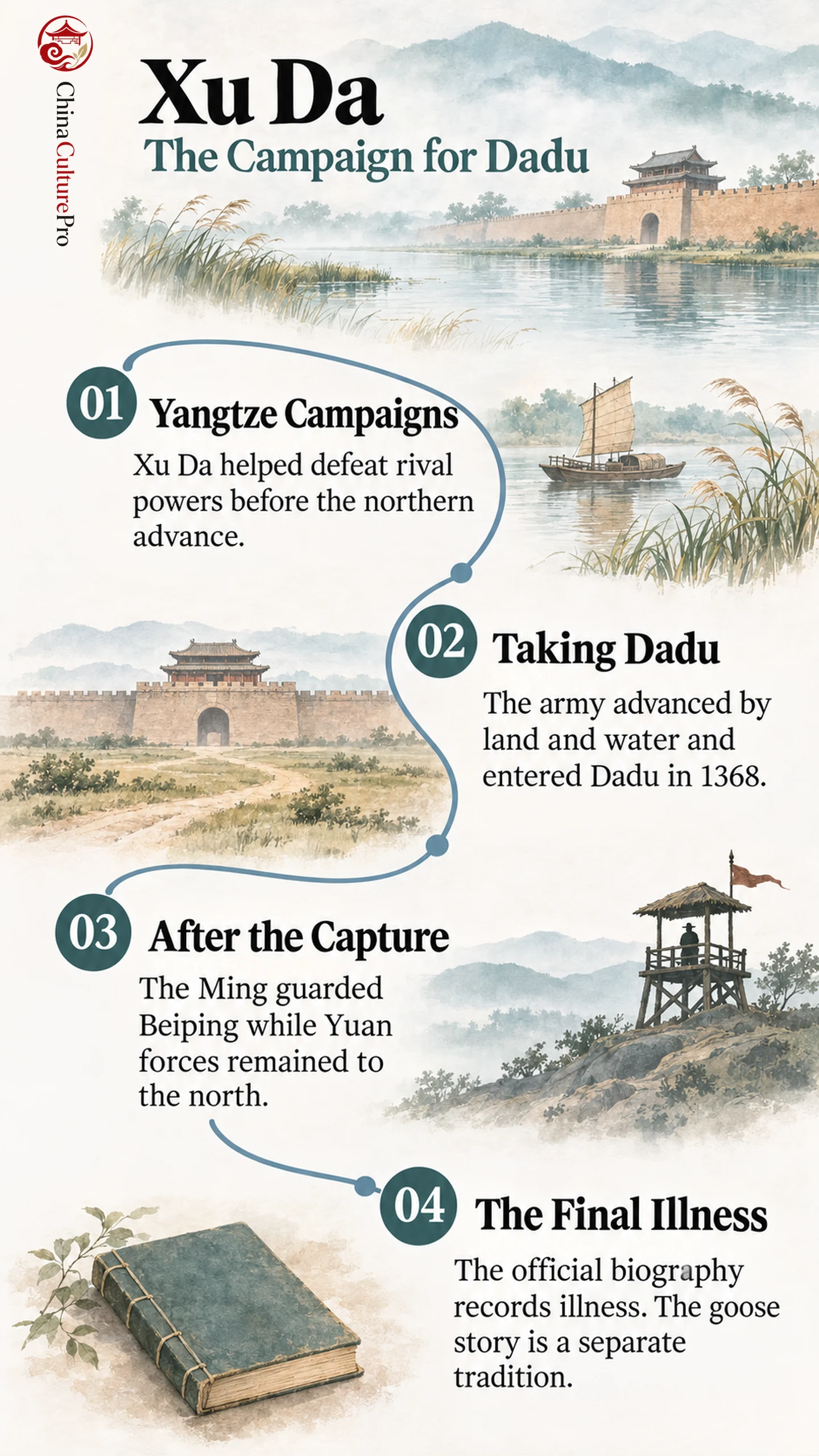
Taking a capital required more than reaching its walls. Xu Da’s career connects campaigns in the Yangtze basin with the advance on Dadu. It also shows what a founding general did once the city was won and the new court needed to defend it.
How Xu Da Helped Build Zhu Yuanzhang’s Power
Xu Da came from Haozhou, in present-day Anhui, and joined Zhu in the 1350s. His early service included the crossing of the Yangtze and operations around the future Ming capital at Nanjing. At Zhenjiang, he led an attack east of Zhu’s base. Over time he moved from serving on the advance to commanding expeditions himself.[1][2]
The two major rival campaigns came in sequence. Xu fought Chen Youliang’s forces at Lake Poyang in 1363 and then returned to guard Zhu’s base on Zhu’s orders. Later Xu and his deputy Chang Yuchun (常遇春, Cháng Yùchūn) besieged Zhang Shicheng’s stronghold at Pingjiang (平江, Píngjiāng), now Suzhou. The fall of Pingjiang in 1367 removed a rival power in the lower Yangtze just before Zhu sent his forces north.[1][2]
The Northern Campaign and the Capture of Dadu
The expedition began in 1367, before the formal establishment of the Ming dynasty in 1368. Xu and Chang first secured ground in Shandong, then operated across Henan. The History of the Ming relates a discussion between Xu and the emperor at Bianliang, present-day Kaifeng, about using those gains to advance on Dadu. The capital was the last objective of this phase. Securing other regions first gave the army routes and bases for the approach.[1][2]
Near Linqing, Xu assigned Fu Youde to open a land route for infantry and cavalry and Gu Shi to clear the waterway for boats. The army advanced by water and land, taking Tongzhou on the eastern approaches to the capital. Toghon Temür, the Yuan ruler, fled north before Xu’s troops entered Dadu. The dynastic biography credits Xu with securing government stores and cataloguing books and other property after the capture.[2][3]
What Changed After the Yuan Court Left
The Ming renamed the city Beiping (北平, Běipíng) and put a garrison in place. It was an important northern base while the Ming court was still centered at Nanjing. The loss of Dadu ended the Yuan dynasty’s rule from that capital. The Yuan ruling house and its forces continued to operate to the north, where the Ming still faced military opposition.[2][3]
Xu and Chang moved into Shanxi after the capture, and Xu continued to hold frontier commands. That work involved protecting garrisons and keeping opposing forces from threatening Beiping. The difference between taking a city and holding the territory around it explains why the biography continues to follow his operations long after the entry into Dadu.[2]
What the Sources Say About Xu Da’s Death
The History of the Ming, compiled under the later Qing dynasty, records that Xu developed a serious illness involving a sore on his back while at Beiping. It reports that he was recalled and that his condition worsened before his death in 1385. He received the title Duke of Wei in life and was honored posthumously as Prince of Zhongshan (中山王, Zhōngshān Wáng), and the biography records a commemorative inscription by the emperor.[1][2]
A separate story says that the emperor sent Xu a steamed goose during his illness. The CUHK account presents this as a tradition and distinguishes it from the official history. The official history supports the chronology of his final illness. The goose story has a separate history as a retelling, and its claim about the emperor’s role remains unverified.[2][4]
FAQs About Xu Da
Did Xu Da found the Ming dynasty?
Zhu Yuanzhang proclaimed the dynasty and became its first emperor. Xu Da was a founding general whose campaigns helped bring territory under Zhu’s control.
Was Dadu the same city as Beijing?
Dadu was the Yuan capital at the site of present-day Beijing. The early Ming called the city Beiping.
Did Xu Da die because he was given a goose?
The official biography records a serious illness and death in 1385. The claim that a steamed goose caused his death comes from a separate tradition.
Источники
[1] Palace Museum, Beijing. Xu Da
[2] History of the Ming. Chapter 125: Xu Da and Chang Yuchun
[3] Acta Mongolica, National University of Mongolia. Glazed Ceramics from Qaraqorum: Archaeological Evidence on Routes to the Old-Mongolian Capital
[4] School of Chinese Medicine, Chinese University of Hong Kong. Xu Da and the Steamed Goose