


Quick Answer: Who Was Wu Lien-teh?
Wu Lien-teh (伍连德, Wǔ Liándé, 1879–1960) was a Penang-born physician who helped direct the response to pneumonic plague (肺鼠疫, fèi shǔyì) in northeast China in 1910–11. His career linked bacteriological investigation with the organization of epidemic control.[1][2][3]
- Diagnosis: He identified the outbreak’s pneumonic form and focused attention on spread between people.
- Response: Masks were one measure within a larger response involving isolation and railway controls.
- Institutions: He presided over an international conference and led a continuing prevention service.
The outbreak measures and the institutions that followed belong to different stages of his work.
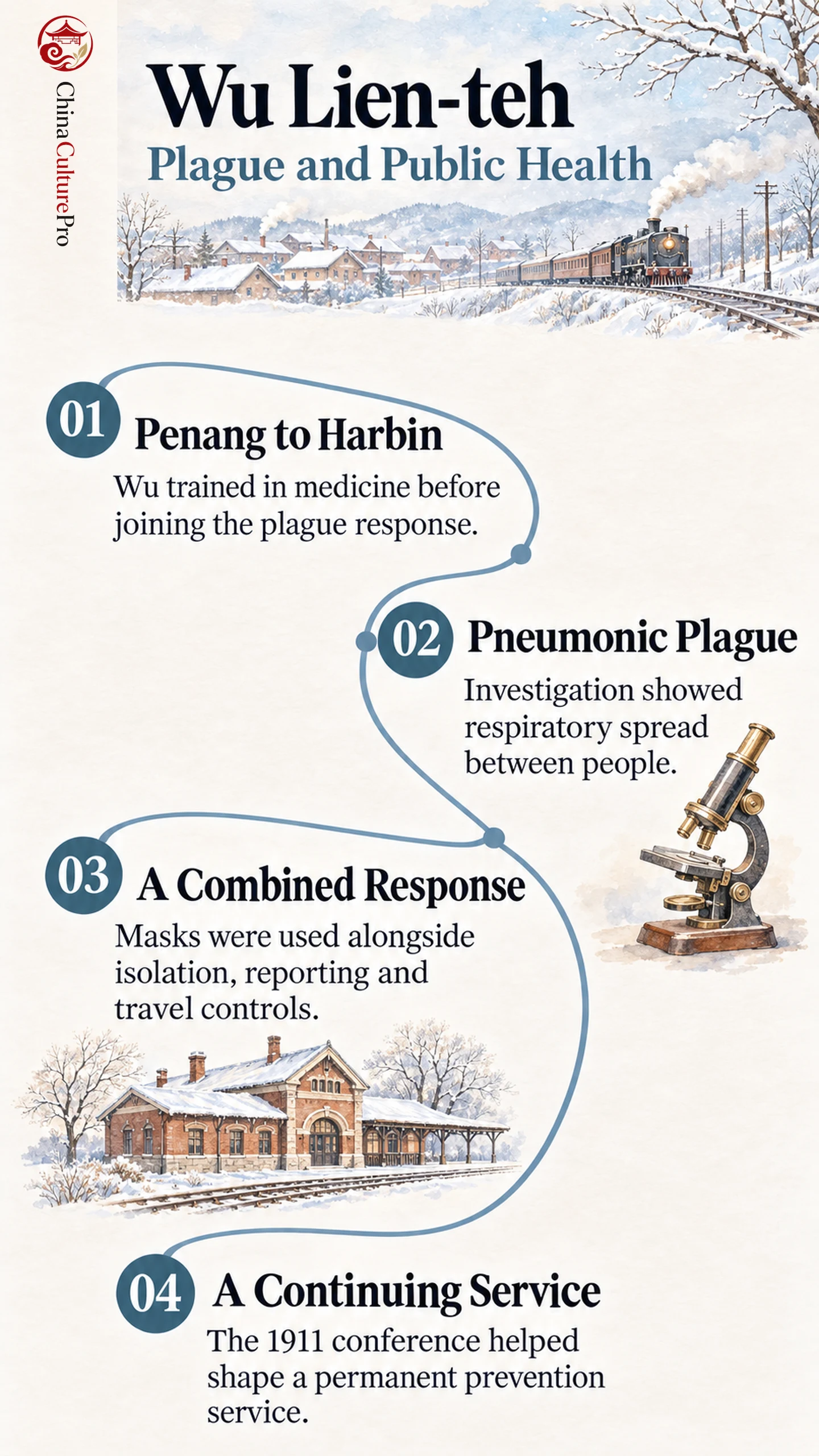
Wu Lien-teh’s name is often attached to a mask. The records of the plague response show a wider problem. Doctors had to determine how the disease was spreading, and officials had to organize a response across communities connected by rail.
From Penang to an Outbreak in Northeast China
Wu grew up in Penang, then part of the British Straits Settlements, and studied medicine at Cambridge. Records may list him under a form of his earlier name, including G. L. Tuck. The prevention service report places that name beside Wu Lien-teh, a useful link between the records of his training and his later publications.[1][5]
The epidemic drew him into work for the late Династия Цин. Around Harbin (哈尔滨, Hā’ěrbīn), railways linked towns and moved people across areas administered by different authorities. The railway setting made coordination across jurisdictions part of the work of controlling disease.[2][3]
Wu’s later publications provide another record of his career. He wrote a treatise on pneumonic plague and a much later autobiography. The treatise sets out a physician’s organized account of the disease, while the autobiography recalls his work across decades. Readers can compare either with the earlier report to distinguish a contemporary institutional record from later recollection.[1][5]
Why the Pneumonic Diagnosis Mattered
The animal source of an infection and the way it spreads after reaching people are different questions. Historical accounts identify contact with infected marmots as a plausible origin. The exact first human infections are harder to establish. During the epidemic, infection spread between people in a pneumonic outbreak. Wu’s investigation focused on that latter problem.[2][3][5]
The modern historical study describes two kinds of evidence. Investigators found the plague bacterium in specimens, including from a postmortem examination. They also observed that people in close contact were becoming ill. The first helped identify the cause of the disease, and the second helped explain its transmission during the outbreak. That interpretation mattered for the response. If sick people were transmitting infection to others, officials needed to identify and separate cases and take account of the contacts made through travel and crowded living conditions.[3]
The Plague Mask and the Wider Response
Wu promoted a mask made of gauze and cotton for use during the outbreak. Photographs and later accounts made the mask closely associated with his work. The history of protective equipment includes earlier devices and other designs used during the epidemic. Its use shows how a proposed explanation of transmission shaped one part of an epidemic response.[3][4]
The wider program also included dedicated isolation facilities, restrictions on movement, reporting and coordination with railway authorities. These measures involved people outside Wu’s immediate medical team. The epidemic declined after a combination of measures. A record of mask use establishes one part of that program. It gives no separate measure of how much each intervention contributed.[2][3]
The Conference and the Service That Followed
In April 1911, Wu presided over the International Plague Conference at Mukden (奉天, Fèngtiān), now Shenyang. The meeting brought specialists together to compare findings and propose preparations for later outbreaks. The first report of the North Manchurian Plague Prevention Service describes the move from discussion to standing arrangements.[2][5]
The report distinguishes facilities for people diagnosed with plague, accommodation for suspected cases and quarantine stations for contacts. Those categories show how the service planned different arrangements for people in different situations. It also describes public education and field investigation. Those tasks required buildings, funding and personnel after the immediate emergency had ended. They place Wu’s work in the institutional history of medicine in China.[5]
The dates in the report make the transition more precise. It records recommendations and early staffing in 1911, then describes political disruption that delayed stable financing. A customs revenue allocation in 1912 put the service on firmer footing. That sequence distinguishes the start of field operations from the establishment of a continuing institution.[5]
A photograph of delegates documents the meeting and its participants. A report documents proposals and the arrangements Wu’s service set out to make. That difference helps readers trace the contribution of one of China’s best-known public health figures without treating every later claim as part of the same record.[2][5]
FAQs About Wu Lien-teh
Did Wu Lien-teh invent the N95 respirator?
Wu promoted a historical plague mask made of cotton and gauze. The N95 is a later respirator category with its own performance requirements.
Did Wu Lien-teh win a Nobel Prize?
He was nominated for the 1935 prize in Physiology or Medicine. The prize went to another researcher. The nomination records recognition of Wu’s work by a nominator.[6]
What did the 1911 conference do?
It brought specialists together to review the outbreak and recommend measures. Wu’s early service report connects those recommendations to plans for hospitals, quarantine facilities, research and education.
Источники
[1] National Library Board, Singapore. Wu Lien Teh
[2] University of Cambridge Repository. Delegates of the International Plague Conference in Session
[3] Qingmeng Zhang and colleagues, Virologica Sinica. Inception of the Modern Public Health System in China
[4] Christos Lynteris, University of St Andrews Research Repository. Plague Masks: The Visual Emergence of Anti-Epidemic Personal Protection Equipment
[5] Wu Lien-teh, Journal of Hygiene. First Report of the North Manchurian Plague Prevention Service
[6] Japan Science and Technology Agency. Wu Lien-teh and the fight against plague