


Quick Answer: What Is Wing Chun?
Wing Chun (咏春拳, yǒngchūnquán) is a southern Chinese martial tradition known for close-range work, direct movement and coordinated use of the hands and body. It belongs within the wider world of Chinese martial arts, rather than being another name for all kung fu. [1]
- Early founder stories are part of its cultural inheritance, but should be distinguished from independently traceable teachers. [2]
- Center-line relationships, body alignment and combining defense with attack are recurring teaching ideas. [4]
- Hand forms, partner contact drills, training apparatus and weapons serve different purposes. [1][7]
Wing Chun has multiple branches. This overview focuses on widely recognized material, especially the teaching tradition associated with its modern international spread.
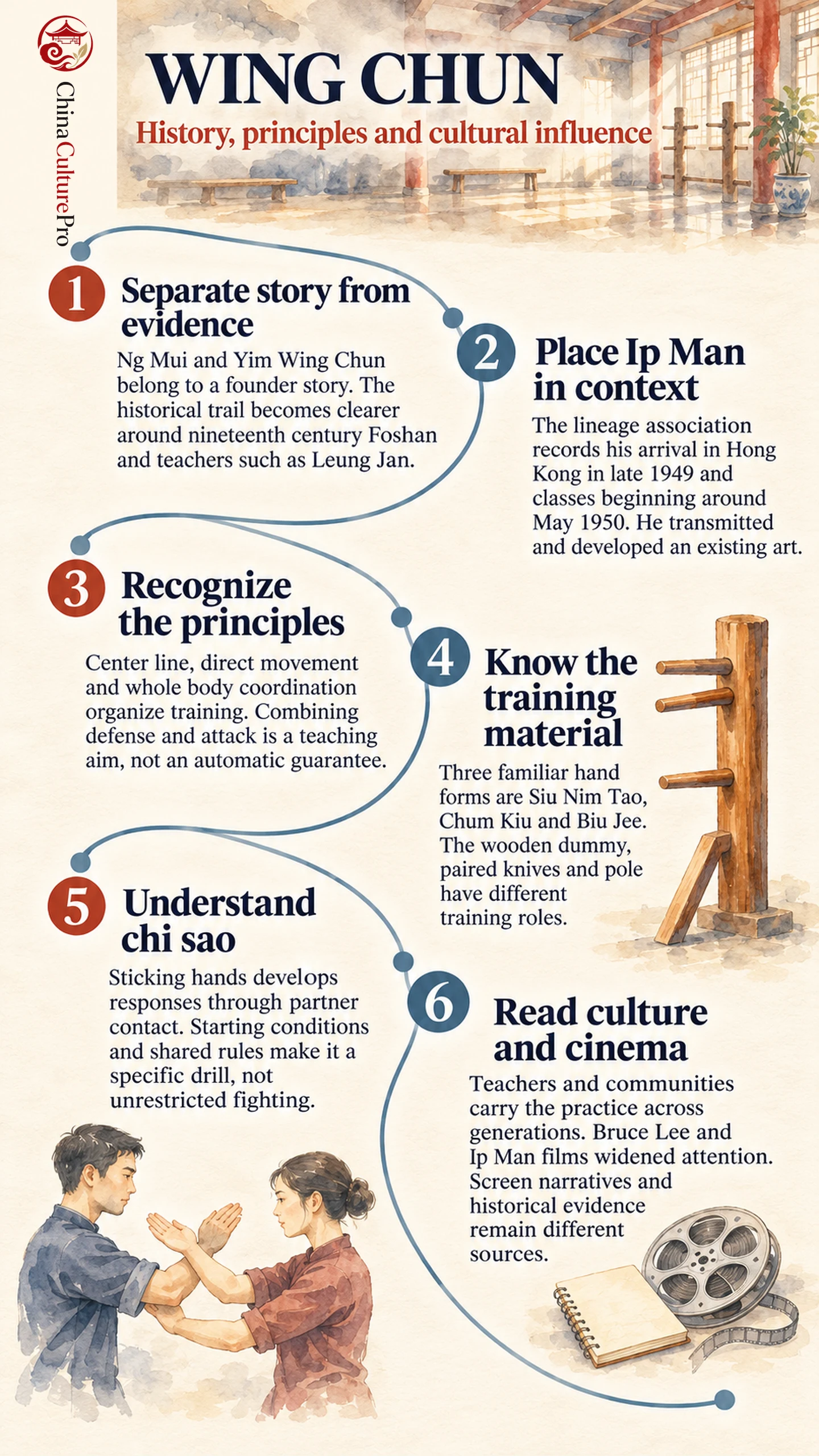
The wooden training apparatus and rapid exchanges familiar from films show only selected aspects of Wing Chun. Its history also involves teachers, migration and changing ways of organizing practice. Follow the teachers, the training methods and the screen narratives as separate parts of its history.
Wing Chun Origins: Legend and Historical Evidence
A founder story credits the nun Ng Mui (五枚, Wǔ Méi) with teaching Yim Wing Chun (严咏春, Yán Yǒngchūn). Historian Benjamin Judkins distinguishes its fictional opening episodes from later, independently verifiable teachers. The story illuminates lineage identity without establishing a founding date. [2]
The historical trail becomes clearer around nineteenth-century Foshan (佛山, Fóshān), in Guangdong, and teachers such as Leung Jan (梁赞, Liáng Zàn). The national heritage account of Foshan Wing Chun places his contribution within the late Qing period. This regional development is a firmer starting point than assuming every detail of a long ancestor chain has equal documentary support. The guide to Chinese history and legend explains that reading distinction. [1]
Ip Man and Teaching in Hong Kong
Ip Man (叶问, Yè Wèn), also written Yip Man, became central to Wing Chun’s modern international history. The Ving Tsun Athletic Association records his arrival in Hong Kong (香港, Xiānggǎng) in late 1949 and the beginning of classes around May 1950 through a restaurant workers’ association. This connects his teaching with the city’s working and social networks. [3]
His role was transmission and development, not invention of the entire art. Students carried the practice into new teaching environments. Judkins describes how Hong Kong’s connections with overseas education and employment helped create opportunities for international transmission; celebrity alone does not explain that movement. [2]
Principles: Center Line, Directness and Coordination
These ideas describe training priorities rather than promises that a technique automatically succeeds:
- Center line: The center line (中线, zhōngxiàn) organizes how practitioners understand their own position in relation to another person. It concerns both protecting central space and finding direct routes through it. [4]
- Directness: Teachers often aim to reduce unnecessary movement and combine defensive and attacking actions. This is a tactical preference to train, not proof that every straight movement defeats every curved movement. [4]
- Whole-body coordination: Hand methods work with stance, turning and movement of body weight. The aim is coordinated positioning and force, rather than treating the arms as independent from the rest of the body. [4][9]
These principles are expressed differently by different teachers. Broader martial arts classifications help locate the tradition, but a school’s actual methods explain more than a broad label does.
Three Hand Forms, the Wooden Dummy and Weapons
Common English names for the forms reflect Cantonese speech. The tone-marked pinyin below gives their Mandarin readings; the two are different pronunciation systems, so the familiar Cantonese labels are not Mandarin pinyin.
- Siu Nim Tao (小念头, xiǎoniàntóu): The foundational hand form, emphasizing hand positions, structure and focused coordination. [4]
- Chum Kiu (寻桥, xúnqiáo): A hand form developing the relationship between arm methods, turning and body movement. [4]
- Biu Jee (标指, biāozhǐ): A later hand form exploring further applications of coordinated power through the hands. [4]
The wooden dummy (木人桩, mùrénzhuāng) is training apparatus with projecting limbs. It gives practitioners a physical reference for practicing material associated with the hand forms. A fixed apparatus does not offer the changing responses of a live partner. [5]
Weapons include the paired eight slashing knives (八斩刀, bāzhǎndāo) and the six and a half point pole (六点半棍, liùdiǎnbàngùn). These names identify established training material; the knife name does not mean a practitioner carries eight separate knives. Six and a half names the method, not a fixed pole length. Schools differ in sequencing and presentation. See the weapons guide for wider context. [5]
Chi Sao: Learning Through Partner Contact
Chi sao (黐手, chīshǒu), also written chi sau and often translated as “sticking hands,” is partner contact practice. Practitioners learn to notice changes in pressure and positioning through touch while coordinating their responses. It gives teaching ideas a responsive setting that solo forms and a fixed dummy cannot supply. [6]
Different exercises constrain movement in different ways, and some introduce stepping and turning as learners progress. Those constraints make a drill useful for a particular skill. They also explain why doing well at sticking hands should not be confused with unrestricted fighting: the starting contact, permitted actions and shared expectations matter. [6]
Cultural Influence, Lineages and Film
Wing Chun remains a living teaching tradition. Hong Kong’s heritage programs present it through master–student relationships, public demonstrations and community transmission. The national heritage listing of Foshan Wing Chun dates to 2021; that is a specific Chinese listing, not a claim of UNESCO inscription for all Wing Chun. [1][9]
Bruce Lee (李小龙, Lǐ Xiǎolóng) helped bring Chinese martial arts to wider audiences through television and film. He also developed Jeet Kune Do (截拳道, jiéquándào) through engagement with different martial approaches. His later art should not be treated as simply another name for the whole Wing Chun curriculum. [8]
Films about Ip Man brought another wave of attention, including the influential fictionalized film released in 2008. Such works can convey aspiration and cultural identity while rearranging events for drama. The history of Chinese cinema provides context for reading them as screen narratives. [2][7]
For the wider southern martial setting, compare Hung Gar и Choy Li Fut. To understand a particular Wing Chun school, ask about its lineage, curriculum and approach to partner practice; teacher relationships and etiquette are part of that learning context.
FAQs About Wing Chun
Did Ip Man invent Wing Chun?
No. Earlier teachers and traditions preceded him. His Hong Kong teaching, beginning in 1950 in the association’s account, was important to the art’s modern transmission and international visibility. [3]
Is Wing Chun only for women or smaller people?
No. A female founder story does not restrict who can learn the art or guarantee that a smaller practitioner will overcome a larger one. Training quality, experience and circumstances remain relevant; legend should not be turned into a universal performance claim. [2]
Is chi sao the same as unrestricted fighting?
No. It is contact practice with particular starting conditions and teaching aims. A school may connect it with broader application training, but the drill and an unpredictable encounter are different tasks. [6]
Why are Wing Chun names spelled in different ways?
Many familiar labels use differing English conventions for Cantonese sounds. For example, Siu Nim Tao, Siu Nim Tau and Siu Lim Tau can refer to the first hand form. Comparing the Chinese characters helps identify the intended term; Mandarin pinyin supplies a separate reading. [7][10]
Источники
[1] China Intangible Cultural Heritage Network. Wing Chun: Foshan Wing Chun
[2] Benjamin N. Judkins. The History and Global Transmission of Wing Chun
[3] Ving Tsun Athletic Association. History and Development
[4] Shenzhen University Sports Intangible Cultural Heritage. Wing Chun: Ip Man Branch
[5] Chu Shong Tin Ving Tsun Alumni. A Brief Account of Ving Tsun
[6] International Wing Chun Academy. Chi Sau: Sticking Hands
[7] Hong Kong Intangible Cultural Heritage Office (Управление нематериального культурного наследия Гонконга). Yip Man Wing Chun: Martial Arts and Films
[8] Hong Kong Heritage Museum. A Man Beyond the Ordinary: Bruce Lee
[9] Hong Kong Intangible Cultural Heritage Office. Meet the Masters: Living Martial Arts Transmission
[10] Ving Tsun Athletic Association. Hand Forms, Wooden Dummy and Sticking Hands Demonstration Index