


Quick Answer: How Does Chinese Martial Arts Etiquette Work?
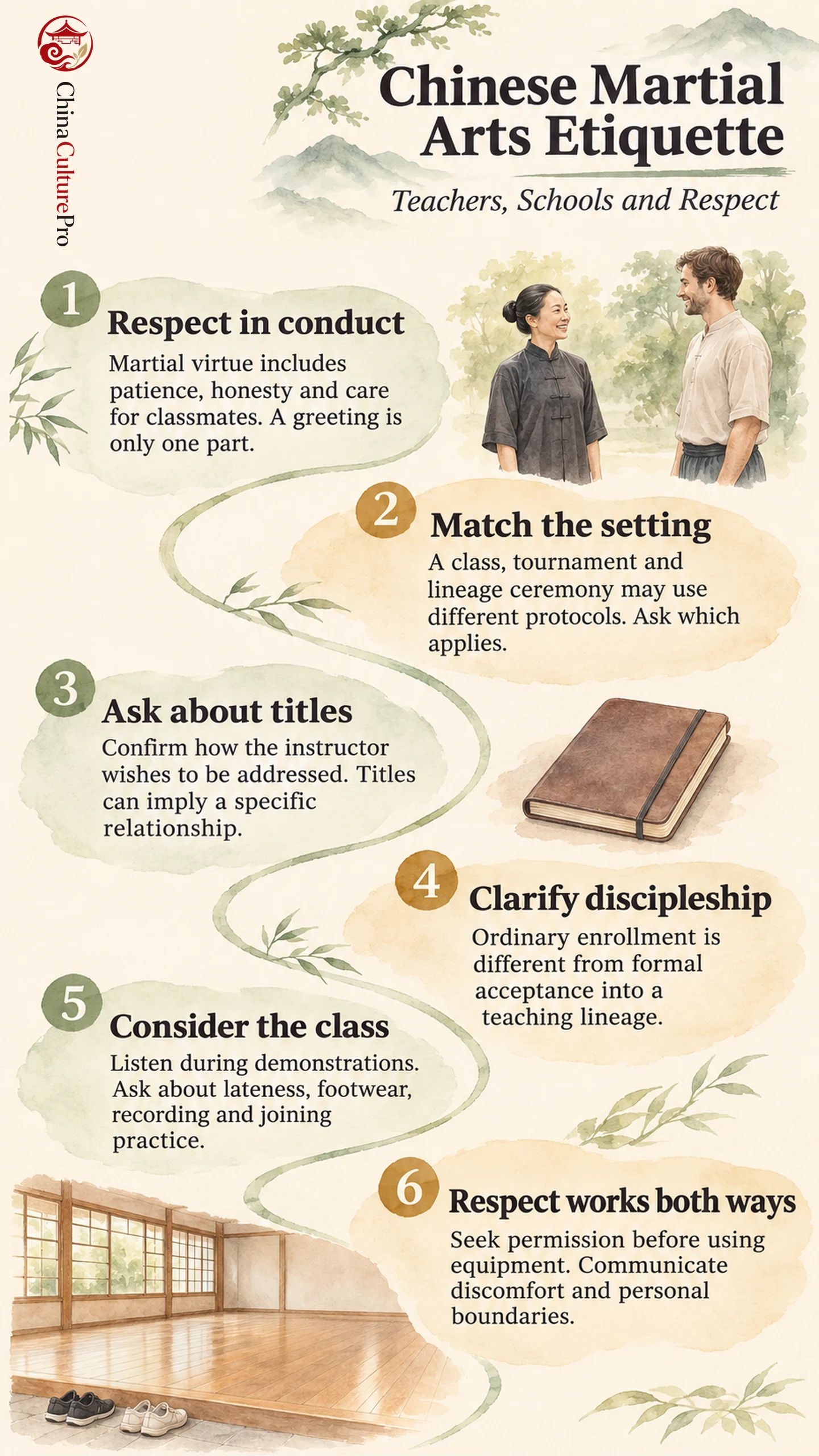
Chinese martial arts etiquette expresses respect through greetings, attention, responsible practice and care for other people. It is often connected with wude (武德, wǔdé), or martial virtue, but particular schools define and express these values differently.[1]
- Follow the setting: a competition, an ordinary class and a formal lineage ceremony can have different protocols.
- Ask about local customs: confirm the greeting, instructor’s title and rules for joining or leaving practice.
- Show consideration: listen during demonstrations, respect classmates and seek permission before using equipment or recording.
A school’s published rules apply to that school; they are not a universal script for every Chinese martial art.
For a newcomer, the best preparation is a few clear questions rather than a memorized performance of “traditional respect.” Understanding what a custom does—greeting someone, acknowledging instruction or marking a teaching relationship—makes it easier to participate without pretending to hold a status you have not been given.
Wude: Conduct Beyond the Greeting
Wude concerns behavior as well as physical skill. One lineage’s published code asks practitioners to respect teachers and classmates, cultivate patience and avoid bullying or using their abilities to commit injustice. Those priorities show how martial virtue can connect training with responsibility outside a lesson.[2]
The values should not be confused with a single standardized list. A code preserved by one lineage, a modern school’s classroom rules and a teacher’s personal explanation may overlap without being identical. Ask what the school expects in observable terms: how students cooperate, handle disagreements and care for shared space.
Courtesy is also something a teacher demonstrates. A practitioner’s account of Chen-style training describes respect as reciprocal: teachers should teach honestly and avoid hurting or abusing those below them. Its informal atmosphere contrasts with the highly ceremonial image sometimes associated with all Chinese training.[3]
This distinction matters whether you attend a martial class or a movement session such as Baduanjin. A quiet, friendly lesson can still take discipline and teaching relationships seriously.
The Palm-and-Fist Salute and Its Variations
The palm-and-fist greeting is often called baoquanli (抱拳礼, bàoquánlǐ). A widely recognized version places the left palm against the right fist in front of the body. It marks a courteous exchange. Other forms and interpretations exist, so learn the version used in the setting you are entering.[4]
For example, one international tournament’s own rules require the open-palm-and-fist salute and specify greetings to the chief judge. The same rules describe separate requirements when competitors carry different weapons. Competition protocol therefore has an operational purpose as well as a symbolic one.[5]
| Ситуация | What the greeting does | What to confirm |
|---|---|---|
| Ordinary class | Acknowledges the teacher or practice space | Whether the class uses a salute and when |
| Competition | Marks prescribed exchanges with officials | The organizer’s rules for that event |
| Lineage or ceremonial gathering | Expresses a particular tradition or relationship | The host’s instructions and your role |
Meanings attached to hand shapes can vary. An interpretation of a symbol does not by itself establish its origin. You can follow the host’s courtesy without treating every story about the gesture as settled history.
Addressing Teachers and Understanding Discipleship
Laoshi (老师, lǎoshī) means teacher; shifu (师父, shīfu) can express a more personal master–disciple relationship. Usage varies by community and language. One Chen-style account distinguishes ordinary students’ respectful teacher title from a disciple’s use of shifu. That is an example of local practice, not a rule that permits you to correct everyone else’s address.[3]
Ask, “How would you like me to address you?” An instructor may prefer a Chinese title, a Cantonese form such as sifu, an English title or a name. Copy the school’s guidance rather than assigning “grandmaster” based on age or appearance.
Baishi (拜师, bàishī) refers to formally acknowledging a teacher and entering a teaching relationship. One teacher’s published account describes accepted disciples as “indoor students” entering the lineage through a ceremony, with an application and evaluation process. Ordinary enrollment is not the same as that acceptance.[8]
If a ceremony is proposed, ask what it means, what commitments it creates and whether you want to participate. Skill, personal relationships and formal recognition are related questions, not interchangeable credentials.
Everyday Manners in a Training Class
Practical courtesy helps everyone hear, move and learn. One school’s rules ask students not to talk during instruction, to keep clothes and shoes clean, and to notify the instructor about absence or early departure. They also reserve teaching and corrections for authorized instructors or assistants.[1]
Treat those examples as questions to clarify at your own class:
- Arrival: where should you wait if you are late, and when may you join?
- Dress and footwear: what belongs on this floor or mat, and where are belongings stored?
- Questions: should you raise a hand, wait until the demonstration ends or ask during a break?
- Recording: may you film the instructor, classmates or a sequence for personal notes?
- Practice partners: who assigns partners, and how should someone pause or decline a drill?
A brief explanation is often enough: “I’m new here—please tell me if I miss a custom.” It gives the instructor useful information without interrupting every exchange with an apology.
Shared-space manners can extend beyond practice in a residential school. Published academy rules may cover visitors, quiet periods, cleanliness and personal privacy. A day visitor should confirm the relevant visitor rules instead of assuming that enrollment, accommodation and casual observation carry the same permissions.[6]
Respect, Safety and Personal Boundaries
Respect includes taking responsibility for the training environment. Hong Kong’s school physical-education guidelines address martial ethics, qualified instruction, suitable space and safe equipment. They also state that stored equipment should not be used without the responsible teacher’s consent. These are guidelines for that educational setting, rather than a universal law for every school.[7]
The practical lesson travels well: wait for permission before handling unfamiliar equipment and leave adequate space for others. If Chinese sword culture or traditional archery interests you, historical appreciation is separate from authorization to handle a school’s equipment.
You can accept correction while asking what it means. Say when a movement is uncomfortable, when you did not understand an instruction or when you do not consent to a partner activity. A title, seniority or ceremony does not remove the teacher’s responsibility to treat students respectfully.
FAQs About Chinese Martial Arts Etiquette
Must every teacher be called shifu?
No. Titles differ between schools and communities, and shifu can imply a particular teaching relationship. Ask the instructor what form of address they prefer.
Does joining a class make me a formal disciple?
No. Ordinary enrollment and formal discipleship are different relationships. Ask about the school’s process before claiming a lineage role or using a title that implies one.
Should I bring a gift to my first lesson?
Do not assume one is required. Confirm fees and visitor expectations in advance. If you are invited to a specific ceremony, ask the host about its customs rather than applying a general gift rule to every class.
Is it disrespectful to question a correction?
A clear, well-timed request for explanation is compatible with respect. Let the demonstration finish when practical, ask about the specific point and explain any discomfort or uncertainty before continuing.
Источники
[1] Seattle Wushu Center. Wu Teh and School Rules
[2] Choy Lee Fut Kung Fu and Lohan Qigong. Ten Rules of Conduct
[3] Chen Zhaokui Taijiquan Association North America. Gongfu Training & Tradition
[4] Gene Ching, UNESCO International Centre of Martial Arts. Variation in Salutes within Chinese Martial Arts
[5] International Chinese Martial Arts Championship. ICMAC Competition Rules
[6] Maling Shaolin Kung Fu Academy. Our Code
[7] Hong Kong Education Bureau. Safety Guidelines on Physical Education Key Learning Area for Hong Kong Schools, Chapter Fourteen
[8] Masich Internal Arts. Indoor Student