


Quick Answer: What Is To Li Bai at the Ends of the Sky About?
To Li Bai at the Ends of the Sky (天末怀李白, Tiānmò Huái Lǐ Bái) is a poem by Du Fu (杜甫, Dù Fǔ) about his concern for the faraway Li Bai (李白, Lǐ Bái). Wind, high water and the thought of another poet give shape to his worry.[1][2]
- Distance: The speaker waits for a wild goose while rivers and lakes fill with autumn water.
- Danger: Writing and demons seem to take sides against the traveller.
- Allusion: The ending imagines him addressing Qu Yuan (屈原, Qū Yuán) through a poem offered to the Miluo River (汨罗江, Mìluó Jiāng).[1][3]
The poem records the worry of someone at a distance.[1][2]
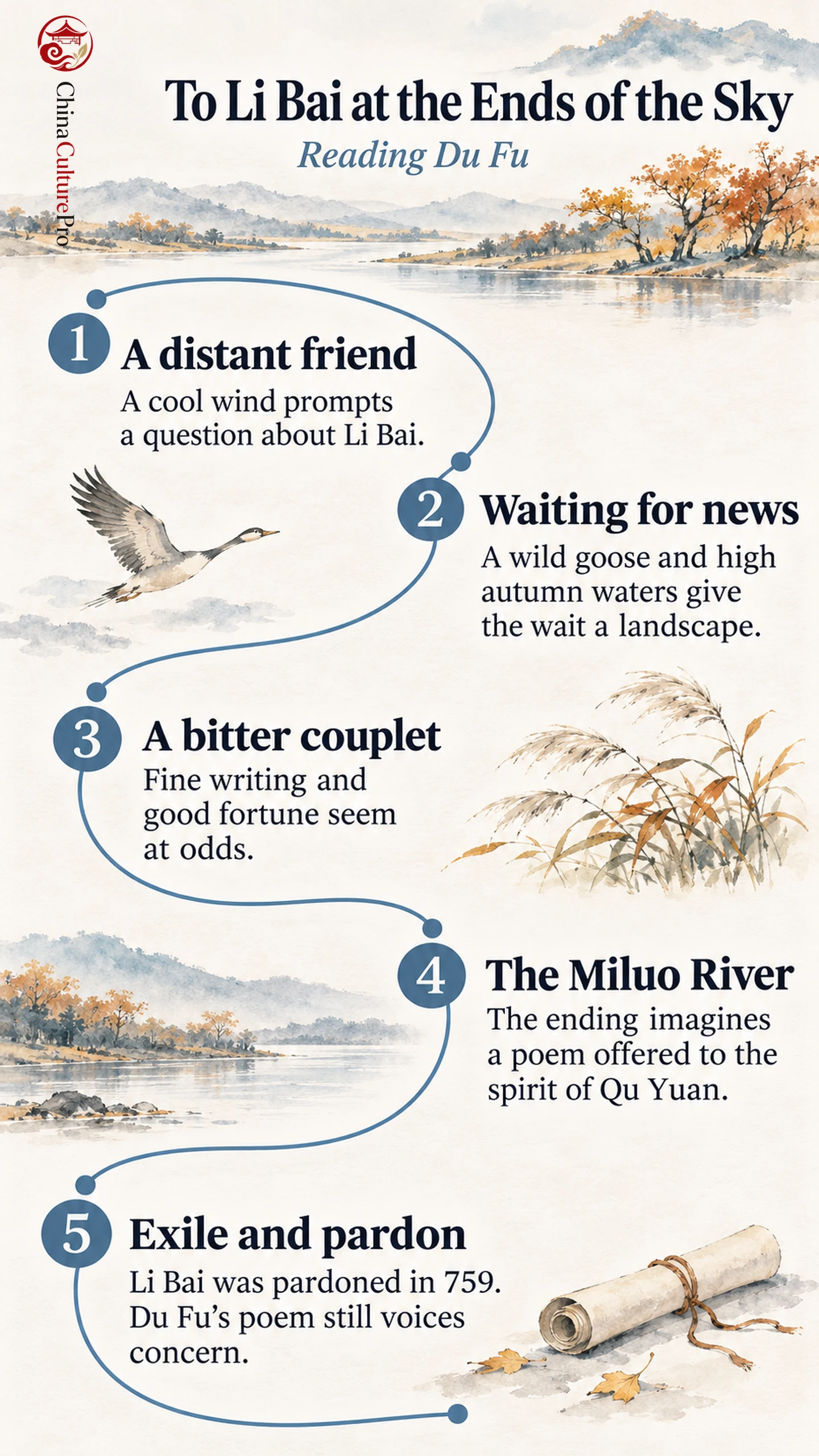
The first question is one a friend might ask in a letter. How are you doing out there? There is no reply in the poem. Instead, Du Fu gives the reader the conditions in which a message would have to travel, and ends by imagining a message sent to someone who died centuries earlier.
The Poem in Chinese, Pinyin and English
This is a regulated poem of eight five-character lines. The translation keeps the four couplets and follows the received wording. The pinyin gives a modern Mandarin reading.[1][3]
| Китайский | Пиньинь | Смысл |
|---|---|---|
| 凉风起天末 | Liáng fēng qǐ tiānmò | A cool wind rises at the edge of the sky. |
| 君子意如何 | Jūnzǐ yì rúhé | My good friend, what is on your mind? |
| 鸿雁几时到 | Hóngyàn jǐ shí dào | When will the wild goose arrive? |
| 江湖秋水多 | Jiānghú qiūshuǐ duō | The rivers and lakes are full of autumn water. |
| 文章憎命达 | Wénzhāng zēng mìng dá | Fine writing seems to hate good fortune. |
| 魑魅喜人过 | Chīmèi xǐ rén guò | The wild spirits are pleased when travellers go by. |
| 应共冤魂语 | Yīng gòng yuānhún yǔ | You could speak with that wronged spirit. |
| 投诗赠汨罗 | Tóu shī zèng Mìluó | Cast a poem as a gift into the Miluo. |
Why the Poem Waits for a Goose
The first couplet gives the weather before it asks how Li Bai feels. The cool wind brings on a question about Li Bai’s state of mind. Then the wild goose suggests news that might cross the distance. The rising autumn waters also give the journey an unsettled quality. Du Fu has no reported letter to read aloud, so the poem gives the act of waiting a landscape.[1][3]
The poem is usually dated to autumn 759, when Du Fu was in Qinzhou. Li Bai had been sentenced to exile after his involvement with the Prince of Yong and had received a pardon on the way. Du Fu’s worry has its own time and point of view. The verse gives no confirmation that his friend’s fortunes have changed.[2]
The Harsh Turn from Literature to Demons
The next couplet gives writing a verb normally used for feeling. Fine writing “hates” a fortunate life. Beside it, spirits take pleasure when someone passes. In that pairing, neither creative talent nor the world along the route promises protection. The statement has the shape of a bitter joke about the fortunes of a writer.[1][3]
The last character of the spirit line, 过, can point to passing by or evoke a fault. The sense translation follows the traveller passing through, a reading that fits the rivers and the dangerous way. Another reading can hear the spirits as glad to catch a person in an error. In both readings the line makes danger sound eager.[3]
Why Du Fu Ends at the Miluo River
The closing couplet names a river and a wronged spirit. The Miluo recalls Qu Yuan, a figure associated with exile and death in that river. Du Fu imagines Li Bai talking with the spirit and offering a poem. Earlier the speaker waits for a message from a friend. Now the friend can send one to a poet of an earlier age.[1][3]
The resemblance between the writers is poetic. It connects a living friend who has faced exile with a literary figure whose story gives injustice a name. Li Sao и The Fisherman of the Chuci give different views of that earlier tradition. In Li Bai’s Early Departure from Baidi City, water also carries a traveller, but the pace and feeling belong to another occasion.[1][2][3]
FAQs About To Li Bai at the Ends of the Sky
Was Li Bai still in exile when Du Fu wrote the poem?
Li Bai received a pardon in 759 while travelling toward exile. Du Fu’s poem is generally placed in that autumn. The poem does not say what Du Fu had heard of the pardon.[1][2]
What form does the poem use?
It is an eight-line regulated poem, with five Chinese characters in each line. Its four couplets move from a direct question to an imagined address to a spirit.[1][3]
Источники
[1] Du Fu. To Li Bai at the Ends of the Sky
[2] Shanghai Jiao Tong University. Li Bai and Du Fu
[3] Ray Brownrigg. Tian Mo Huai Li Bai: Text and Translation Comparisons