


Quick Answer: What Is Li Sao About?
Li Sao (離騷, Lí Sāo), commonly translated as “Encountering Sorrow,” is a long poem traditionally attributed to Qu Yuan (屈原, Qū Yuán) in the Songs of Chu (楚辭, Chǔcí). A speaker’s claim to integrity develops into a troubled search for recognition, companionship and a place where his ideals can matter.[1][2]
- The conflict: The speaker presents himself as sincere and cultivated while describing a world that misunderstands or rejects him.
- The journey: Mythical travel enlarges the search without automatically resolving its obstacles.
- The return: Attachment to home interrupts departure and gives the ending its difficulty.
The speaker’s account, a traditional biography of Qu Yuan, and later interpretations of the poem are related layers that should be distinguished.
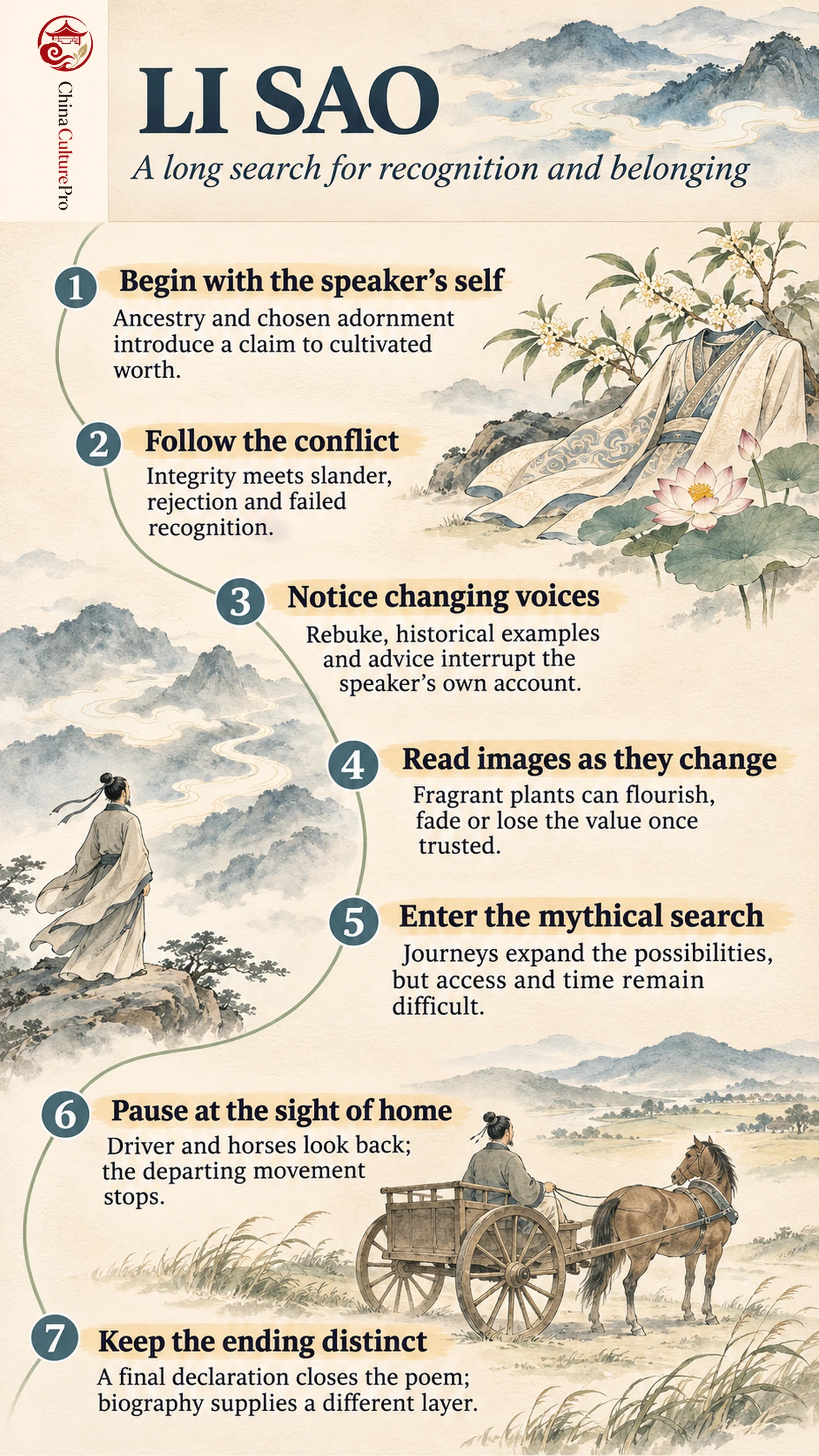
A speaker cultivates beautiful things, protests against misunderstanding, and travels through a world of divine beings without finding an easy place to belong. This guide follows the whole poem’s movement and explains selected lines. It is an introduction for reading a complete annotated translation, rather than a replacement for one.
The Long Poem’s Main Movements
The poem moves through several kinds of speech: self-description, accusation, advice, historical argument and visionary travel. The following map follows that progression without claiming that the text originally came with these five section headings.[1]
| Движение | Что делают | What to track |
|---|---|---|
| Establishing a cultivated self | The speaker introduces ancestry, birth, names, inward qualities and chosen adornment | How inherited standing and deliberate cultivation support his authority |
| Defending an unchanged purpose | Slander, rejection and failed recognition provoke complaints and renewed declarations | The gap between the speaker’s standards and others’ judgments |
| Answering criticism through the past | A rebuke challenges his solitary commitment; accounts of earlier rulers and worthy figures supply arguments | Who is speaking, and what each example is meant to justify |
| Seeking through the divine world | An ascent, obstructed access, attempted encounters and divinatory advice expand the search | Time, messengers, intermediaries and repeated hesitation |
| Departing, then looking homeward | A renewed journey reaches an expansive height, but the sight of home stops the movement | Why distance does not free the speaker from attachment |
The narrative repeatedly revisits its central difficulty. A new region, adviser or possibility may change the circumstances while leaving the need to be understood unresolved.
Selected Chinese Lines and English Meanings
These five passages are selected from across the poem. Their English renderings are original sense translations; the source contains the complete Chinese text.[1]
| Passage | Chinese text | Смысл |
|---|---|---|
| Inner qualities and cultivation | 紛吾既有此內美兮,又重之以脩能。 | Already endowed with this inward beauty, I added to it cultivated abilities. |
| Making an outward self | 製芰荷以為衣兮,集芙蓉以為裳。 | I fashioned water plants into a garment and gathered lotus blossoms for a skirt. |
| The long search | 路曼曼其脩遠兮,吾將上下而求索。 | The road stretches onward, long and far; above and below I shall continue seeking. |
| The homeward look | 僕夫悲余馬懷兮,蜷局顧而不行。 | My driver grieves, my horses long for home; looking back, they will not go on. |
| The closing declaration | 既莫足與為美政兮,吾將從彭咸之所居。 | With no one fit to join in worthy governance, I shall follow where Peng Xian (彭咸, Péng Xián) dwells. |
Reading the famous long-road passage between the opening self-description and the final halted journey makes its searching energy more complicated than a promise of eventual success.
Fragrant Plants, Beauty and the Speaker’s Character
Plants are part of the speaker’s chosen self. He grows, gathers, wears and evaluates them. Garments and pendants make inward qualities visible, so his insistence on beauty becomes an argument about how he lives and what he values.[1]
This creates more than a fixed code in which each flower equals one virtue. Plants can change, lose their fragrance or become entangled with less valued growth. The speaker worries about the reliability of the very things he once trusted. Cultivation therefore carries both hope and the possibility of disappointment.
The language also moves between beauty, affection and moral worth. Jealousy of the speaker’s appearance can coexist with accusations about his conduct. Such imagery gives political rejection an intimate register without making every detail a literal report of his clothing or relationships.
An influential tradition explains attractive figures as rulers or worthy ministers. That remains useful to consider alongside the poem’s religious imagination. Divine women can also be read as divine women, rather than dissolved into a single set of historical male identities.[2][3]
Why the Search Becomes a Journey through Myth
The speaker’s problem is not solved simply by leaving an unsatisfactory court. In the visionary world he still confronts waiting, barriers, unreliable intermediaries and difficulty finding a suitable encounter. The journey enlarges the field of possibility while carrying the original conflict with it.[1]
Kunlun (崑崙, Kūnlún) belongs to this imagined geography, while Xihe (羲和, Xīhé) appears in connection with the sun’s movement. The speaker’s request to slow that movement makes time part of the struggle. The guides to Kunlun in Chinese mythology и Xihe’s different traditions provide context without turning the poem into a modern travel map.
The long-road couplet appears amid this ascent and pressure of approaching evening. “Above and below” belongs first to the poem’s expansive search. Later readers can borrow it for persistence, but its original setting contains anxiety, delay and uncertainty as well as determination.[1]
For a first reading, ask what each encounter changes. Is access granted? Does a messenger help? Does advice remove hesitation? Those questions are more useful than trying to memorize every mythical name before continuing.
The Return of Home and the Unsettled Ending
Near the end, the journey becomes magnificently expansive. Yet the old homeland comes into view, and movement stops. Grief and attachment enter through the driver and horses, making a departure that seemed possible suddenly difficult.[1]
This reverses the expectation that traveling farther must bring release. The speaker wants a place for his principles, but the place that has failed to recognize him still exerts a pull.
The closing declaration names meizheng (美政, měizhèng), “worthy governance,” and turns toward Peng Xian. Traditional commentary associates that figure with unrecognized loyalty and death, then reads the ending through the account of Qu Yuan’s death. This is an interpretive frame; the poem itself ends with a declaration, not a narrated scene of drowning.[1][2]
The ending preserves a severe conflict between commitment and belonging. It does not supply a successful appointment, a comfortable retreat or a simple resolution to the speaker’s search.
Qu Yuan, Commentary and the Poem’s Later Life
The life and cultural memory of Qu Yuan provide an important entrance to the work. At the same time, the surviving poem and the accounts of its author reached readers through later transmission. Questions about composition and the making of the author’s image remain part of modern scholarship.[4]
Wang Yi (王逸, Wáng Yì) gave the poem an influential account of loyalty and misunderstood service. Earlier and later readers did not agree on every aspect of the speaker’s conduct, the mythical material or the proper relation between personal grievance and moral authority. Commentary is part of the poem’s history of meaning, rather than a neutral window onto every original intention.[2][3]
Within the anthology, the Nine Songs (九歌, Jiǔ Gē) foreground ritual encounters, while the Nine Pieces (九章, Jiǔ Zhāng) offer several distinct works concerned with rejection and purpose. Their guides—Nine Songs и Nine Pieces—make useful comparisons after a first reading of Li Sao.
How to Read Li Sao without Losing the Thread
- Keep a movement map nearby: Identify self-description, complaint, advice and journey before decoding individual allusions.
- Mark each change of voice: Separate the speaker’s own claims from a rebuke, an oracle or another adviser’s words.
- Follow one recurring image: Watch what happens to plants, roads or messages as the poem proceeds.
- Revisit the final turn: Compare the wish to leave with the interruption caused by seeing home.
A complete annotated translation and the Songs of Chu reading guide can support a second pass. Variation between English versions is a reason to compare their notes as well as their wording.
FAQs About Li Sao
What does the title Li Sao mean?
“Encountering Sorrow,” “On Encountering Trouble” and versions emphasizing separation reflect different readings of the title. Even traditional commentators explained its first character differently, so no single English rendering exhausts its interpretation.[2]
Is Li Sao the same as the Songs of Chu?
Li Sao is one long work within the larger anthology. It is central to that collection, which also contains separate cycles and poems with different structures and voices.
Is “I will search above and below” just an inspirational saying?
It is widely quoted independently, but in the poem it belongs to a difficult visionary search under pressure from passing time. Its resolve is accompanied by obstacles and hesitation.
Does the ending narrate Qu Yuan’s death?
It announces an intended course through the reference to Peng Xian. The account of Qu Yuan’s death belongs to biography and commentary; the poem does not narrate that event as its final scene.
Источники
[1] Songs of Chu. Li Sao: complete Chinese text
[2] Wang Yi and Hong Xingzu. Supplementary Commentary on the Songs of Chu, volume one
[3] Monica E. M. Zikpi. Wanton Goddesses to Unspoken Worthies: Gendered Hermeneutics in the Chu Ci Zhangju
[4] Martin Kern and Stephen Owen. Introduction to Qu Yuan and the Chuci: New Approaches