
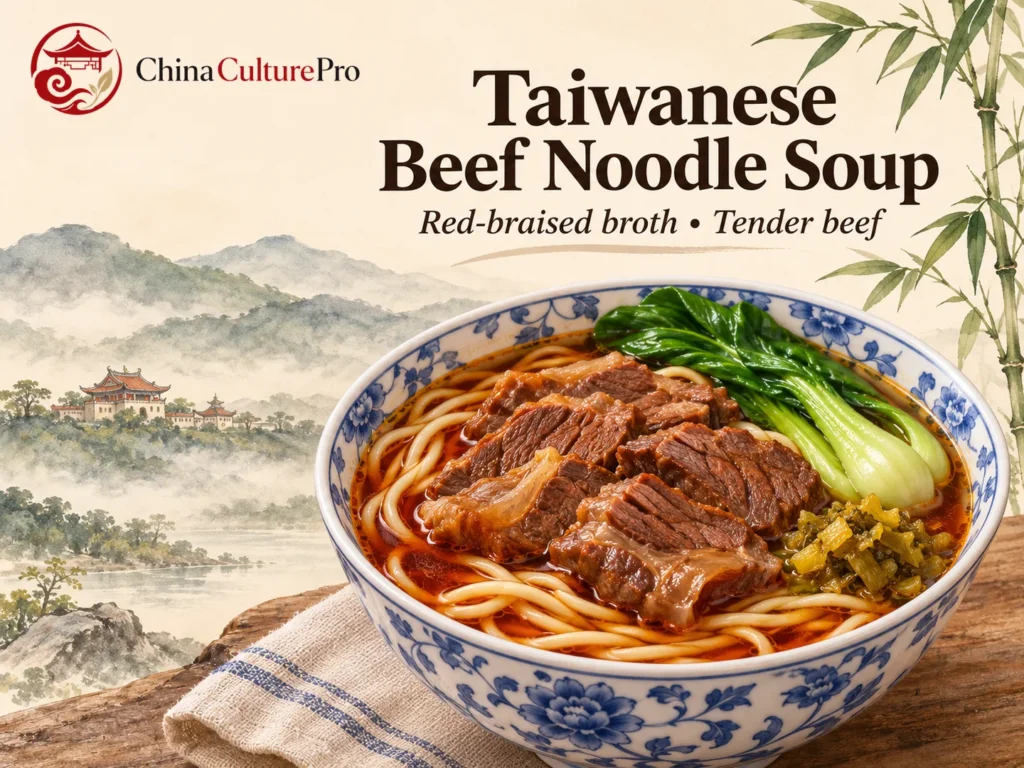

Quick Answer: What Is Taiwanese Beef Noodle Soup?
Taiwanese beef noodle soup, or niurou mian (牛肉面, niú ròu miàn), combines tender cooked beef, broth and wheat noodles, often with greens and a pickled topping.[2][3]
- Red-braised (红烧, hóngshāo) versions use soy seasoning and may include spicy bean paste.[2][4]
- Clear-stewed (清炖, qīngdùn) versions build a lighter-looking broth without the red-style soy-and-chili base.[3]
- Cook noodles separately, then assemble each bowl with hot broth.[2][3][5]
Below is one red-braised recipe.
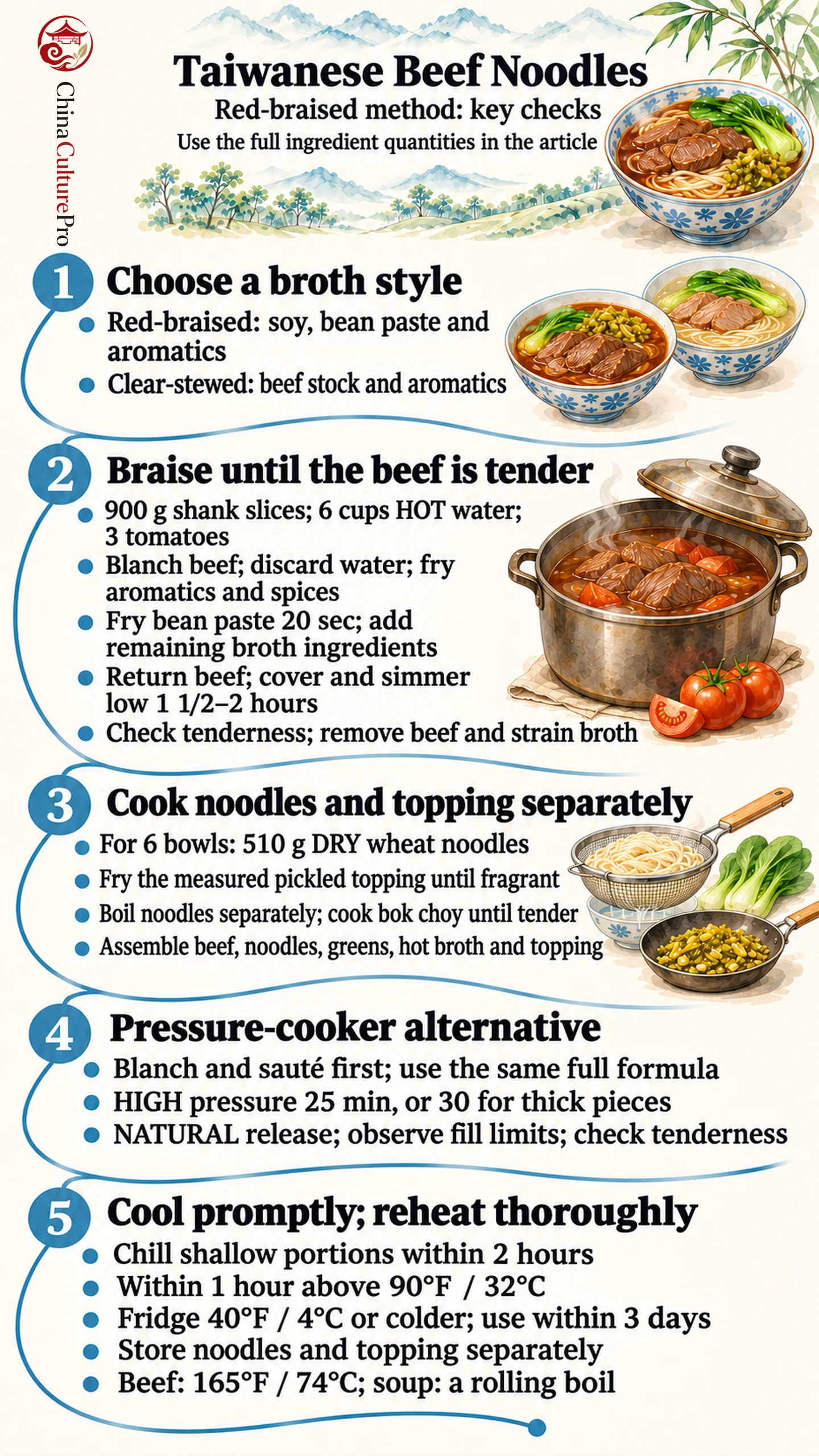
Treat this as two linked tasks: braise beef until tender, then prepare noodles and greens for serving. Keeping the noodle pot separate lets you assemble each bowl when it is ready to eat.
Red-Braised and Clear-Stewed Styles
Beef noodles are an established Taiwanese specialty. A common red-style method starts by frying spicy bean paste, then simmering the beef with water and seasonings.[4]
The two broad styles answer different preferences:
- Red-braised broth: Soy sauce, bean paste and aromatics produce a dark, richly seasoned soup. Tomatoes appear in some recipes; spice blends and heat levels vary.[2][5]
- Clear-stewed broth: One version starts with beef-bone stock, onion, carrot, daikon, ginger and star anise, then cooks the beef in that stock.[3]
Straining a red broth removes loose spices and cooked vegetables; it does not turn that soy-seasoned soup into the clear-stewed style. Similarly, Lanzhou beef noodles have their own preparation tradition: a pale-looking soup alone does not identify the recipe.[3][4]
Ingredients for Six Red-Braised Bowls
- Beef: 900 g beef shank slices; 1 tbsp neutral oil; 2 medium onions, sliced; 1 garlic head, peeled; 8 ginger slices.[1]
- Spices: 3 bay leaves; 2 star anise; 1 piece Chinese cinnamon (桂皮, guìpí); 1 tsp whole Sichuan peppercorns (花椒, huājiāo).[1]
- Seasoning: 3 tbsp spicy doubanjiang (辣豆瓣酱, là dòubànjiàng); 2 tbsp Shaoxing wine (绍兴酒, Shàoxīng jiǔ); 1 tbsp each light soy sauce (生抽, shēngchōu) and dark soy sauce (老抽, lǎochōu); 1 tbsp sugar; 3 chopped medium ripe tomatoes; 6 cups hot water.[1]
- Topping: 200 g chopped suancai (酸菜, suāncài), pickled mustard greens; 1 tbsp neutral oil; 1 tbsp minced garlic; 1 tsp minced ginger.[1]
- Serving: 510 g dry wheat noodles (85 g/bowl); bok choy.[1]
How to Braise the Beef and Assemble the Bowls
- Blanch. Boil beef from cold water; skim. Remove beef; discard water.[1]
- Fry aromatics. Fry aromatics and spices in broth oil in a heavy pot until onion edges brown. Fry doubanjiang 20 seconds; add remaining broth ingredients.[1]
- Braise. Return beef; cover and simmer low 1½–2 hours until tender. Remove beef; strain broth.[1]
- Fry topping. Fry topping garlic and ginger in its oil; add suancai until fragrant.[1]
- Cook noodles separately. Boil according to package directions; blanch bok choy until tender.[2][3]
- Assemble. Divide noodles, greens and beef among bowls; add hot broth and topping.[1]
Taste the broth before serving. A concentrated braising liquid can be loosened with hot water or stock to suit the bowl; do not add more soy automatically.[5]
FAQs About Taiwanese Beef Noodle Soup
Which beef cuts and noodles work best?
Shank and well-marbled chuck are useful braising choices because their connective tissue benefits from slow, moist cooking. Thin or thicker wheat noodles can work; the rice-versus-wheat noodle guide explains why changing noodle material changes texture.[2][3][6]
Why is the beef still tough?
Braising time depends on the cut and piece size. If a connective-tissue-rich piece remains resistant to a fork, keep it at a gentle simmer and check again. Collagen needs sustained moist heat to soften; reaching a food-safety temperature is not the same as becoming tender.[2][6]
Can I use a pressure cooker?
Blanch and sauté; pressure-cook on high 25 minutes (30 for thick pieces); release naturally. Observe fill limits; check tenderness.[1]
How should I store and reheat leftovers?
Divide beef and broth into shallow containers promptly; keep cooked noodles and topping separately. Refrigerate within 2 hours, or 1 hour above 90°F/32°C, at 40°F/4°C or colder. Use within 3 days; reheat beef to 165°F/74°C and bring the soup to a rolling boil.[7][8]
Источники
[1] Wei Guo. Taiwanese Beef Noodle Soup
[2] Kaitlin Leung. Taiwanese Beef Noodle Soup: Pressure Cooker or Stovetop
[3] Stephen Jack. Clear Beef Noodle Soup
[4] Taiwan Tourism Administration. Taiwan Snacks: Beef Noodles
[5] The Culinary Institute of America, recipe courtesy of Taiwan Tourism Bureau. World Culinary Arts: Taiwan, Beef Noodle Soup
[6] Exploratorium. What Makes Meat Juicy and Tender?
[7] U.S. Department of Agriculture. How Do I Handle Leftovers Safely?
[8] U.S. Department of Agriculture. What Methods of Reheating Food Are Safe?