

Quick Answer: What Is Tai Chi?
Tai Chi, also called Taijiquan (太极拳, tàijíquán), is a Chinese martial tradition combining coordinated movement, attention and breathing. Its relaxed, circular movements are widely practiced for health and cultural learning as well as martial training. [7]
- Its historical development is associated with seventeenth-century China; legendary founders require a different kind of reading from documented teachers. [2][9]
- Chen, Yang, Wu, Wu/Hao and Sun are five major family styles, with further lineages beyond this familiar grouping. [10]
- Practice can include solo routines, partner exercises and weapons; a slow public exercise session shows only part of the tradition. [1][6]
Style names describe lineages. A numbered routine, such as the 24 form, describes a particular sequence, not an additional family style. [5]
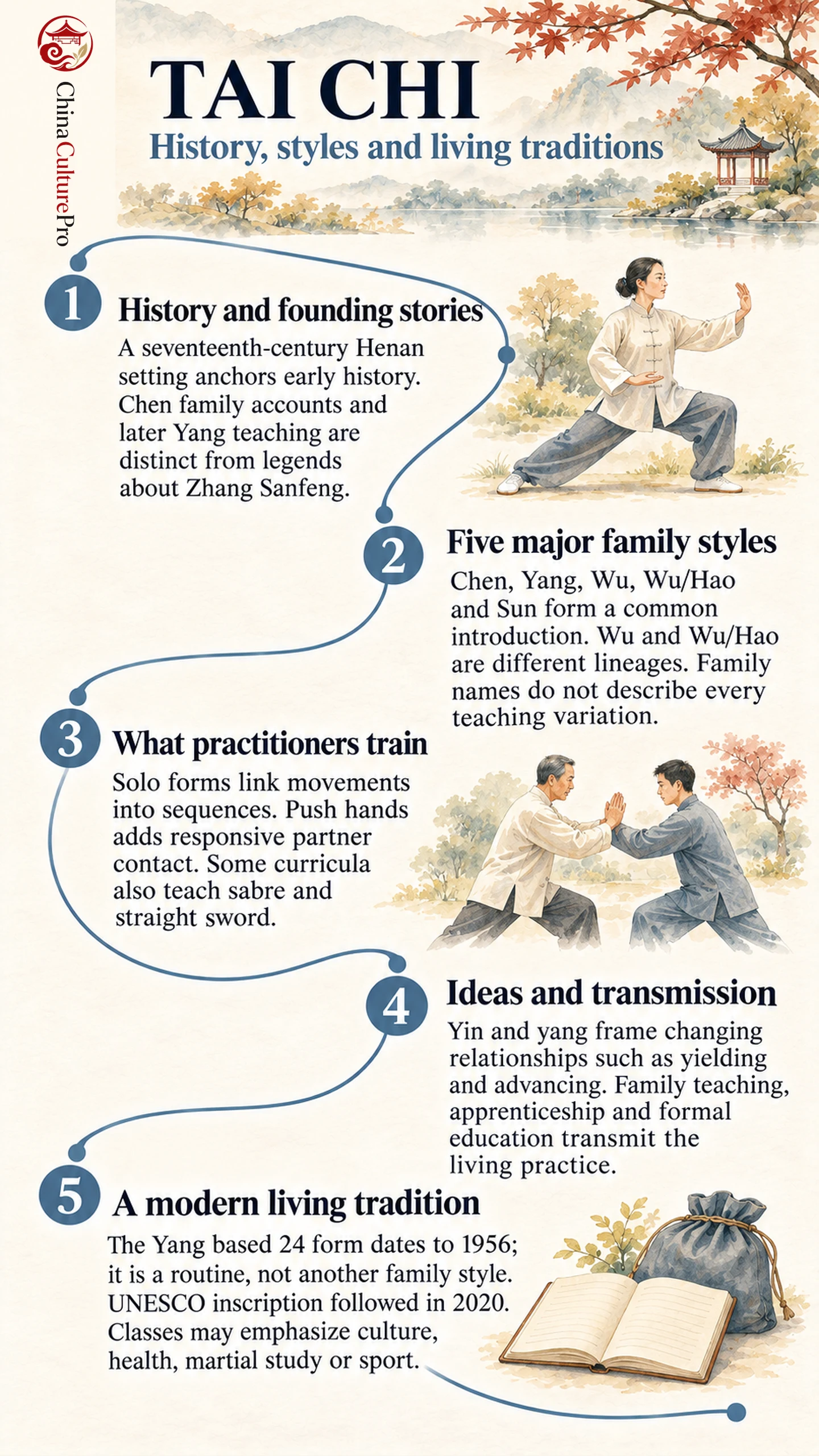
The park image of Tai Chi—people moving together through a quiet sequence—is familiar. Understanding the art also means asking how that sequence was transmitted, what its movements train and why different schools teach it differently. Those questions connect Tai Chi with the wider history of Chinese martial arts.
Tai Chi History: Evidence and Founding Legends
UNESCO locates Tai Chi’s origins in mid-seventeenth-century Wenxian County, Henan. Early-development accounts associate the Chen family tradition with Chen Wangting (陈王廷, Chén Wángtíng). [1][9]
Another prominent origin story credits the Daoist figure Zhang Sanfeng (张三丰, Zhāng Sānfēng). Martial arts historian Douglas Wile examines how this founder narrative and claims about early documents became subjects of debate. A lineage’s treasured story can illuminate its identity without proving the story’s events. The distinction matters when reading Chinese history and legend. [2]
During the nineteenth century, Yang Luchan (杨露禅, Yáng Lùchán) learned within the Chen tradition and helped spread the practice beyond it. Yang family accounts place his teaching in Beijing in the 1850s. Later generations developed the large-frame Yang practice now widely recognized. Even the family’s own history distinguishes uncertain early-life details from popular fictional retellings. [3]
Five Major Tai Chi Styles
The familiar five-style grouping offers an orientation. The Chinese characters matter: Wú and Wǔ have different tones and refer here to different family names. Their identical unmarked English spelling can hide that distinction. [4]
| Стиль | Characteristic emphasis |
|---|---|
| Chen style (陈式, Chénshì) | Associated with the Chen family tradition; routines can combine slow passages with faster, forceful movements. [9] |
| Yang style (杨式, Yángshì) | Developed through the Yang family; the widely taught large frame emphasizes expansive, flowing movement. [3][4] |
| Wu style (吴式, Wúshì) | Developed from the Yang tradition; compact, continuous movement is a characteristic emphasis. [4] |
| Wu or Wu/Hao style (武式, Wǔshì) | A separate lineage from 吴式; characterized by compact movement and attention to body alignment. [4] |
| Sun style (孙式, Sūnshì) | Combines Tai Chi with influences from Xingyiquan (形意拳, xíngyìquán) and Baguazhang (八卦掌, bāguàzhǎng), with agile following steps. [4] |
The last row names two other Chinese martial traditions. Each family style contains teaching variations. Compare Chen and Yang Tai Chi for a closer look at two of them. [4]
Forms, Push Hands and Weapons
Three activities help explain why Tai Chi retains a martial identity even when a particular class emphasizes gentle exercise:
- Solo routines: A routine, or taolu (套路, tàolù), links named movements into a practiced sequence. The Wu federation’s curriculum, for example, lists a long hand form as well as a shorter competition form. Learning a sequence involves coordination and continuity, rather than collecting isolated poses. [6]
- Partner practice: Push hands (推手, tuīshǒu) brings two practitioners into responsive contact. It makes the relationship between one’s own movement and another person’s movement visible. UNESCO includes it within Tai Chi’s training repertoire; it is not simply another solo dance sequence. [1]
- Weapons: Traditional curricula can include sabre and straight sword. These extend practice beyond empty-hand routines. The Wu federation’s published forms provide concrete examples; broader Chinese martial arts weapons have their own histories and training roles. [6]
A class may teach only some of this material. Seeing a hand form does not establish that its students also train partner applications, weapons or competition routines.
Philosophy and Cultural Transmission
Yin and yang (阴阳, yīnyáng) frame changing relationships, such as yielding and advancing. UNESCO connects Tai Chi with Daoist and Confucian thought. These cultural influences neither establish medical mechanisms nor require shared religious beliefs. [1]
Family lines and master–apprentice teaching coexist with formal education. The wider context of martial arts etiquette и Chinese philosophy helps explain how physical skills carry cultural meanings. [1]
Tai Chi in Modern Community Life and Sport
In 1956, a simplified 24-movement routine was created using Yang-style material. Beijing Sport University’s course description identifies both its date and that foundation. This explains why someone may say they practice “24-form Tai Chi” without naming a separate family lineage: the number identifies an organized sequence. [5]
Tai Chi was inscribed on UNESCO’s Representative List of the Intangible Cultural Heritage of Humanity in 2020. This recognizes a living practice and its transmission, rather than designating a building or archaeological site. [1]
Today, health-oriented exercise, lineage study and competitive performance can place different demands on the same movement tradition. NCCIH reports evidence that Tai Chi may improve balance and help reduce falls among older adults. Research concerns particular populations and programs; it does not show that every class produces identical results. Slow movement alone also tells you little about a class’s martial content. [7]
When reading a course description, look for three separate pieces of information: its family style, the routine being taught and the purpose of instruction. That distinction makes more sense of the choices than treating every Tai Chi class as interchangeable.
FAQs About Tai Chi
Is Tai Chi always slow?
No. Some Chen routines alternate slower passages with faster, forceful movements. Slow practice is a prominent feature of many forms, but it does not describe every part of every lineage’s training. [9]
Are there only five Tai Chi styles?
No. Chen, Yang, Wu, Wu/Hao and Sun are a common introductory grouping. The International Wushu Federation’s traditional competition categories also accommodate other Tai Chi routines; the five names are not an exhaustive list. See the broader guide to Chinese martial arts styles for classification context. [10]
Is the 24 form a separate style?
It is a standardized routine created in 1956 from Yang-style material. A routine’s movement count and a family lineage identify different things, so “24 form” is not a sixth family style. [5]
Is Tai Chi the same as qigong?
They overlap, especially in health-oriented practice, but the terms are not interchangeable. Qigong (气功, qìgōng) covers a broader range of practices involving posture or movement, breath and attention, including relatively still exercises. Tai Chi has a particular martial history and lineage structure. The Tai Chi versus qigong comparison explains their different uses. [8]
Источники
[1] UNESCO. Taijiquan: Representative List entry
[2] Douglas Wile. Fighting words: Four new document finds reignite old debates in Taijiquan historiography
[3] Yang Family Tai Chi. A Short History of the Yang Family Taijiquan
[4] General Administration of Sport of China. An Introduction to Tai Chi in Hebei
[5] Beijing Sport University. Launch of the 24-Form Tai Chi Open Online Course
[6] International Wu Style Tai Chi Chuan Federation. Forms and Techniques
[7] National Center for Complementary and Integrative Health. Tai Chi: What You Need To Know
[8] National Center for Complementary and Integrative Health. Qigong: What You Need To Know
[9] University of Tennessee at Chattanooga. The Story of Tai Chi Chuan
[10] International Wushu Federation. 8th World Kungfu Championships Regulations: Traditional Taijiquan Categories