

Quick Answer: What Is Li Jianzhong’s Box of Herbs?
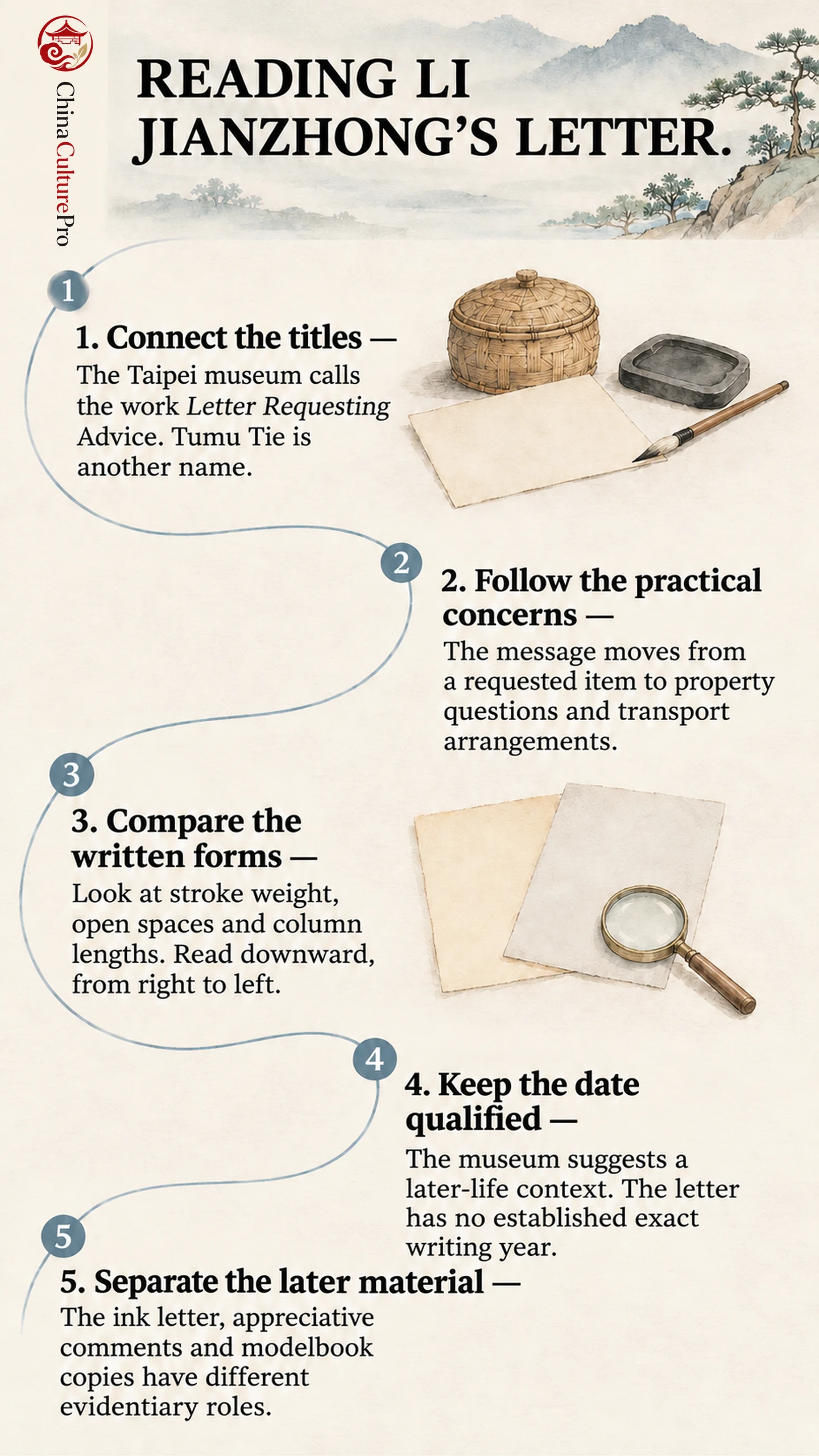
Box of Herbs refers here to a letter by Li Jianzhong(李建中,Lǐ Jiànzhōng), also known as Tumu Tie(土母帖,Tǔmǔ tiè), after the item tumu(土母,tǔmǔ) named in its opening. The National Palace Museum, Taipei, catalogs it as Letter Requesting Advice, an ink-on-paper album leaf.[1]
- Subject: Practical requests and arrangements communicated in writing.
- Viewing focus: The spacing, shape and changing weight of the written characters.
- Key distinction: The English title does not make this a painting of a box or a botanical specimen.
Read the letter’s content alongside its written form.
Dark columns fill a small rectangular sheet, with red collection marks around and among the writing. Before trying to decipher every character, notice how the columns hold together without looking mechanically uniform. This Chinese calligraphy guide follows both the everyday message and the visual decisions that make the letter worth sustained attention.
Box of Herbs, Tumu Tie and the Museum Title
The alternative title comes from the item named near the beginning of the letter. Li says he has obtained a small basket of it and asks whether it is suitable for use. He also asks what it is needed for.[1] Those questions belong to the original message; they do not identify a plant species or establish a medical purpose.
Letter Requesting Advice is therefore a helpful museum title. It directs attention to the exchange of information running through the text. Box of Herbs is the English label used for this article, but the Chinese title and opening passage provide the firmer connection when comparing reproductions or catalog entries.
What the Letter Actually Discusses
The message moves between several practical concerns. In paraphrase, its main exchanges are these:[1]
- Sending an item: Li has obtained a small basket of the requested material from Xin’an, mentions its place of origin and seeks further instructions. Sending it has not settled the question of whether it will meet the recipient’s needs.
- Discussing property: The basis of a proposed house-site arrangement involving the Yin family remains unclear. Li says it is difficult to negotiate and mentions seeking a more dependable alternative. He asks whether an existing house might be considered.
- Arranging transport: A westward journey raises the problem of a vehicle. Li mentions an old cart and the possibility of selling it if it is no longer needed at the destination.
These shifts make the work readable as correspondence rather than a continuous literary composition. The repeated requests for a response connect the topics: the writer supplies information, acknowledges uncertainties and asks the other person to clarify a preference. The surviving message preserves one side of that exchange, not the recipient’s answer.
Looking at the Running Script
The work is classified as running script(行书,xíngshū).[1] In this script family, abbreviated forms and flowing transitions can coexist with recognizable character structures. Flexible brushwork permits variation in stroke width, while the traditional reading sequence runs down columns from right to left.[2] The running-script guide offers a broader introduction to that balance.
In the original image, begin with the fuller vertical strokes and then compare the smaller connecting movements. Some characters occupy substantial blocks of dark ink; others open out around smaller strokes and pale internal spaces. The columns remain upright while individual forms tilt or vary in width.
Now compare neighboring columns. Their tops and bottoms do not produce a rigid rectangular grid. The changing lengths leave a different pattern of open paper near the lower edge, where the message and concluding marks occupy less regular positions. Looking at those intervals helps you see rhythm without needing to mistake every variation for a change of subject.
An Early Song Letter and Its Artistic Value
Li lived from 945 to 1013 and served as an official. The museum associates this undated letter with his later years around Luoyang, while leaving its recipient unidentified.[1] That is a contextual inference, not a securely inscribed year.
The practical message and its written forms can be studied together. Questions about a basket, property and transport do not prevent the writing from being studied as art. The broader history of Song-dynasty culture provides context for a letter written by an early Song official.
The Met’s account of calligraphy emphasizes both compositional order and expressive movement.[2] In this leaf, compare the sustained column structure with the individual changes of weight and direction. That gives a more concrete starting point than treating a popular ranking as an objective measure of quality.
The Ink Letter, Later Colophons and Modelbook Copies
The original letter is accompanied by later appreciative writings. The museum reproductions show these on separate openings, with changes in handwriting and layout. Reading a later comment as part of Li’s message would merge different voices and moments.[1]
There are also separate modelbook versions, including one cataloged in volume eight of the Three Rarities Hall collection.[3] A reproduced text and the original ink leaf are different objects. Check the catalog category and object record before using the color, surface or date of one to describe the other.
For close viewing, keep the original image beside a transcription. Locate the opening item name, follow the practical topics, and then look away from the words to compare the column spacing. The guide to inscriptions and seals can help distinguish the main writing from later collection evidence.
FAQs About Li Jianzhong’s Box of Herbs
Who received Li Jianzhong’s letter?
The museum does not identify the recipient.[1]
Is the exact writing year known?
No exact year is established in the collection record.[1]
Does Box of Herbs identify a particular medicine?
No. The original letter names an item and asks about its use; it does not provide a medical identification or recipe.
Источники
[1] National Palace Museum, Taipei. Letter Requesting Advice by Li Jianzhong
[2] The Metropolitan Museum of Art. Китайская каллиграфия
[3] National Palace Museum, Taipei. Three Rarities Hall Modelbook, Volume Eight: Tumu Tie