


Quick Answer: What Is the Difference?
Sichuan and Chongqing hot pot(火锅,huǒguō)belong to a closely connected southwestern dining tradition. Chongqing is especially associated with rich beef-tallow red broth; Sichuan, including Chengdu, offers both tallow-based and vegetable-oil versions.
- Shared flavor: Chili, peppercorn, aromatics and a heated communal pot are familiar reference points.
- Useful distinction: The fat base influences aroma and mouthfeel, but does not fix the chili level.
- Ordering priority: Ask about the actual broth, stock, heat and dip rather than predicting everything from a city name.
The comparison describes tendencies and recognizable traditions, not two exclusive recipes or a contest over authenticity.
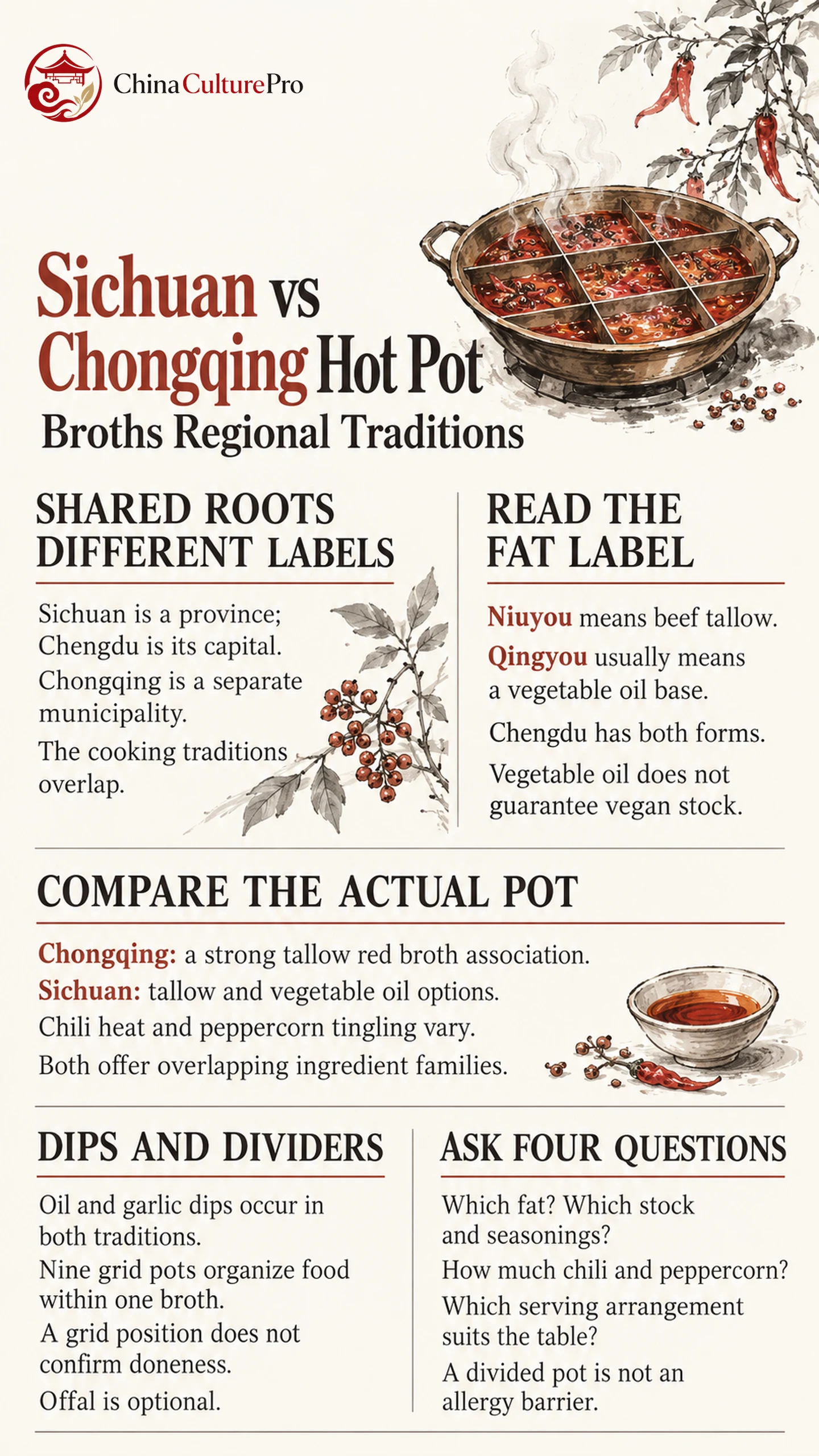
Two red pots can look similar while tasting quite different, and two restaurants in the same city can use different bases. Understanding the names on the broth menu is more useful than assigning one recipe to an entire place. The Chinese hot pot guide provides the national context for this regional comparison.
Shared Roots, Different Regional Labels
Sichuan is a province and Chengdu is its capital. Chongqing is a separate centrally administered municipality, established in its current provincial-level form in 1997. Calling Chongqing simply another present-day Sichuan city confuses administrative geography with a historically connected food culture.[1]
Restaurant language is less tidy than administrative boundaries. “Sichuan-style” can be used broadly for southwestern chili-and-peppercorn hot pot, while “Chongqing-style” often foregrounds a particular red-broth identity. “Chengdu-style” describes a city-level reference within a much larger Sichuan repertoire.
The Sichuan cuisine overview explains that wider flavor world. Shared ingredients and movement between places help explain the overlap; they do not erase local traditions or make every restaurant identical. The comparison concerns cooking traditions and restaurant choices.
Read the Oil Label Before Judging the City
Mala(麻辣,málà)combines chili heat and the tingling sensation of Sichuan peppercorns. The fat carries aromas, but the fat type and the amount of chili are separate choices.
Niuyou(牛油,niúyóu)on a Chinese hot pot menu means beef tallow. Qingyou(清油,qīngyóu)usually indicates a vegetable-oil base, often rapeseed oil in this setting. Chengdu’s published food guidance describes both tallow and rapeseed-oil red pots, rather than defining the city as vegetable-oil-only.[2]
Traditional Chongqing red broth has a strong association with tallow’s rich aroma and coating mouthfeel.[3] Tallow is also documented in a Chengdu beef-and-offal hot pot heritage practice. That specific local example is enough to disprove the claim that Chengdu hot pot must never use it.[4]
Qingyou is not the same as a clear, unseasoned soup, and it does not automatically mean vegan. One published enterprise standard, for example, lists beef powder in a qingyou base made with rapeseed oil. That is evidence of a possible product formula, not a requirement applying to every restaurant.[5]
Sichuan and Chongqing Hot Pot at a Glance
Read the table as a set of menu clues. The actual kitchen can offer several of these choices together.
| Аспект | Sichuan, with Chengdu as a common reference | Chongqing-style reference |
|---|---|---|
| Broth fat | Tallow and vegetable-oil red bases both occur; the menu should identify the version | Especially associated with a rich tallow-based red broth |
| Heat and tingling | Chili and peppercorn levels vary; a vegetable-oil base can still be hot | A forceful mala profile is familiar, but “mild” has no universal measurement |
| Ingredient range | Meat, offal, tofu, vegetables and starches can share the menu | Tripe and other offal are prominent reference points, alongside many other ingredients |
| Dipping bowl | Oil, garlic and aromatics are common; additional condiments vary | Oil-and-garlic dips are also familiar, so this is an area of overlap |
| Pot arrangement | Open and divided pots are available in different restaurants | Nine-grid presentation is recognizable, but is not required for every meal |
These are traditional emphases with overlapping restaurant choices. A particular tallow broth in Chengdu can be richer or hotter than a particular Chongqing restaurant’s milder offering. Ask the kitchen how its selected broth is seasoned.
Dips, Pot Shapes and Ingredient Overlap
Both traditions can pair cooked food with a personal oil-and-garlic dipping bowl. Coriander, scallion, vinegar or other additions depend on preference and the restaurant. A large sauce station is a service choice, not proof that the kitchen belongs to one city. The dipping sauces guide separates those ingredients from the broth base.
Jiugongge(九宫格,jiǔgōnggé)means the nine-grid arrangement associated with many Chongqing presentations. A grid can be inserted into a single pot to organize ingredients; the sections are not automatically nine independently flavored broths. It can help diners keep track of food, but a square’s position is not a cooking-safety guarantee.[6]
Tripe, intestine, sliced meat and vegetables are not exclusive to either city. The hot pot ingredients guide explains their different forms. Offal is optional; choose ingredients the table wants to share.
Choose the Actual Broth for Your Table
Four questions are more dependable than a regional stereotype:
- Fat: Is the base beef tallow, vegetable oil or a blend?
- Stock and seasoning: Does it contain meat stock, animal flavoring or ingredients relevant to your diet?
- Heat: Can chili and peppercorn intensity be adjusted, and what does the house mean by mild?
- Serving arrangement: Are contrasting broths or individual pots available, and what tools does the table use?
For a mixed group, explain preferences before the pot arrives. A divided pot can help separate flavors, but it does not reliably isolate allergens from splashes or shared utensils. The vegetarian food guide helps with whole-broth checks rather than judging by the oil label alone.
Use how to eat hot pot for the cooking and shared-table sequence. Whatever the city label, cook the actual ingredients thoroughly and use separate raw and cooked tools. A regional timing rhyme or a familiar pot shape does not establish that a particular piece is ready to eat.
FAQs About Sichuan vs Chongqing Hot Pot
Is Chongqing hot pot always hotter?
No. Strong mala flavors are an important association, but heat depends on the kitchen and the selected base. There is no universal ranking that compares every restaurant in the two places.
Does qingyou mean a clear, non-spicy soup?
No. It identifies a vegetable-oil base in this context. The broth can still be red, chili-hot and peppercorn-rich.
Is every Chengdu hot pot vegetarian-friendly?
No. Tallow, meat stock or animal flavoring may be present, including in some vegetable-oil products. Check the entire base, ingredients and dip.
Does a nine-grid pot contain nine flavors?
Usually the grid organizes food within one connected broth. It is different from a pot designed to hold separate broth compartments.
Источники
[1] Chongqing Government. Chongqing Overview
[2] GoChengdu. Have Hotpot as Locals Do
[3] iChongqing. Hot Pot Warms up the Winter
[4] Chengdu Intangible Heritage Protection Center. Traditional Chengdu Beef Hot Pot Technique
[5] Pingliang Zhengyi Foods. Hot Pot Base Product Classifications
[6] Da Long Yi. How the Nine-Grid Pot Works