
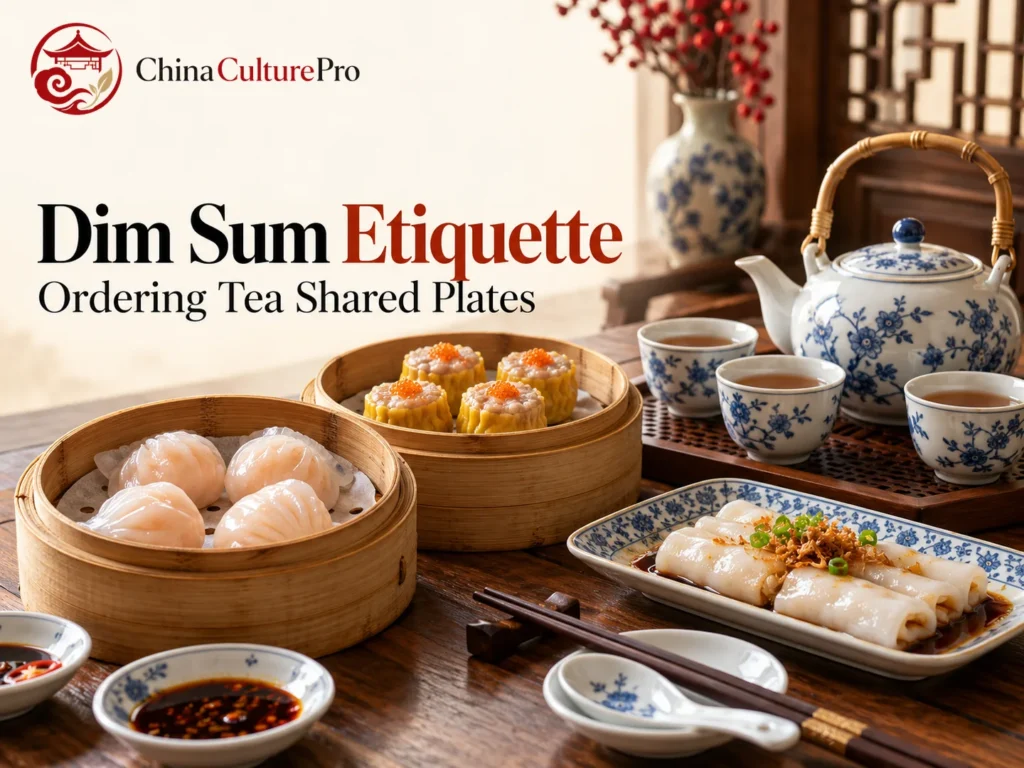

Quick Answer: What Matters Most in Dim Sum Etiquette?
Good dim sum(点心,diǎnxīn)etiquette is considerate participation: agree on tea and food, order manageable rounds, make shared dishes accessible, and communicate with the people around you.
- Ordering: Learn whether the restaurant uses trolleys, an order sheet or another menu system before selecting food.
- Tea: Offer to pour for others; a light finger tap can acknowledge someone who pours for you.
- Sharing: Use serving utensils where supplied, avoid moving dishes while someone is serving, and ask before taking the last piece.
Yum cha(饮茶,yǐnchá)names the tea-centered occasion. The yum cha and dim sum comparison explains the terminology; no special gesture is a substitute for ordinary courtesy.
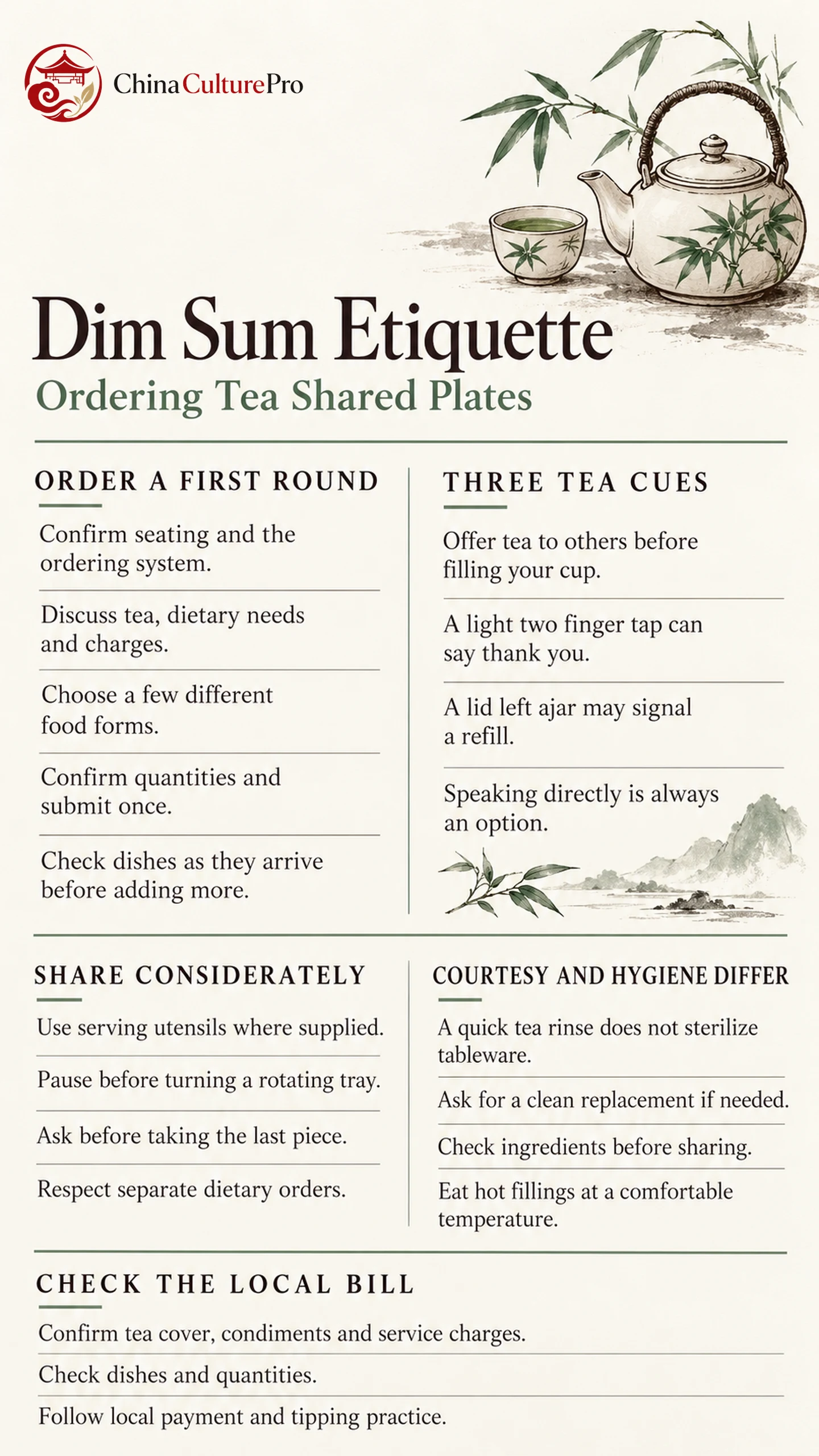
The teapot arrives, an order sheet lands on the table, and several people begin choosing baskets at once. A first visit is easier when you understand the service system and the shared space. This guide focuses on participation; the dim sum overview introduces the food and its Cantonese setting.
Settle In and Order a First Round
Use this sequence to organize an initial order, adapting it to the particular restaurant.
- Confirm the table and service system: Tell staff your party size and follow their seating arrangement. Ask whether dishes are selected from a trolley, ordered on paper, or submitted from a menu or screen. All these systems can serve the same meal tradition.[1]
- Discuss tea and dietary needs: Agree on a shared tea if the table wants one. Tell staff about allergies and dietary restrictions before food is ordered, and ask whether tea or other accompaniments carry a separate charge.
- Choose a small first round: Ask what others would like and compare different food forms. The dim sum dishes guide helps identify unfamiliar names. A short initial order makes portion sizes easier to judge.
- Confirm quantities and submit once: Check whether the number means pieces, baskets or plates. In a group, agree who will hand over or submit the order so the same selection is not accidentally ordered twice.
- Check the dishes as they arrive: Make room for shared plates, identify any special dietary order, and tell staff promptly about an incorrect or missing item. Add another round only after checking the table’s appetite.
At a trolley, ask the server what is available rather than lifting every lid or taking food without their attention. Where a card records dishes, keep it available for staff. The precise marking or payment system belongs to that restaurant; it is not a ritual every tea house must reproduce.
Tea-Table Cues: Pouring, Thanks and Refills
Three familiar gestures make sense once their practical purpose is clear. Their purpose is to help people share tea comfortably.
| Cue | What it communicates | How to use it considerately |
|---|---|---|
| Offer tea to others first | Hospitality and attention to nearby diners | Ask whether someone wants a refill, then pour carefully before filling your own cup. Do not keep topping up a cup someone has declined. |
| Finger kowtow(叩手礼,kòushǒu lǐ) | Thanks to the person pouring tea | Lightly tap your index and middle fingers on the table beside your cup. A spoken thank-you is also appropriate. |
| Leave the teapot lid slightly ajar | A request for more hot water in many tea houses | Place it securely rather than balancing it where it may fall. If staff do not notice or use another system, ask directly.[2] |
The courtesy can be explained without treating an imperial origin story as established history. You do not need to encode your marital status, age or rank with a special number of fingers. The useful meaning is gratitude. The Chinese tea culture guide provides broader context beyond this meal.
Share Plates Without Taking Over the Table
Leave food within reach of the group, take a reasonable share, and offer the last piece before helping yourself. Ask how the table wants to share rather than assuming equal division of every dish.
Use shared serving chopsticks, spoons or tongs when provided, then eat from your own plate. If a rotating tray is present, pause before turning it and check that no one is reaching, pouring or serving. Ask for a spoon or other utensil if a delicate piece is difficult to handle.[3]
A dish ordered for one person’s allergy, diet or preference can remain separate. Sharing is an invitation, not permission to ignore someone’s restrictions or place unwanted food on their plate. Likewise, a guest does not have to taste every ingredient to demonstrate respect.
Sweet and savory dishes can overlap during the meal. Let a very hot filling cool enough to eat comfortably, and do not force a large dumpling into one bite merely to imitate a rule. Let the table’s pace guide you.
Keep Customs Separate from Hygiene and Diet
Some diners rinse cups and utensils at the table. A quick rinse with tea or warm water should not be described as sterilization: effective cleaning and sanitizing involve appropriate methods and conditions. If tableware looks dirty or damaged, ask for a clean replacement rather than assuming a ritual rinse solves the problem.[4]
Tell the group which orders need to remain separate and ask staff about ingredients before sharing sauces or food. The Chinese vegetarian food guide helps distinguish a vegetable filling from a fully suitable dish. Courtesy cannot establish whether a wrapper, sauce, stock or pastry fat meets a dietary requirement.
You can also decline tea, request water, or ask staff for a simpler explanation. A preference is easier for others to accommodate when stated clearly, without implying that the entire table must make the same choice.
Read the Bill in Its Local Context
Tea cover(茶位,cháwèi)may appear as a per-person charge, and a menu can list additional condiments, snacks or service charges. Ask what is included before assuming the total is just the sum of the baskets. Such charges occur in Hong Kong dining, but their details vary by venue.[5]
Check recorded dishes and quantities, then follow the restaurant’s payment process. Tipping practices differ between Hong Kong, mainland China and overseas restaurants; use the local context rather than applying one country’s percentage everywhere. The Hong Kong food culture guide explains that city’s wider dining setting.
FAQs About Dim Sum Etiquette
Do I have to tap my fingers when tea is poured?
No. It is a recognizable gesture of thanks, not an obligation. A quiet spoken thank-you communicates the same courtesy.
Must I eat a dumpling in one bite?
No. Eat comfortably, use a spoon if useful, and let a hot filling cool. Size and temperature matter more than a blanket one-bite rule.
Is it rude to order a dish just for myself?
Not when you communicate with the table. A separate order may suit a dietary need, allergy or preference; simply make clear which dishes are shared.
Must desserts come last?
No. Sweet and savory small dishes can be eaten during the same meal. Follow the table’s appetite rather than imposing a formal dessert course.
Источники
[1] Hong Kong Tourism Board. Lin Heung Tea House
[2] Chinese University of Hong Kong. Online Cantonese: Tea Culture
[3] Bao Dim Sum House. A First Timer’s Guide to Dim Sum Etiquette
[4] Centre for Food Safety. Cleaning and Sanitisation
[5] Hong Kong Tourism Board. Traveller Essentials: Dining Charges