


Quick Answer: What Is Qingqiu?
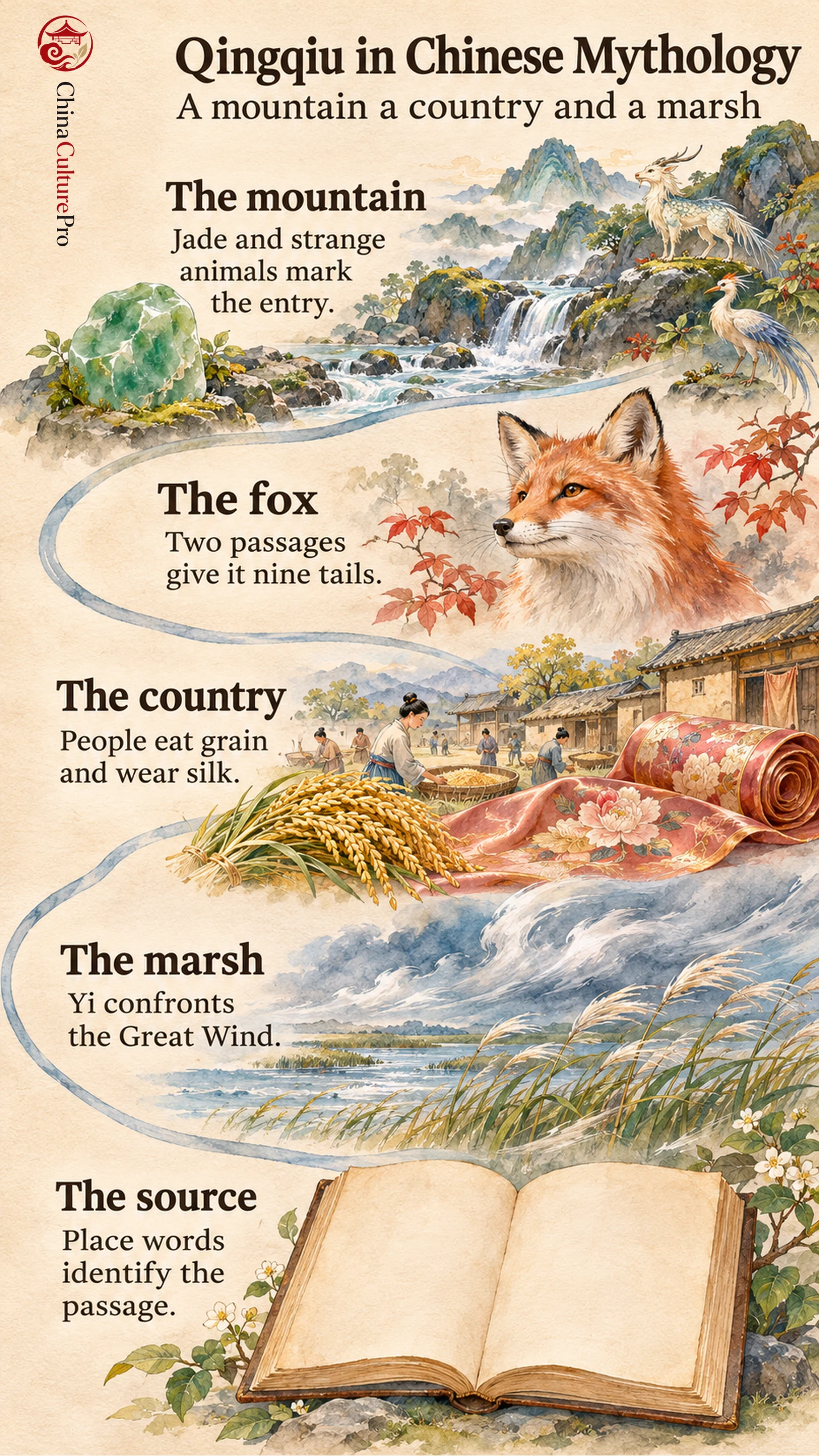
Qingqiu (青丘, Qīngqiū) is a place name in several Chinese mythological texts. The Classic of Mountains and Seas gives it to a mountain and a country, each associated with a nine-tailed fox. The Huainanzi also names a Qingqiu marsh in a story about the archer Yi.[1][2][3]
- Mountain: The southern entry describes jade, unusual animals and a river.
- Country: The eastern entry describes inhabitants who eat grain and wear silk.
- Marsh: Yi confronts Dafeng (大風, Dàfēng), the Great Wind, there.
The place word that accompanies Qingqiu, whether mountain, country or marsh, points to the passage.[1][2][3]
Qingqiu is often remembered as the home of a fox. Its old descriptions contain enough other details to tell which landscape a particular account means.
Mount Qingqiu in the Southern Mountains
The Southern Mountains chapter places Qingqiu east of Mount Ji and gives its sunny side jade and its shady side blue-green mineral pigment. In the same entry lives the nine-tailed fox, whose cry is compared with an infant’s. The animal is one feature in a catalogue of the mountain’s materials, creatures and waters.[1]
The entry also names a dove-like bird, Guanguan. A stream called Ying flows south to a marsh, and its water contains fishlike beings with human faces. These are distinctive clues to this version of Qingqiu. The chapter’s sequence of mountains allows the reader to place it relative to its neighbors within the text.[1]
The Country Beyond the Eastern Sea
The Beyond the Eastern Sea chapter organizes its entries by what lies north of the preceding place. It gives the name Qingqiu to a country north of the place associated with the water deity Tianwu. The inhabitants eat the five grains and wear silk. The passage also describes a fox with four feet and nine tails.[2]
Here the book gives a glimpse of a community as well as of an animal. The silk and grain belong to the description of the country. The infantlike cry belongs to the mountain entry. The familiar tail count links the two passages without making their accounts interchangeable.[1][2]
The Marsh Where Yi Stops the Great Wind
The Huainanzi tells of disasters in the age of Yao and lists places where the archer Yi stops various threats. It names the marsh of Qingqiu as the place where he confronts Dafeng, the Great Wind. The commentary explains that this being could damage houses.[3]
The marsh is the setting of one episode in Yi’s wider response to the disasters. Its identifying details are Yao’s commission, Yi and the threatening wind. The passage uses the place name for a different story from the ones that describe the fox.[1][2][3]
How to Recognize Which Qingqiu a Story Means
Check the noun before looking for a map. A mountain entry with jade and a southward river points to the Southern Mountains. A country with silk and grain points to the Beyond the Eastern Sea account. A marsh and a contest with the Great Wind point to the Huainanzi.[1][2][3]
Like mythic Kunlun, Qingqiu is best read in the geography of each account. Its relations to nearby places matter within that text. A familiar place name by itself gives too little evidence to locate the story on a modern map.[1][2][3]
FAQs About Qingqiu
Is Qingqiu a mountain or a country?
Both forms occur in the Classic of Mountains and Seas, in separate chapters. The Huainanzi also calls a place Qingqiu in its story of a marsh.[1][2][3]
Why is Qingqiu associated with the nine-tailed fox?
The Southern Mountains gives Qingqiu a foxlike creature with nine tails. The Beyond the Eastern Sea account also describes a nine-tailed fox in a country called Qingqiu.[1][2]
Can Qingqiu be placed on a modern map?
The texts supply relative directions and settings. Those descriptions identify passages, but do not provide enough information to establish one modern location for every Qingqiu account.[1][2][3]
Источники
[1] Chinese Wikisource. Classic of Mountains and Seas, Southern Mountains
[2] Chinese Wikisource. Classic of Mountains and Seas, Beyond the Eastern Sea
[3] Chinese Wikisource. Huainanzi, Basic Warp, volume eight