


Quick Answer: What Is the Nine-Tailed Fox?
Jiuwei hu (九尾狐, jiǔwěihú) is the nine-tailed fox in Chinese mythology. The Classic of Mountains and Seas describes it at Qingqiu (青丘, Qīngqiū). Other works read nine tails as an auspicious sign or use a fox spirit as a character in a story.[1][2][3]
- Early description: The fox at Mount Qingqiu has a voice like an infant’s cry.
- Auspicious sign: The Baihu Tong groups the nine-tailed fox with animals associated with virtuous government.
- Fiction: In Investiture of the Gods, a fox spirit takes the place of Daji (妲己, Dájǐ).
The tails identify a motif. The surrounding passage tells you whether it signals danger, good rule or a character’s supernatural nature.[1][2][3]
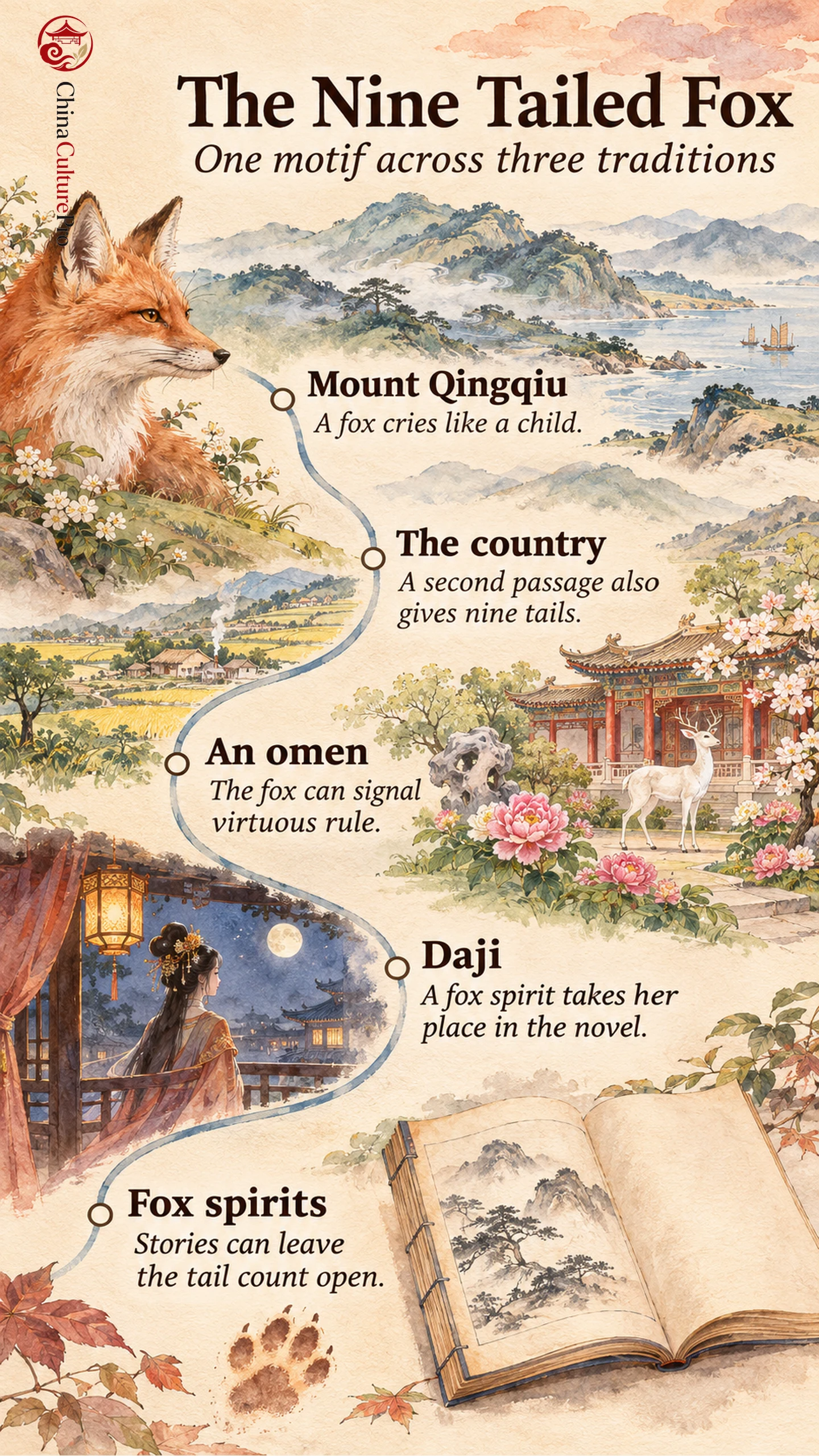
A nine-tailed fox can be a dangerous mountain animal, an omen or a character at court. The tail count carries across stories more easily than the fox’s role.
The Nine-Tailed Fox on Mount Qingqiu
In the Southern Mountains chapter, the creature appears in the entry for Mount Qingqiu. It resembles a fox and has nine tails. Its cry sounds like a child’s, and the text says it can prey on people. The same account gives it a paradoxical property: it credits eating the creature with protection against gu, a form of harmful influence in traditional belief.[1]
The Regions Beyond the Eastern Sea chapter has a shorter description of a fox in the country of Qingqiu. It gives the creature four feet and nine tails. The tail count links the descriptions, but the setting is presented differently. Only the southern mountain account gives the cry and the claim about gu.[1][4]
The Fox as a Sign of Good Rule
In the Baihu Tong discussion of royal rites, unusual animals appear when a ruler’s virtue reaches the animal world. The nine-tailed fox is listed with other signs such as the arrival of the qilin and the appearance of a white deer. The animal’s rare appearance serves as a sign of order and favorable rule.[2]
The text does not need a long story about the fox. Here the significant event is its appearance among a group of portents. The other auspicious animals in the list make the fox’s role as an omen clear.[1][2]
Daji and the Fox in Investiture of the Gods
Investiture of the Gods makes a fox spirit part of the story of the last Shang king. The young woman Daji is being taken to the capital when her party stops at Enzhou. At the lodging the spirit overtakes her, assumes her form and continues toward the court. That impersonation is a plot event within the novel’s fictional account of the Shang court.[3]
The novel uses a supernatural impersonation to explain what follows at court. In the mountain entry, by contrast, the animal is described in its own habitat. The two scenes are easy to distinguish if you start with the setting, even when later pictures or retellings share the same many-tailed silhouette.[1][3]
Nine-Tailed Foxes and Fox Spirits
The expression huli jing generally refers to a fox spirit. Jiuwei hu calls attention to the nine tails. These terms can overlap in stories about a many-tailed fox with supernatural powers. A source that names a fox spirit can also leave the number of tails unstated. Conversely, the Qingqiu passage gives a number without describing a human disguise.[1][3][4]
FAQs About the Nine-Tailed Fox
Is the nine-tailed fox always evil?
Its role changes by source. The Southern Mountains entry describes a dangerous creature. The Baihu Tong names a nine-tailed fox among auspicious signs of virtuous rule.[1][2]
What do the nine tails mean?
Nine tails identify the creature in the Qingqiu accounts. In the Baihu Tong, that unusual trait forms part of a system of royal portents.[2][4]
Where does the nine-tailed fox live?
The Classic of Mountains and Seas connects it with Qingqiu, giving both a mountain entry and an account of a country bearing that name.[1][4]
Источники
[1] Chinese Wikisource. Classic of Mountains and Seas, Southern Mountains
[2] Shidian Classics. Baihu Tong with Subcommentary, volume six
[3] Shidian Classics. Investiture of the Gods, chapter four
[4] Shidian Classics. Imperial Collection of Books, extracts from the Classic of Mountains and Seas