


Quick Answer: What Is Chilong?
Chilong (螭龙, Chīlóng) is a dragon-like creature often described as hornless in Chinese art and myth. An early dictionary records hornlessness as one description. Museum catalogs also use the name chi for carvings that vary in appearance.[1][2][4]
- Jade: On a Han jade pendant, chi motifs frame the central opening.[3]
- Stone: A chi design can crown an inscribed stele.[5]
- Identification: Look at how the creature fits the object and read the catalog alongside it.[3][4][5]
Start at the head, then follow the body around the edge or across the surface.
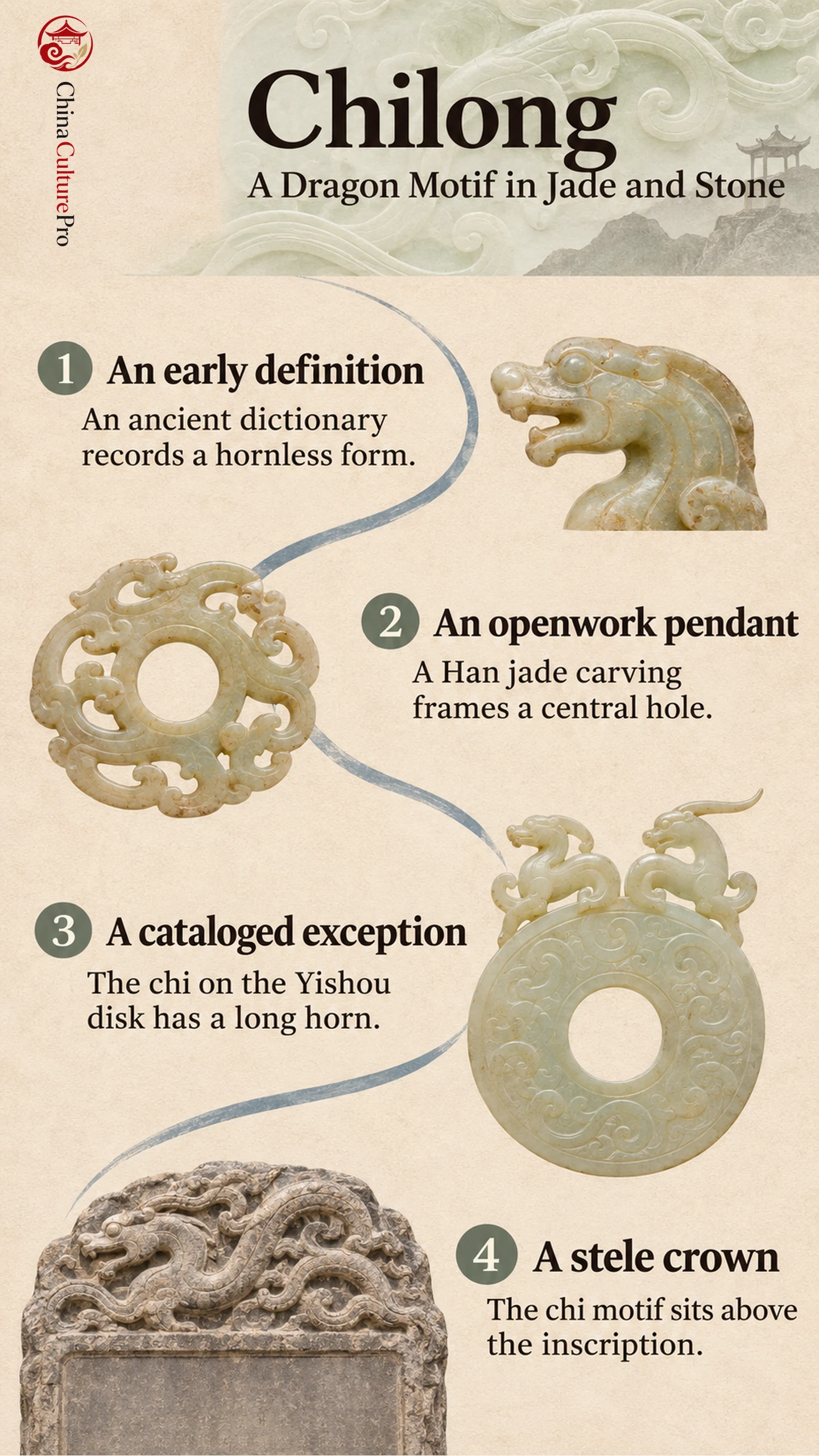
Look through the cutouts in the Han pendant and the spaces help trace the dragon’s shape. On a tall stone monument, the carving is read from below, as part of the crown above the inscription.[3][5]
What the Early Dictionary Says
The Shuowen Jiezi (说文解字, Shuōwén Jiězì) describes chi as yellow and dragon-like, then gives hornlessness as an alternative description. In the “River Lord” poem of the Songs of Chu, chi appear with dragons drawing the river deity’s conveyance. The poem also places chi in a watery setting in Chinese mythology.[1][2]
Two Ways to See the Motif in Han Jade
The Palace Museum catalogs a green Han jade pendant whose shape developed from an archer’s thumb ring. Openwork chi motifs surround the hole. Start at the opening and follow the carved body along its edge. The gaps cut through the stone help define the creature’s outline, an effect often seen in Chinese jade carving.[3]
On the museum’s Han jade bi disk (璧, bì) with the inscription Yishou, a wish for longevity, two creatures flank the characters above the disk. The catalog calls one a dragon and the other a chi. It describes the chi as turning its head back and having a long horn. Here the cataloged name is more informative than a rule based on horns alone.[4]
From Jade to the Crown of a Stele
The term chishou (螭首, chīshǒu) identifies a stele crown decorated with chi. The Beijing Stone Carving Art Museum records one on an imperial road stele erected in 1731. The same monument has a turtle-shaped support under the inscription. Trace the monument from the carved crown to the inscription and then to the turtle below. Each animal belongs to a different part of the Chinese stone carving.[5]
FAQs About Chilong
Do Chilong carvings always lack horns?
Hornlessness is a familiar description in early dictionaries. The Palace Museum also catalogs a Han jade figure with a long horn as a chi.[1][2][4]
What is the difference between Chilong and Chiwen?
Chilong is the name for the dragon-like creature or motif. In Yang Shen’s account, Chiwen (螭吻, Chīwěn) names a creature associated with beast-head ornaments on roofs.[2][6]
Источники
[1] Xu Shen, Shuowen Jiezi. Entry for Chi
[2] Taiwan Ministry of Education. Chi Dictionary Entry
[3] Palace Museum. Jade Thumb-Ring-Shaped Pendant With Chi Pattern
[4] Palace Museum. Jade Bi Disk With Yishou Inscription
[5] Beijing Stone Carving Art Museum. Collection Highlights
[6] Yang Shen, Sheng’an ji, vol. 81. Account of the Dragon’s Nine Sons