

Quick Answer: Who Was Princess Pingyang?
Princess Pingyang (平阳公主, Píngyáng Gōngzhǔ; died 623) was a military leader involved in the founding of the Tang dynasty. She was a daughter of Li Yuan (李渊, Lǐ Yuān), later Emperor Gaozu (唐高祖, Táng Gāozǔ), and organized forces supporting his rebellion against Sui rule.[1]
- Campaign: Her forces helped the Li family gain control of the capital region.
- Command: The histories describe recruitment, allied leaders and a headquarters distinct from her husband’s.
- Commemoration: Her funeral included military honors recognizing her founding contribution.[1][2]
She belongs to the early seventh century. The familiar title should not be confused with that of a Han-dynasty princess who lived many centuries earlier.[5]
Princess Pingyang’s place in history rests on military organization as well as royal birth. Her biography describes how resources, alliances and discipline built a fighting force, while the debate over her funeral reveals how the new court recognized an exceptional woman’s service.
Family and the Sui–Tang Transition
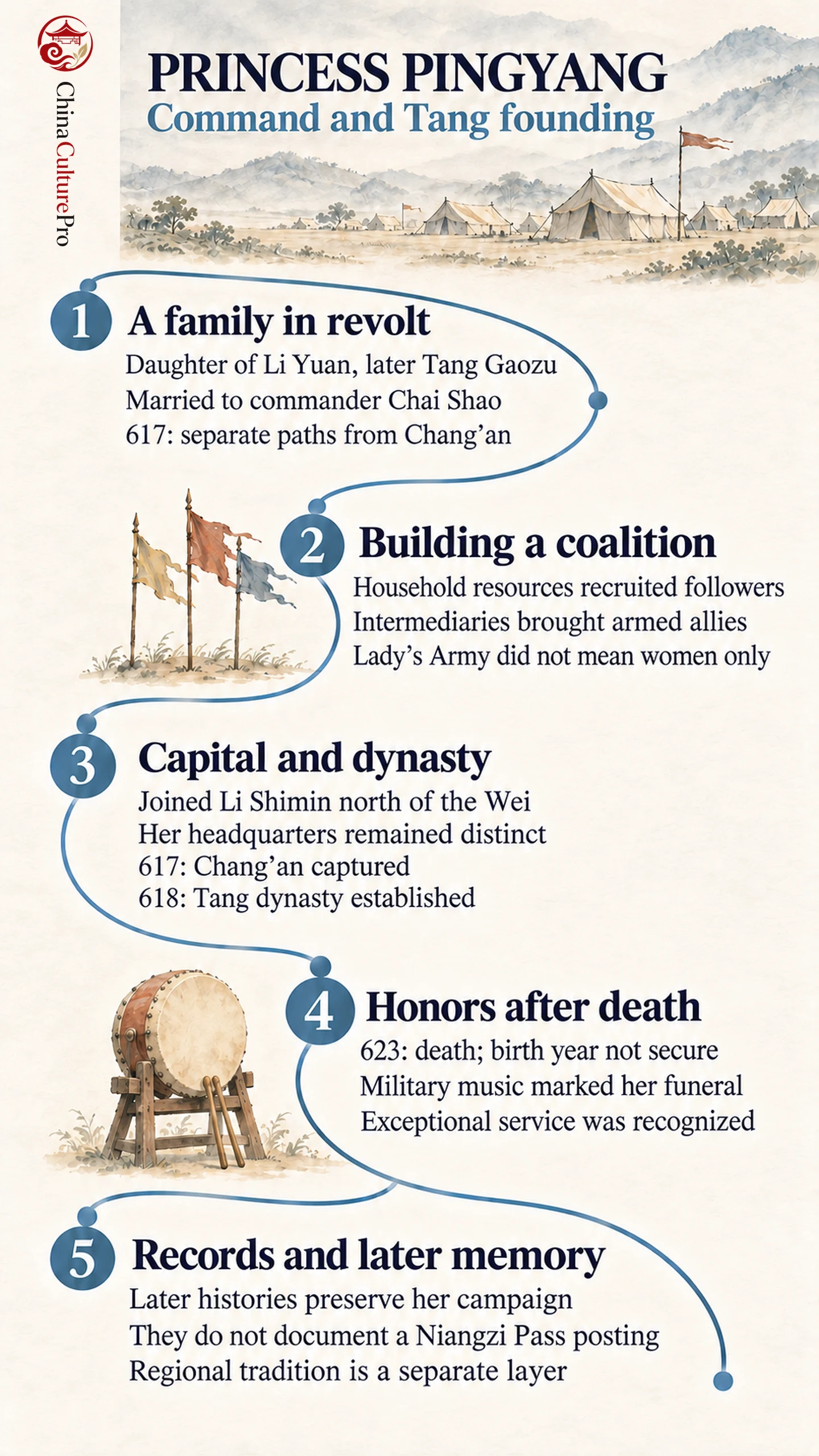
The Tang princess was married to Chai Shao (柴绍, Chái Shào), who also became an important commander. The couple were in Chang’an (长安, Cháng’ān) when Li Yuan prepared his revolt in 617. Their connection to his household created opportunities, but also exposed them to danger in the capital of the Sui dynasty.[1][6]
The histories describe the couple separating: Chai Shao went to join her father, while she developed support near the capital. Their separate activity gave her a role in mobilization before their forces joined the same campaign.[1][2]
The older Han princess with the same title was the sister of Emperor Wu (汉武帝, Hàn Wǔ Dì). The Tang commander belonged to the Li family, whereas the Han court belonged to the Liu family. Dynasty and family relationships are the clearest way to distinguish them.[1][5]
How She Assembled a Military Coalition
She returned to a family estate in Hu County (鄠县, Hù Xiàn) and used household property to recruit followers. This placed resources at the service of military mobilization. The account then describes expansion through negotiations with existing armed groups, rather than the creation of a uniform force in a single moment.[1]
Her household servant Ma Sanbao (马三宝, Mǎ Sānbǎo) acted as an intermediary with the armed leader He Panren (何潘仁, Hé Pānrén). Other leaders joined with their followers. The coalition took places including Zhouzhi and Wugong and resisted forces sent from the capital.[1][2]
Discipline is central to the biography’s explanation of her success. It says she prohibited plundering and attracted further support. That is a specific claim about the organization of her forces; it does not establish that every encounter was peaceful or that all inhabitants welcomed conquest.[1]
The force became known as Niangzi Jun (娘子军, Niángzǐ Jūn), often translated as the Lady’s Army. The name identifies its woman commander, not an exclusively female membership. The recruitment narrative includes male allied leaders and their troops.[1][2]
Both histories report a force of 70,000. This is the transmitted figure, not a surviving muster roll that can be independently checked. The important point is the substantial coalition attributed to her command, with several leaders contributing manpower.[1][2]
The Campaign for Chang’an and Tang Founding
When Li Yuan’s main army approached, Princess Pingyang brought a field force to join Li Shimin (李世民, Lǐ Shìmín) north of the Wei River. He later ruled as Emperor Taizong; he was not yet emperor during this campaign.[1]
She and Chai Shao maintained separate headquarters while participating in the operation against Chang’an. Her command operated within a larger dynastic coalition, with its own organization contributing to the shared attack.[1][2]
The seizure of Chang’an in 617 and Li Yuan’s establishment of the Tang dynasty in 618 are related but distinct events. After the capital’s capture, the biography records her title and rewards for military merit. Those honors acknowledged the military service she had already performed.[1][6]
Death in 623 and Military Funeral Honors
She died in 623. The accounts examined here do not establish a secure birth year or explain her cause of death. Her recorded death should be distinguished from later attempts to explain its circumstances.[1][2]
Her father ordered an elaborate funeral that included guchui (鼓吹, gǔchuī), military processional music using wind instruments and drums. Ritual officials objected that such honors were not customary for a woman. The transmitted reply defended the music by pointing to her personal role in raising and commanding troops.[1][2]
She also received the posthumous designation Zhao (昭, Zhāo), associated in the account with illustrious virtue and service. It forms part of the fuller title Princess Pingyang Zhao. This was commemorative recognition after death, not an imperial reign name.[1]
The exchange recognizes her achievement while presenting her as an exception to ordinary expectations of women. The court also linked her merit to the legitimacy of the founding imperial family. These two purposes can coexist: honoring her independent agency did not amount to granting equal military opportunities to all women.[3]
Historical Sources and the Niangzi Pass Tradition
The Old Book of Tang (旧唐书, Jiù Tángshū) places her account beside Chai Shao’s biography. The New Book of Tang (新唐书, Xīn Tángshū) includes her among imperial princesses. Compiled in the tenth and eleventh centuries respectively, they transmit earlier material through later editorial selection.[1][2]
Their agreement preserves the core story of recruitment, coalition warfare and funeral honors. It should not be counted as two wholly independent confirmations of every detail. The surviving narrative gives more space to the founding campaign and ceremonial recognition than to her intervening years.[1][2]
Niangzi Pass (娘子关, Niángzǐ Guān), in Shanxi, is closely associated with her in later regional memory. The familiar story says her troops guarded it and gave it their name. That connection is debated; the standard biographies discussed here do not provide a documented posting at the pass.[1][2][4]
Keeping historical accounts and later legend distinct preserves both kinds of significance. Her recorded role in assembling an army stands on its own, while the pass tradition shows how later communities attached her reputation to a landscape.[1][4]
FAQs About Princess Pingyang
Was the Lady’s Army made up only of women?
No. The recorded coalition included male leaders and their followers. “Lady’s Army” refers to the commander, rather than proving that all its soldiers were women.[1][2]
Was Princess Pingyang an empress?
No. She was an imperial daughter and military commander. Her father founded the Tang as emperor; she did not rule the empire as sovereign.[1]
How old was Princess Pingyang when she died?
Her death is recorded in 623, but a reliable birth year is not established in the accounts used here. A precise age cannot be given securely.[1][2]
Источники
[1] Liu Xu and other compilers. Old Book of Tang, Chapter 58: Chai Shao and Princess Pingyang
[2] Ouyang Xiu, Song Qi and other compilers. New Book of Tang, Chapter 83: Imperial Princesses
[3] Shoufu Yin, Journal of Chinese History. Rewarding Female Commanders in Medieval China: Official Documents, Rhetorical Strategies, and Gender Order
[4] Lu Bo, Beijing Evening News. Did Princess Pingyang Really Defend Niangzi Pass?
[5] Sima Qian. Records of the Grand Historian, Chapter 49: Imperial Relatives
[6] Liu Xu and other compilers. Old Book of Tang, Chapter 1: Emperor Gaozu