

Quick Answer: Who Was Zhang Qian?
Zhang Qian (张骞, Zhāng Qiān) was an envoy of the Western Han (西汉, Xī Hàn) court under Emperor Wu (汉武帝, Hàn Wǔdì). His missions expanded the court’s knowledge of Central Asia and its diplomatic connections with the Western Regions (西域, Xīyù), a changing geographical label for lands west of the Han heartland. His birth year is unknown; he died in 114 BCE.[1][3]
- First mission: He sought a military alliance and endured prolonged captivity.
- Second mission: A larger delegation established contacts through several deputy envoys.
- Legacy: His journeys strengthened exchanges across networks that already existed.[1][6]
His personal travels, information gathered from others and later stories about him should be distinguished.
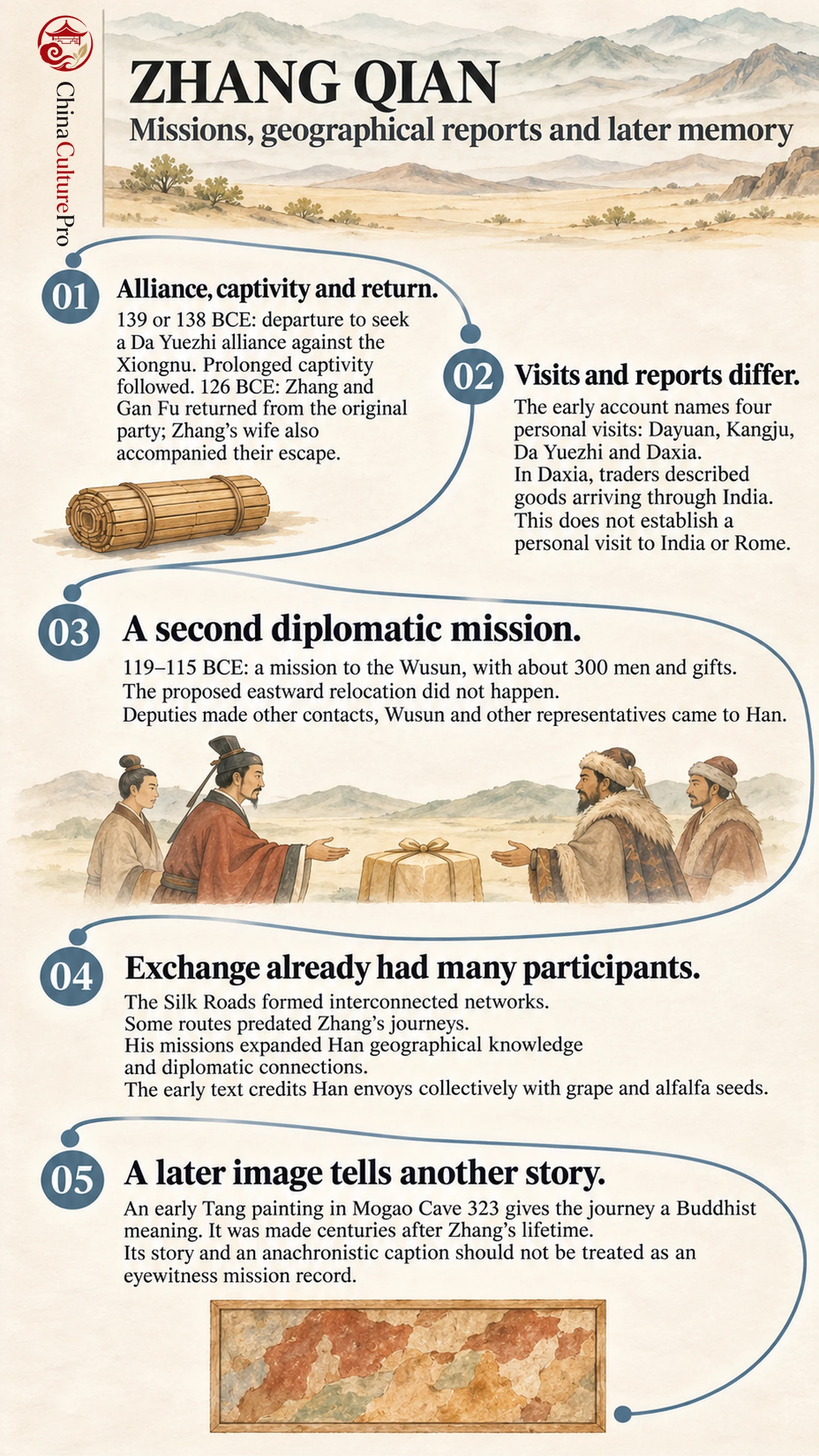
Zhang Qian’s journeys changed what the Han court knew about Central Asia. Their significance lies in the diplomatic connections and geographical reports they produced, rather than a single traveler creating an entire trade route. The surviving accounts also distinguish observation from information gathered elsewhere.
The First Mission: An Alliance That Did Not Happen
The original goal was an alliance with the Da Yuezhi (大月氏, Dà Yuèzhī) against the Xiongnu (匈奴, Xiōngnú). Modern chronologies differ by a year, placing his departure in 139 or 138 BCE. He was captured while crossing Xiongnu-controlled territory and detained for more than ten years. During that period he married and had a child, while retaining his identity as a Han envoy.[1][4][5]
Gan Fu (甘父, Gān Fù), an enslaved archer associated with the Tangyi (堂邑, Tángyì) household, accompanied him. Hunting helped sustain the party. After escaping, Zhang reached the Da Yuezhi, but they had settled in new territory and did not want to renew war against their former enemies. The proposed alliance therefore failed.[1][2]
He was captured again on the return journey, then escaped after further detention. He returned in 126 BCE. The Shiji (史记, Shǐjì), or Records of the Grand Historian, describes an absence of thirteen years and says that only Zhang and Gan Fu returned from the original party of more than one hundred. It also records that Zhang’s wife accompanied their escape. The later Hanshu (汉书, Hànshū), or Book of Han, preserves a parallel account; its overlap with the earlier history should not be counted as a second independent eyewitness.[1][2][5]
Where Did Zhang Qian Actually Travel?
The early account explicitly separates four places he visited from several others known through reports. Ancient political territories should not be treated as exact equivalents of modern countries.[1]
| Place named in the account | What it contributes to the journey |
|---|---|
| Dayuan (大宛, Dàyuān) | The Ferghana region; its ruler helped him obtain onward guidance. |
| Kangju (康居, Kāngjū) | An intermediary in his journey toward the Da Yuezhi. |
| Da Yuezhi | The intended alliance partner, which declined the proposed war. |
| Daxia (大夏, Dàxià) | Bactria, where he observed markets and encountered goods from the Han southwest. |
In Daxia, Zhang saw bamboo staffs and cloth from the Sichuan (四川, Sìchuān) region. Local traders said they had obtained them through India. Zhang used that report to propose looking for a southwestern connection. The episode reveals trade operating before his diplomatic mission, but it does not establish that he personally traveled to India.[1][2]
The Second Mission and a Wider Diplomatic Network
The second major mission, conventionally dated 119–115 BCE, focused on the Wusun (乌孙, Wūsūn). Zhang proposed drawing them into closer relations with Han and encouraging an eastward return to former territory. He led roughly three hundred men, with gifts and deputies available for further missions.[1][5]
Internal divisions, distance from Han and longstanding relations with the Xiongnu prevented the Wusun ruler from accepting the relocation plan. Zhang nevertheless sent deputies to other polities. Wusun representatives accompanied him back, and other envoys subsequently arrived through the contacts his deputies had made.[1]
Although the Wusun did not relocate, the mission extended diplomatic communication. Zhang died after his return; the missions continued through other people.[1][3]
What Opening the Silk Roads Really Means
The Silk Roads were interconnected routes, not a single highway built by one explorer. Some stretches had been used long before Zhang’s lifetime. His missions gave the Han court more detailed geographical reports and additional diplomatic contacts. Repeated embassies, merchants, local guides and intermediaries sustained the exchanges.[1][6]
The Shiji later credits Han envoys collectively with bringing grape and alfalfa seeds. That passage supports exchange through successive missions, rather than a claim that Zhang personally introduced every product later associated with the routes.[1]
The Dunhuang Image: Later Memory, Not an Eyewitness Record
An early Tang dynasty (唐朝, Táng Cháo) painting in Cave 323 at the Mogao Caves (莫高窟, Mògāo Kū) turns Zhang’s journey into a search for the identity of sacred golden images. It was created centuries after his lifetime. One caption names an emperor from a later generation, exposing a chronological mismatch. This is evidence of Buddhist reinterpretation, not a contemporary record of his original commission.[5]
Интерпретация Dunhuang murals as religious storytelling preserves their value without turning every scene into a travel report. Comparing such images with the earlier written accounts helps separate historical evidence and later legend.
FAQs About Zhang Qian
Did Zhang Qian visit Rome?
No surviving account places him in Rome. His personal travels were in Central Asia; information about more distant lands could reach him through intermediaries.[1]
Did Zhang Qian travel to India?
The early account describes what Bactrian traders told him about India. Reporting that information is different from visiting the country himself.[1][2]
Did he personally bring grapes to China?
That precise personal claim is not established by the cited passage. The Shiji attributes the arrival of grape and alfalfa seeds to Han envoys collectively.[1]
Did only two people return from his first mission?
Two members of the original delegation returned: Zhang and Gan Fu. The narrative also includes Zhang’s wife in their escape, so two is not the total number of returning people.[1][2]
Источники
[1] Sima Qian, Records of the Grand Historian, chapter 123. Account of Dayuan
[2] Book of Han, chapter 61. Biographies of Zhang Qian and Li Guangli
[3] Shaanxi Normal University historical culture database. Zhang Qian
[4] Palace Museum. Zhang Qian
[5] Dunhuang Academy. Zhang Qian’s Mission to the Western Regions: Pictorial Memory
[6] UNESCO World Heritage Centre. Silk Roads: The Routes Network of Chang’an–Tianshan Corridor