


Quick Answer: What Is Poem of Fragrance?
Poem of Fragrance (秾芳诗帖, Nóngfāng Shītiè) is a silk handscroll by Zhao Ji (赵佶, Zhào Jí), known as Emperor Huizong (宋徽宗, Sòng Huīzōng) of the Northern Song. It transcribes an eight-line poem in regular script (楷书, kǎishū), using his distinctive Slender Gold (瘦金体, shòujīntǐ) style. Held by the National Palace Museum, Taipei, the main section measures 27.2 × 263.8 cm. Its unusually large characters reveal fine ink lines, pointed strokes and strongly marked endings.[1][2]
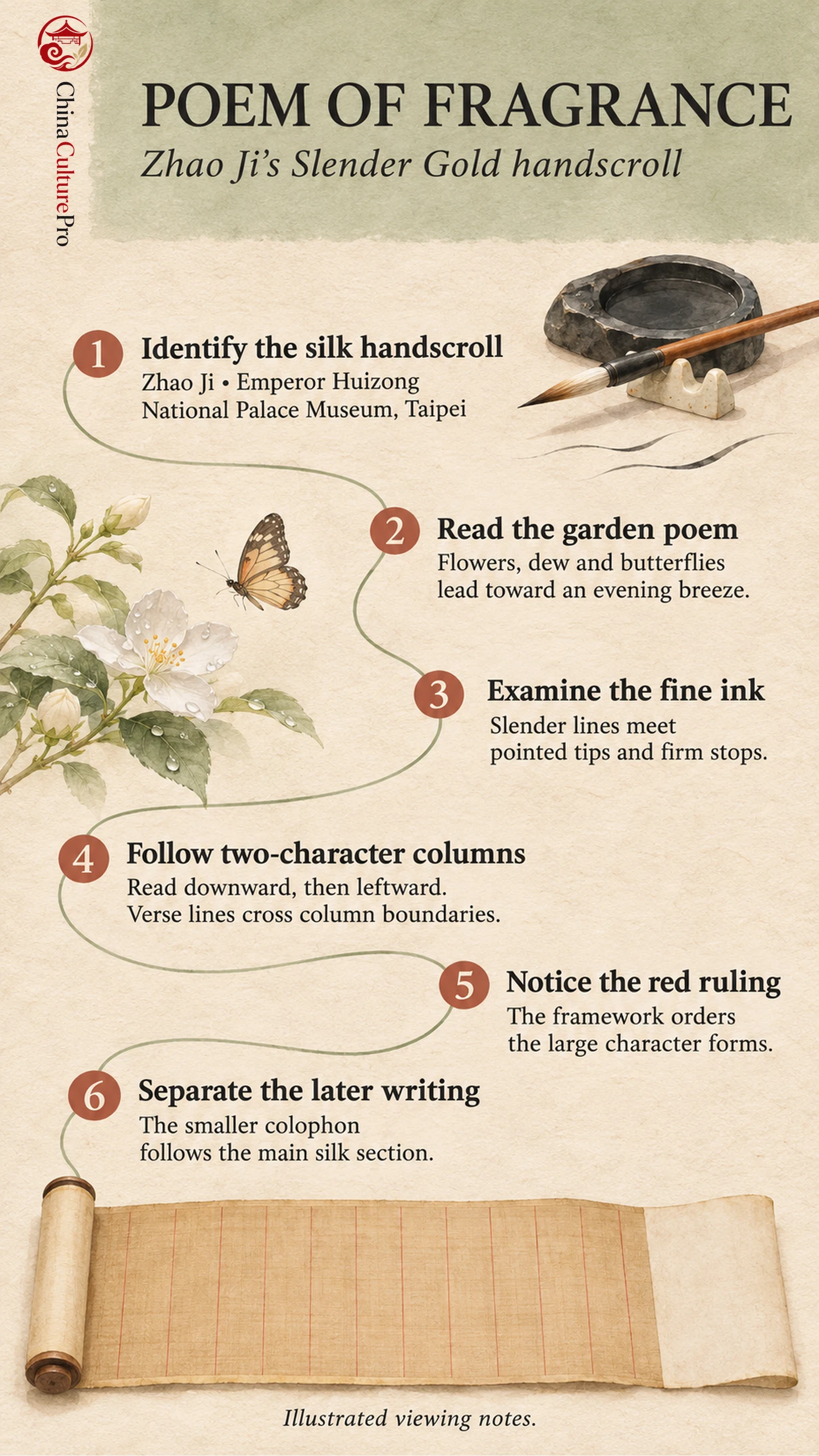
Thin strokes can look fragile until you examine their ends. In this scroll, sharp tips and emphatic stops make the writing feel taut and deliberate. Read the poem’s flower imagery alongside those marks: one supplies a fragrant garden, while the other makes every movement of the brush visible.
The Taipei Handscroll at a Glance
| Поле | Identification |
|---|---|
| Museum title | Poem; also known as Poem of Fragrance |
| Calligrapher | Zhao Ji, Emperor Huizong |
| Период | Northern Song; exact creation year unspecified |
| Medium and format | Ink on silk; handscroll |
| Main section | 27.2 cm high × 263.8 cm long |
| Collection | National Palace Museum, Taipei |
| Object number | 中書000001N000000000 |
The main silk section is distinct from the mounting and the later paper colophon.[1] A handscroll’s format encourages close examination of successive passages rather than viewing the entire length at once. For the artist’s wider historical setting, see Song Huizong’s life and legacy.
The Poem Moves from Brilliant Flowers to an Evening Breeze
The verse has eight lines of five characters each. The following gives its four couplets and a plain English sense, without trying to reproduce the original rhyme.[1]
| Original couplet | Plain English sense |
|---|---|
| 穠芳依翠萼,煥爛一庭中。 | Rich blossoms rest against green calyxes, glowing throughout the courtyard. |
| 零露霑如醉,殘霞照似融。 | Scattered dew wets them as if they were drunk; the lingering sunset makes them seem to melt. |
| 丹青難下筆,造化獨留功。 | A painter can hardly set brush to them; nature alone deserves the credit. |
| 舞蝶迷香徑,翩翩逐晚風。 | Dancing butterflies lose themselves along the fragrant path, fluttering after the evening breeze. |
The opening is full of color and substance: flowers, green calyxes and a courtyard filled with brightness. Dew then changes their appearance, while the fading glow makes their forms seem less solid. The flowers are not described as a botanical specimen; the language keeps shifting their sensory effect.
The third couplet turns from the garden to art. Its praise of nature also imagines a painter hesitating before something difficult to capture. In the last couplet, butterflies carry the poem away from a fixed arrangement of blossoms toward movement, fragrance and air. The progression matters as much as any individual flower. The guide to Chinese poetry forms places this regulated verse within a broader literary tradition.
Slender Gold Is Fine Ink with Forceful Endings
The name describes a style of brushwork, not golden lettering. Its thin, sharp strokes make changes of pressure especially conspicuous. A horizontal can travel lightly across the silk, then finish with a firmer, angled stop. Turns and hooks likewise display deliberate changes of direction.[2]
Look at the difference between a stroke’s middle and its termination. An extended line may remain narrow for much of its length, but its last movement gives it weight. In a complex character, several such endings point into the surrounding space. The result can seem energetic even though the characters remain separately structured.
That distinction is useful: regular script describes the underlying character organization, while Slender Gold identifies the particular manner of execution. Quick, lively brush gestures do not by themselves turn the work into cursive. The wider guide to Chinese calligraphy styles explains these script categories.
The scale also matters. These are the largest characters among Huizong’s surviving calligraphic works, making their force more conspicuous than in his smaller writing.[2] At this size, the uninked spaces inside a character become prominent shapes of their own.
Two-Character Columns Shape the Reading Rhythm
The poem is arranged in columns of two large characters. Read each column from top to bottom and move from the right toward the left. That visual unit differs from a poetic line of five characters: a complete verse line continues across column boundaries.[1]
In the opening, for example, the first two columns give 穠芳 and 依翠. The next character, 萼, completes the first five-character line. Following the transcription helps you hear the verse while still noticing how the calligraphy groups it on silk.
Faint red ruling provides an ordered framework for the large forms.[3] Compare that framework with the diagonal strokes: the writing can reach emphatically outward while each character still occupies its own place. A guide to reading Chinese calligraphy offers a broader method for separating text, script and composition.
The Hall Inscription and Later Colophon Are Separate
The ending names Xuanhe Hall (宣和殿, Xuānhé Diàn), and an imperial-calligraphy seal accompanies it. Farther along the assembled scroll is a later appreciation by Chen Bangyan, who likened its brush movement to orchids and slender bamboo.[1][3] These additions belong to different moments of the object’s history.
The botanical comparison makes an interesting companion to the poem: the verse describes flowers, while the later viewer sees plant-like movement in the written strokes themselves. That relationship is explored more broadly in Chinese calligraphy and painting.
How to Read the Poem and Examine Its Brushwork
- Start with the text: Read one couplet in the transcription and locate its characters in the scroll.
- Follow the columns: Move downward within a column, then leftward, allowing a verse line to cross column boundaries.
- Compare stroke endings: Choose a long horizontal and a diagonal, noticing where thin movement becomes a pointed or emphatic finish.
- Separate the later writing: Distinguish the large poem characters from the smaller appreciation added after the main section.
FAQs About Poem of Fragrance by Zhao Ji
Was the poem written with gold?
No. It is ink on silk. “Slender Gold” names its distinctive calligraphic style.[1][2]
What kind of flowers does the poem describe?
The text describes rich blossoms and green calyxes without naming a flower species. Identifying them specifically as plum, peony or another flower goes beyond the wording.
Does Xuanhe Hall give an exact creation date?
No. The recorded ending names a hall, but it supplies no year. It should not be converted into an exact date merely because Xuanhe was also a reign-era name.[1]
Источники
[1] National Palace Museum, Taipei. Emperor Huizong: Poem, Collection Record and Transcription
[2] National Palace Museum, Taipei. Poem: Selected Artwork Commentary
[3] National Palace Museum, Taipei. The Making of a National Treasure: Poem, Huizong