

Quick Answer: How Do You Read Chinese Calligraphy?
To read Chinese calligraphy, identify the object and its format, find the main text and direction, and compare several characters for recurring shapes and connections. Then look at ink and spacing. A label, transcription or translation can help you check what you saw. [1][2][3][5]
- Orientation: A handscroll, a rubbing and a folding fan give the eye different starting points. [2][3][4]
- Brushwork: Changes in width, ink density and spacing can be visible even before you recognize any words. [1][2]
- Context: Dates, seals and attached writing can come from different stages in an object’s history. [5][6][7]
Visual reading and literal reading answer different questions. The same work can reward both. [1][2]
When you encounter an unfamiliar work of Chinese calligraphy, you can begin with a few features you can see directly. Use a full image to orient yourself before zooming in. A close crop can make the brush marks clear while hiding the beginning of the text.
How to Read a Work of Chinese Calligraphy
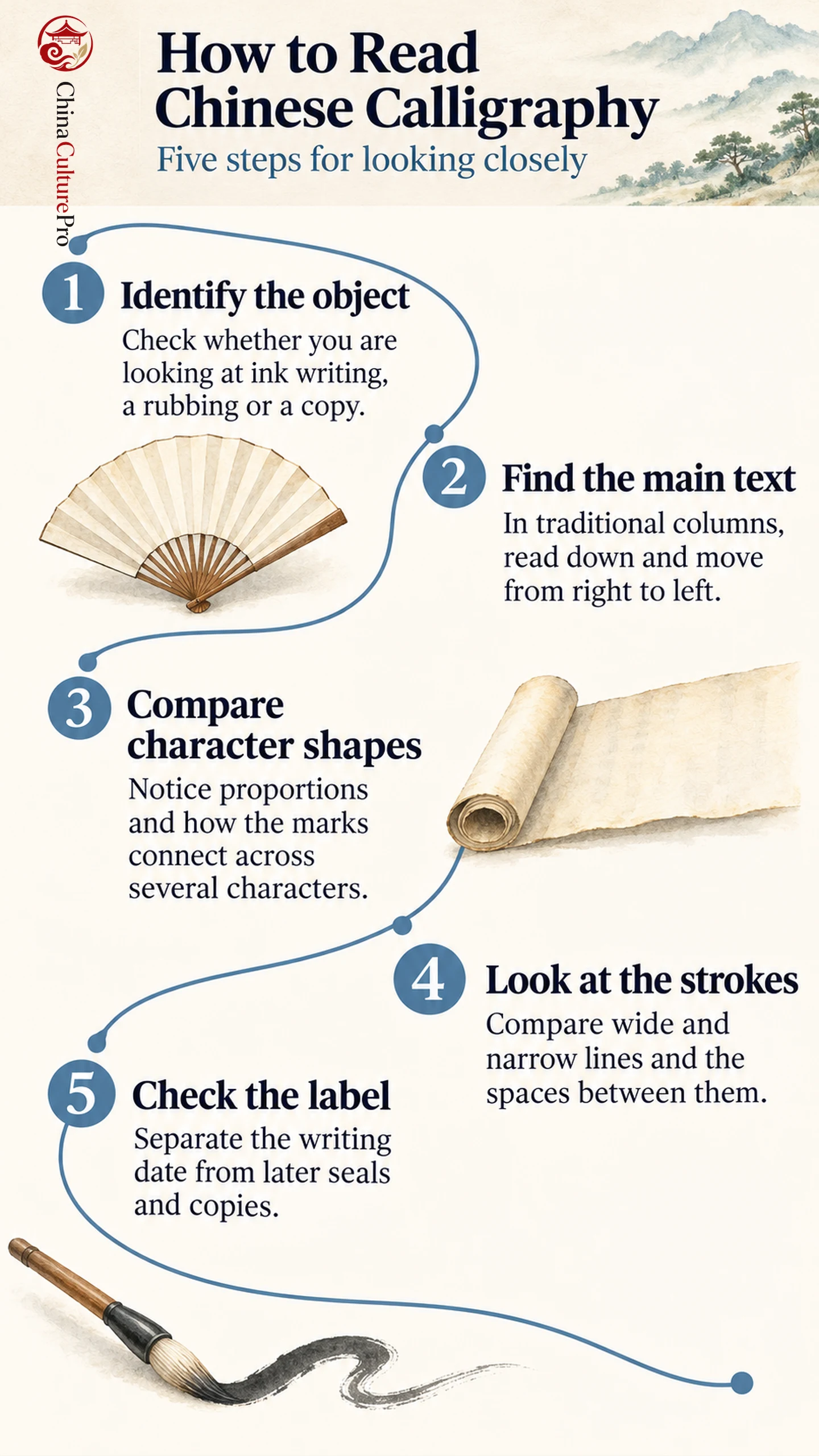
1. Identify the Object and Its Format
Check whether the object is ink writing, a rubbing or another kind of copy. Identify its format before assuming how it was meant to be seen. [2][3][4][7]
Wen Zhengming wrote Lu Ji’s Essay on Literature in ink on a paper handscroll. Zhu Yunming’s Winter Journey in the North is a folding fan mounted as an album leaf. The fan widens toward the outer edge. Compare its curved writing surface with the long rectangular field of the handscroll. In Chinese scroll formats, the mount also separates the main image or text from other attached areas. [3][4]
2. Find the Main Text and Reading Direction
Locate the main text before reading a title or a later note. In a traditional vertical layout, start at the top of the rightmost column and move down, then continue with the next column to the left. [1][3]
This is a guide to a common layout. Wen’s handscroll can be viewed from right to left, with a passage coming into view at a time. On Zhu’s fan, the characters are packed closely and columns are less clearly divided. In a digital viewer, zoom out before guessing the reading order from a single cluster. [3][4]
3. Compare Several Character Shapes
Compare multiple characters for proportion, visible components and joins. Repeated structures carry more weight than a single long stroke or unusually shaped character. [1][2]
In Wen’s small regular script (楷书, kǎishū), individual strokes fit into a closely organized space. Yan’s running script (行书, xíngshū) can show more fluid movement. The cursive script (草书, cǎoshū) on Zhu’s fan uses abbreviations that can make the familiar components harder to see. A tightly packed column can be hard to read even when its individual strokes are clear. A guide to Chinese calligraphy styles can help you compare these recurring features. [1][2][3][4][5]
4. Follow the Brush and the Spacing
Look for where a single stroke widens or narrows. If you can recognize the stroke order, follow it in the direction the brush would have moved. Then compare gaps between characters and between columns to see how the pace changes across the work. [1]
Ink loading, pressure and brush movement can all affect what you see. A dry-looking section might show that the brush was losing ink, but a reproduction, paper texture or the state of the object may also affect its appearance. In Yan Zhenqing’s draft, a visible cancellation gives a more concrete clue to the act of writing than an impression that the script looks hurried. [1][2][5]
5. Check the Label and Later Marks
Compare your observations with the catalog’s medium, script and transcription. Keep the date of the text separate from the date of a rubbing or a later addition. [2][5][7]
A transcription gives the words in readable form. It can indicate where a draft has a cancellation, but it does not preserve the exact look of the ink mark. An impression from a studio or collector can also sit next to the main text. Check who made it in the record before treating it as a signature. See painting inscriptions and seals for the same problem on a painted scroll. [5][6]
FAQs About Reading Chinese Calligraphy
Do You Need Chinese to Read Calligraphy?
You can compare layout, spacing and the shape of the strokes without reading the words. A transcription helps with character identification, and a translation adds content and context. [1][2]
Why Is the Writing White on a Dark Background?
In some rubbings, ink darkens the paper that touches the surface of the stone. Paper pressed into the incised characters remains pale. Check the medium before judging how the original writing looked. [2][7]
Can a Red Seal Tell You Who Wrote It?
It can provide a clue. A seal may also name a collector or a studio. Compare it with the catalog record and other evidence on the object. [5][6]
Источники
[1] The Metropolitan Museum of Art. Китайская каллиграфия
[2] Smithsonian National Museum of Asian Art. China’s Calligraphic Arts
[3] The Metropolitan Museum of Art. Wen Zhengming: Lu Ji’s Essay on Literature
[4] The Metropolitan Museum of Art. Zhu Yunming: Winter Journey in the North
[5] National Palace Museum. Yan Zhenqing: Draft of a Requiem for My Nephew
[6] The Metropolitan Museum of Art. Mastering the Art of Chinese Painting
[7] The Metropolitan Museum of Art. Inscriptions on the Stone Drums