

Quick Answer: What Is Peranakan Culture?
Peranakan culture encompasses several communities shaped by long-established connections across Southeast Asia. The Malay-derived term is associated with being locally born, but it is not a label for every person born in the region. Chinese Peranakans (土生华人, tǔshēng huárén) are one group within a wider Peranakan world that also includes communities with Indian, Arab and other connections.[1]
- Connections: Chinese, Southeast Asian and other influences developed together over generations.
- Expressions: Languages, food, clothing and household objects reveal different aspects of that history.
- Variation: Place, family and generation matter; there is no single uniform Peranakan way of life.
This guide focuses mainly on Chinese Peranakan examples from Singapore and the Malay Peninsula while keeping the broader term distinct.

An embroidered blouse, a family meal and a porcelain service can preserve histories of movement and exchange. Understanding Peranakan culture means connecting those objects and practices with people’s lives, rather than treating them as an unchanging mixture of two cultures within diaspora history.
Names, Chinese Connections and Regional Communities
The Malay-Indonesian world has long connected merchants and travelers from China, India, the Middle East and Europe. Peranakan communities developed within that setting. Their histories involve local settlement, family relationships and continuing contact, rather than one encounter that produced a finished culture.[1]
Baba generally refers to a Chinese Peranakan man, and Nyonya or Nonya to a woman, although Baba can also refer more broadly to the community. “Straits Chinese” is another historical label, but being Chinese and born in the Straits did not automatically make someone Peranakan.[2]
The relevant setting extends across Singapore, Malaysia и Indonesia, with connections beyond them. Chinese Peranakan traditions developed differently between places such as Melaka, Penang and Singapore. Regional histories and later marriages helped sustain and reshape those communities.
The broader term also includes groups such as Chetti Melakans, Jawi Peranakans and Arab Peranakans. Their presence matters: Chinese connections are central to this article’s focus, while Peranakan culture as a whole has a wider scope.[1]
Languages and Family Traditions
Baba Malay reflects the interaction of Malay and Hokkien (福建话, Fújiànhuà; Mandarin label). It has been associated especially with Chinese Peranakan communities in Melaka and Singapore. Penang’s Chinese Peranakans, by contrast, have traditionally used a local variety of Hokkien. A shared heritage label therefore does not establish that everyone speaks the same language.[2]
These distinctions belong within the wider history of diaspora languages. Family stories, conversation and performance can carry heritage, while language use also changes between generations. Fluency in one language is not a simple test for whether a person belongs to a community.
Belief and family practice vary too. A museum account published in 2017 documented a Catholic Mass in Baba Malay at Singapore’s Holy Family Church on the eve of Chinese New Year. The example connects a heritage language with a Christian community practice; it should not be read as a current service schedule or a custom followed by all Peranakans.[7]
Food, Flavor and the Occasion of a Meal
Chinese Peranakan food brings together ingredients, skills and habits developed through regional contact. Fermented bean paste, coconut, aromatic spices and other ingredients appear in different combinations. These representative foods illustrate distinct forms, rather than a fixed menu or recipe:[3]
| Блюдо | What it illustrates |
|---|---|
| Ayam buah keluak | A chicken dish associated with the distinctive flavor of buah keluak. |
| Babi pongteh | A pork stew seasoned with fermented soybean paste. |
| Nyonya kueh (粿, guǒ; Mandarin reading of the character) | Small cakes and snacks, including preparations using coconut and palm sugar. |
A meal’s occasion also matters. Tok panjang, Baba Malay for “long table,” describes a Chinese Peranakan feast held at a long rectangular table for occasions such as weddings and birthdays. Serving ware, relatives and friends, and foods chosen for the event form part of the gathering.[4]
The story connects with Chinese food in diaspora, but local foodways are traditions in their own right. Calling the cuisine merely Chinese food with added spices misses the relationships, regional ingredients and family knowledge through which it developed.
Dress, Beadwork and Shared Regional Heritage
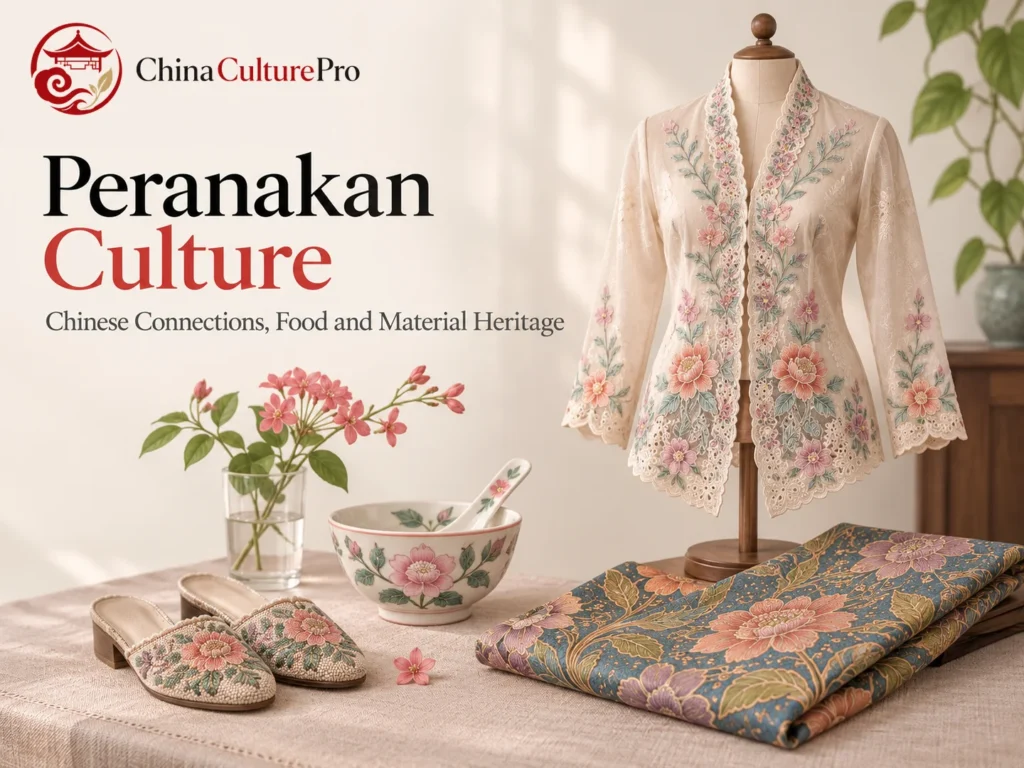
A sarong kebaya brings a blouse and skirt cloth into an ensemble associated with Nyonya dress. Its appearance has changed with fashion and personal choices. A museum record for one early-20th-century cotton-voile kebaya connects European production with tailoring in Singapore and lists machine-made embroidery. Imported materials, machinery and local making could be part of the same garment’s story.[10]
In December 2024, kebaya knowledge, skills, traditions and practices were inscribed on UNESCO’s Representative List through a joint nomination by Brunei Darussalam, Indonesia, Malaysia, Singapore and Thailand. This shared recognition helps place Peranakan dress within regional connections rather than a single community’s exclusive ownership.[6]
Needlework shows another route of exchange. Chinese embroidery supplied symbols and visual resources, while printed pattern books and European fashion publications introduced further designs. Beadwork and embroidery appeared on shoes, purses and wedding furnishings, made in domestic settings and by professional craftspeople.[5]
The connection with Chinese embroidery is important, but makers also selected and transformed other references. An elaborate surviving textile records labor, materials and taste in a particular setting; it does not establish how every Peranakan woman dressed or spent her time.
Ceramics, Family Names and Domestic Objects
Ceramics can connect production, family identity and the social life of meals. A commissioned dinner service bearing the surname Yap (葉, Yè; Mandarin reading) is catalogued as made in China and dated to 1875–1908. Its plates, bowls and spoons served different functions, while butterflies, flowers and the family name decorated the pieces.[4]
The example belongs to the history of Chinese porcelain made for overseas markets. Its meaning includes both the place where it was produced and the family that commissioned and used it. Chinese manufacture does not make the service’s Peranakan social setting any less important.
When reading museum objects, ask about date, provenance, materials and use. A commissioned service, a wedding textile and an ordinary household utensil preserve different kinds of evidence. A collection’s exceptional pieces should not become a picture of every family’s possessions.
Living Heritage and New Forms of Participation
Heritage continues through people’s choices. The Peranakan Museum’s 2023 reopening incorporated contemporary art, fashion, design and craft into its galleries, alongside community interviews and demonstrations. That curatorial approach placed present-day expressions within the history rather than ending the story with antiques.[8]
Community initiatives can try new forms of transmission. In November 2025, The Peranakan Association Singapore described ChakapBot, a project using AI chatbots to support Baba Malay learners alongside face-to-face teaching and human review of heritage content. The account documents a learning initiative, not proof that technology alone can secure a language’s future.[9]
Food, dress, stories and objects can all be renewed through participation. Their continuation depends on what people learn, use and reinterpret, as well as what institutions preserve.
FAQs About Peranakan Culture
Are all Peranakans Chinese?
No. Chinese Peranakans are one group within a wider set of communities. Peranakan histories also include Indian, Arab and other connections in Southeast Asia.
Does every Peranakan community speak Baba Malay?
No. Baba Malay is especially associated with Melaka and Singapore, while Penang’s Chinese Peranakans have traditionally used a local Hokkien variety. Language use also differs across generations.
Is kebaya exclusively Chinese Peranakan clothing?
No. Kebaya belongs to several Southeast Asian communities. Its 2024 heritage inscription involved five countries, while particular communities maintain their own styles and practices.
Is Peranakan food simply Chinese food with local spices?
No. Its ingredients, techniques and social occasions developed through regional exchange over generations. It is a local food tradition rather than a simple altered version of another cuisine.
Is Peranakan culture only a historical museum subject?
No. Contemporary making, family practices and community initiatives continue its story. Museums preserve evidence, while living people decide how heritage enters their present lives.
Источники
[1] Peranakan Museum, National Heritage Board. About the Peranakans
[2] Singapore Chinese Cultural Centre, Culturepaedia. The Peranakan Chinese in Singapore
[3] National Heritage Board, Roots. Peranakan Cuisine in Singapore
[4] Peranakan Museum, National Heritage Board. Ceramics and Food Culture
[5] National Library Board, Singapore, BiblioAsia. Nyonya Needlework and the Printed Page
[6] Ministry of Foreign Affairs, Thailand. Kebaya: Multinational Inscription on the UNESCO Representative List
[7] Peranakan Museum, National Heritage Board. Inside a Baba Malay Mass
[8] Peranakan Museum, National Heritage Board. About Peranakan Museum
[9] The Peranakan Association Singapore. Let’s Chakap Chakap with the President: November 2025
[10] Peranakan Museum, National Heritage Board. Fashion