


Quick Answer: How Do Mandarin and Cantonese Differ?
Standard Mandarin (普通话, pǔtōnghuà) and Cantonese (粤语, Yuèyǔ) differ in pronunciation, vocabulary and some sentence patterns. Their ordinary speech is not automatically mutually intelligible, even though many speakers know both and share a Chinese writing tradition.[1][2]
- Speech: Standard Mandarin has four basic tones plus a neutral tone; Cantonese is commonly taught with six tone numbers.[3][4][5]
- Writing: A shared formal written standard and written Cantonese are different choices; neither is simply a font change.[7]
- Learning: Choose by the people and material you want to understand, then select the matching audio, romanization and characters.
This comparison focuses on Standard Mandarin and the Cantonese associated with Hong Kong and Guangzhou. It does not treat every regional Chinese variety as a version of either one.
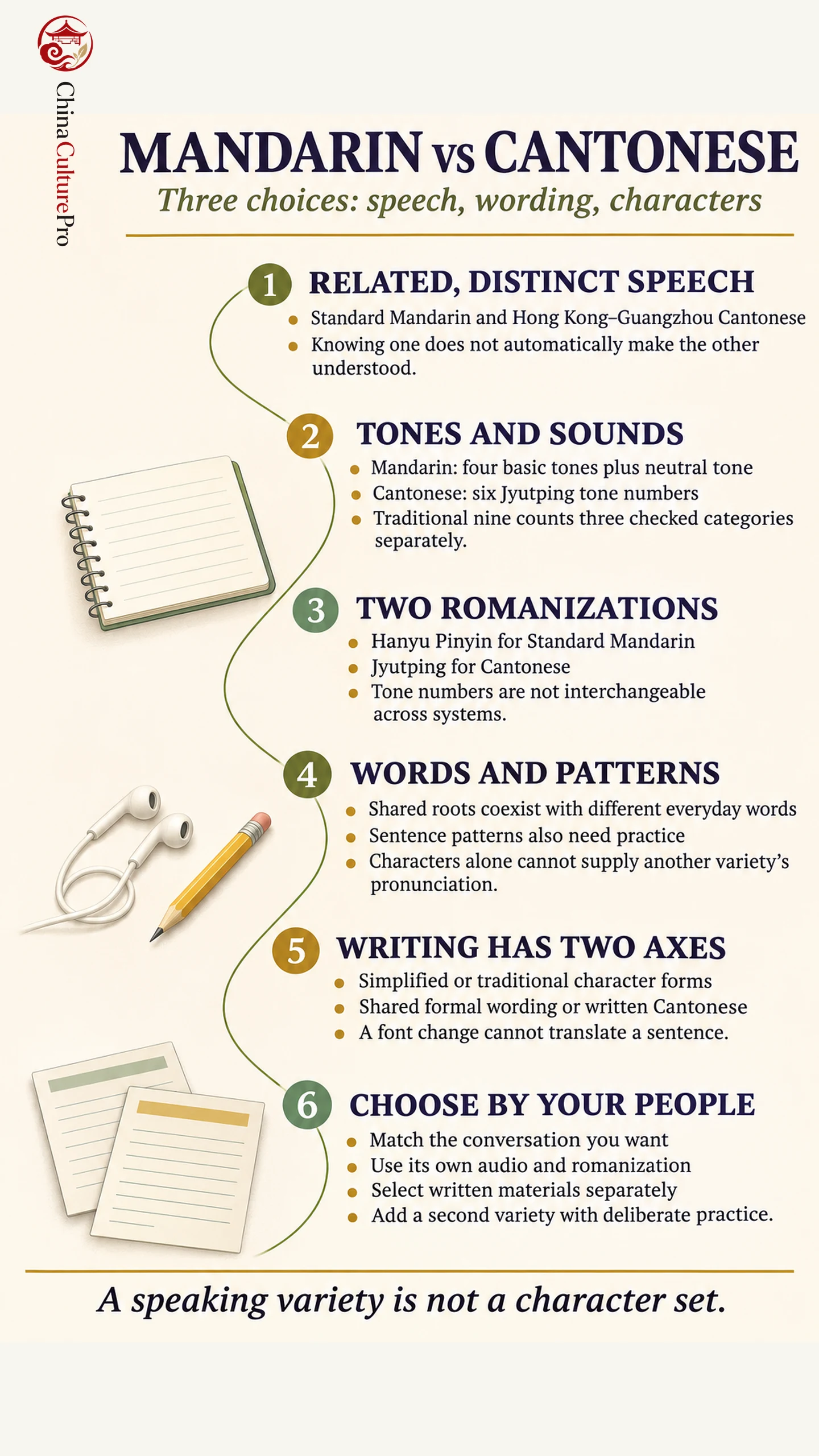
“Which Chinese should I learn?” contains several decisions. The language of a conversation, the wording of a written text and the shapes of its characters can vary independently. Keeping those choices separate prevents a common beginner mistake: expecting a traditional-character textbook to teach spoken Cantonese automatically.
What the Comparison Covers
The broader Mandarin varieties (官话, guānhuà) include regional forms of speech; Standard Mandarin is a standardized common language, with pronunciation based on Beijing speech and a broader northern linguistic base. A local accent, regional Mandarin vocabulary and the taught standard are not interchangeable labels.[1][2]
Cantonese has a strong presence in Hong Kong, Guangzhou and wider southern Chinese and overseas communities. It has related regional varieties as well as differences between speakers. Here, the practical comparison concerns the forms learners commonly encounter in Hong Kong and Guangzhou speech, rather than a claim that all southern China speaks alike.[2][9]
The labels “language” and “dialect” reflect different linguistic and social conventions. Whichever label a source uses, the sound and vocabulary differences still need to be learned. Our Chinese languages and dialects guide places this pair within a much wider landscape.
Pronunciation, Tones and Everyday Words
Hanyu Pinyin (汉语拼音, Hànyǔ Pīnyīn) represents Standard Mandarin pronunciation. Jyutping (粤拼, Yuèpīn) represents Cantonese with its own spelling conventions and tone numbers. The Mandarin pinyin supplied for Chinese labels in this article identifies those labels; Cantonese example pronunciations below use Jyutping.[5][6]
| Характеристика | Стандартный китайский язык (путунхуа) | Cantonese in this comparison |
|---|---|---|
| Basic tone description | Four citation tones, plus neutral-tone syllables | Six commonly taught tone categories |
| Learner notation | Vowel tone marks in Hanyu Pinyin | A number from 1 to 6 after a Jyutping syllable |
| Syllable endings | No final -p, -t or -k stops | Final -p, -t and -k stops occur |
| Everyday words | Many shared roots, with its own common vocabulary | Shared roots plus distinct everyday words |
| Listening transfer | Familiar characters do not supply Cantonese pronunciation | Familiar characters do not supply Mandarin pronunciation |
These differences include both the pitch of a syllable and its consonants and vowels. For “mother,” Mandarin 妈 is mā, while Cantonese 媽 is maa1. Here the word is related, but the two romanizations belong to different sound systems. For the everyday copula “to be,” Mandarin 是, shì, corresponds to Cantonese 係, hai6: this is a vocabulary difference as well as a difference in pronunciation.[2][3][5][8]
Mandarin’s four basic tones are conventionally described as high level, rising, dipping and falling. These are citation descriptions, not a claim that every syllable keeps an identical contour in connected speech. Neutral-tone syllables are shorter, with pitch affected by their surroundings; they are not a fifth full tone with one fixed contour.[3][4]
Cantonese “six tones” and “nine tones” use different counting conventions. The traditional nine-category account separately counts three checked categories associated with syllables ending in -p, -t or -k. Jyutping uses six numbers, assigning those checked syllables numbers 1, 3 or 6. You do not need to invent three extra Jyutping tone digits.[5][6]
Sentence patterns can differ too. An instruction meaning “you go first” can place “first” before “go” in Mandarin and after it in Cantonese. Shared characters do not remove the need to learn word order. Hear such patterns in context; the pinyin guide explains Mandarin notation separately.[2]
Writing: Shared Characters, Different Choices
First distinguish simplified characters (简化字, jiǎnhuàzì) from traditional characters (繁体字, fántǐzì). These concern character forms, not whether a sentence is spoken in Mandarin or Cantonese. Mandarin is commonly written with traditional characters in Taiwan; Cantonese-speaking Guangdong uses simplified characters in ordinary mainland publications. Hong Kong commonly uses traditional characters.[10]
Next ask which written vocabulary and sentence patterns the text follows. Formal Chinese prose often uses a shared written standard relatively close to Mandarin. A Cantonese speaker can read that text using Cantonese pronunciations without its wording becoming a transcript of everyday Cantonese speech. Learning to write such prose is a distinct skill, including for a fluent Mandarin speaker.[7][9]
Written Cantonese can instead follow Cantonese speech more closely, including distinctive words and usages. Replacing 是 with the conversational 係 is not a simplified-to-traditional conversion: the two forms represent different word choices. Cantonese writing therefore cannot be produced merely by changing a font or reading a Mandarin sentence with another accent.[7][8]
Our Chinese characters guide explains how the writing system works, while simplified versus traditional Chinese concentrates on character forms and regional conventions.
Choose a Learning Path for Your Real Context
Choose a learning path for Mandarin or Cantonese by starting with a real conversation or reading goal.
- Name your main conversation: Choose the people or setting you want to understand, such as relatives, a Hong Kong workplace or Mandarin-language study.
- Match audio and romanization: Use recordings for the target variety, with Hanyu Pinyin for Standard Mandarin or Jyutping for Cantonese.
- Choose the written material separately: Select simplified or traditional characters and check whether a text follows a shared formal standard or everyday Cantonese wording.
- Add the second variety deliberately: Reuse familiar characters while learning the second variety’s sound system, vocabulary and sentence patterns with its own audio.
For Mandarin-language classes or media, Mandarin directly serves the goal. For Cantonese-speaking relatives or Hong Kong conversation, Cantonese may be the more rewarding first choice. Neither requires mastering the other in advance. If family members use a different regional variety, identify it before buying either course.
For social interaction, a phrase list also needs context. Our guides to greetings и forms of address help with the relationship and level of formality; practice the actual words with audio in your chosen variety.
Cantonese preserves some historical features that Standard Mandarin lacks, including final stops, but it has also changed over time. It is not unchanged ancient Chinese, nor does a historical retention make one modern variety inherently more expressive or authentic.[9]
FAQs About Mandarin and Cantonese
Can Mandarin and Cantonese speakers understand each other?
Knowing one does not automatically make ordinary speech in the other understandable. Many people can communicate in both because they have learned or encountered both; that personal ability should not be confused with inherent mutual intelligibility.[2]
Does Cantonese have six tones or nine?
Both descriptions occur. Jyutping uses six tone numbers; the traditional nine-category count treats three checked categories separately because they occur with final -p, -t or -k.[5][6]
Is traditional Chinese the same as Cantonese?
No. Traditional describes character forms. Mandarin can be written with those forms, while Cantonese-speaking communities can use simplified forms. Written register is a further choice.[7][10]
Which is harder for an English speaker to learn?
There is no useful universal ranking from tone counts alone. Both require unfamiliar sound contrasts; your existing exposure, access to teachers and reasons to practice affect the task. Choose the variety you can use consistently.
Источники
[1] China Ministry of Education. Overview of Chinese languages and writing
[2] Xiaoheng Zhang, ACL Anthology. Dialect MT: A Case Study between Cantonese and Mandarin
[3] Hong Kong Polytechnic University. Basic Tones
[4] Hong Kong Polytechnic University. Neutral Tone
[5] Linguistic Society of Hong Kong scheme, Jyutping.org. Jyutping Scheme
[6] Education University of Hong Kong. The Six Tones of Cantonese
[7] University of Hong Kong CLEAR. Written Cantonese and Implications for Hong Kong
[8] Chinese University of Hong Kong, Independent Learning Centre. Cantonese Express: daily conversation vocabulary
[9] Samuel H. N. Cheung, Chinese University of Hong Kong. Debunking Some Myths about Cantonese
[10] American Translators Association. Demystifying Simplified Chinese versus Traditional Chinese