
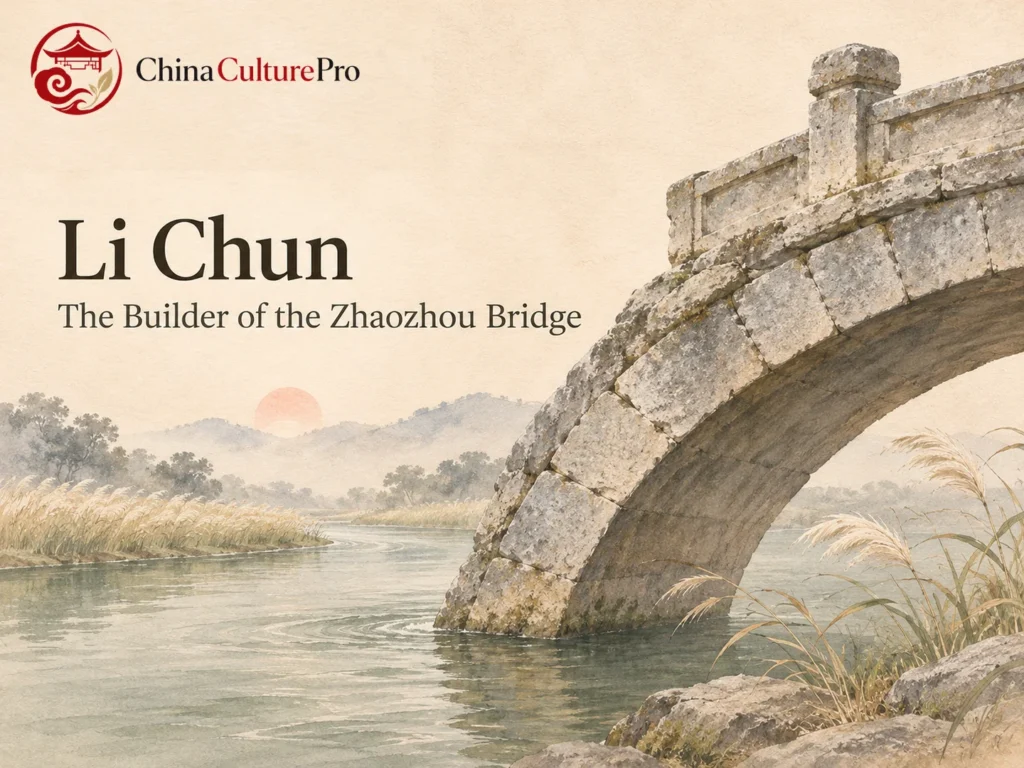

Quick Answer: Who Was Li Chun?
Li Chun (李春, Lǐ Chūn) was a Sui dynasty builder credited with the Zhaozhou Bridge (赵州桥, Zhàozhōu Qiáo), also called the Anji Bridge (安济桥, Ānjì Qiáo). The bridge crosses the Xiao River (洨河, Xiáo Hé) in Zhao County, Hebei.[2][4]
- Date: Zhao County gives approximately 595–605 CE for construction.[2]
- Design: One broad stone arch spans the river. Two smaller openings on each side reduce the weight above it.[2][4]
- Attribution: The Tang writer Zhang Jiazhen (张嘉贞, Zhāng Jiāzhēn) identifies the bridge as Li Chun’s work.[1]
The bridge preserves the design that made it unusual, along with the results of later repair work.[3][5]

A stone bridge can carry a deck over water with one arch. Li Chun’s bridge adds openings where other designs would have more solid stone. The shape makes a practical difference both above and below the deck. Travelers face a gentler climb, and the river has extra openings at high water.
How the Bridge Became Linked to Li Chun
Zhang Jiazhen’s Tang dynasty account names Li Chun as a Sui craftsman. It remarks on the bridge’s stonework, the absence of supports in the river and the four openings that help water pass.[1]
The Tang text is later than the bridge’s Sui construction. It carries Li’s name forward and already singles out the four openings as a feature worth explaining.[1][4]
What Makes the Main Arch Unusual
The main arch spans about 37 meters between its supports. It rises about 7.2 meters from the line between those supports to the crown. That makes it much shallower than a semicircular arch across the same distance.[2][6]
Zhao County describes 28 stone arch ribs built side by side across the bridge’s width. The ribs together form one broad arch over the river.[2]
The main arch carries the deck across the river without a central pier. The approach can stay lower because the arch itself rises less sharply.[3]
Why Four Smaller Openings Matter
A spandrel is the area above the curve of an arch and beneath the bridge deck. In Zhaozhou’s open spandrels, smaller arches replace some of the solid stonework. The openings reduce the amount of masonry the main arch has to support. When the river rises high enough to reach the smaller openings, water has additional paths through the bridge.[3][4]
How Repairs Preserved the Bridge
A repair project between 1952 and 1958 investigated the riverbed, strengthened the bridge and studied the railings. The work continued a history of upkeep. The main form is a record of early Chinese engineering, and parts of the visible bridge reflect decisions made in later repairs.[5]
The National Museum of China holds a railing panel from the bridge with dragons carved on both sides. The paired figures twist around each other on one face. The carved piece helps document the decoration separately from the bridge’s structure.[4]
FAQs About Li Chun and the Zhaozhou Bridge
Is the Anji Bridge the same as the Zhaozhou Bridge?
Yes. Anji Bridge is another name for the same crossing. Locally it is also called the Great Stone Bridge.[2]
Is it the world’s oldest stone bridge?
The American Society of Civil Engineers identifies it as the world’s oldest surviving open-spandrel arch bridge. The distinction refers to that type of arch bridge.[3]
Do we know much about Li Chun’s life?
His name and occupation are preserved in Zhang Jiazhen’s account. The bridge and its attribution provide firmer ground than detailed stories about his personal life.[1]
Источники
[1] Zhang Jiazhen. Inscription and Preface on the Stone Bridge South of Zhao Commandery
[2] Zhao County People’s Government. Zhaozhou Bridge
[3] American Society of Civil Engineers. Zhaozhou Bridge, Historic Civil Engineering Landmarks
[4] National Museum of China. Stone Railing Panel from Anji Bridge
[5] Chinese Cultural Heritage. A Review of the 1952–1958 Repairs to the Anji Bridge
[6] Sheng Chen, Valentina Pintus and Chun Li. Value-Based Conservation of Zhaozhou Bridge