


Quick Answer: How Do You Read Chinese Porcelain Shapes?
Follow the silhouette from rim to foot. Pay particular attention to where the vessel is widest, how the neck meets the body and what supports the base. Compare those features with a museum record that shows the whole object in profile.[1][2][3][4]
- Rim and neck. Note the opening and whether the neck is long, short or absent.
- Shoulder and body. Locate where the profile expands and narrows.
- Foot. Check whether the body sits on a low ring, a tall stem or another support.
A shape name describes the form. Read the catalog’s material, date and proposed use as separate fields.[1][2]
Blue-and-white decoration draws the eye first. To recognize the form beneath it, look at the empty space around the vessel. The outline can separate two shapes even when their patterns look alike.
Read a Ceramic Silhouette in Four Steps
- Find a straight profile view. Use a photograph where the vessel stands upright and the camera shows its outline without looking steeply down.
- Read from the rim to the widest point. Note the mouth, neck and slope of the shoulder. Record whether the broadest part sits high or low on the body.
- Look at the support and scale. Check the foot and use the dimensions from the catalog record. Compare rim and foot diameters where useful.
- Match the form in a collection record. Compare complete profiles under the same name. Then read the date, material and place of manufacture separately.
Use the same angle for each comparison whenever possible. A close-up of the foot can add useful information, but a foot photo alone leaves out the rest of the form.
Compare Three Forms From Museum Collections
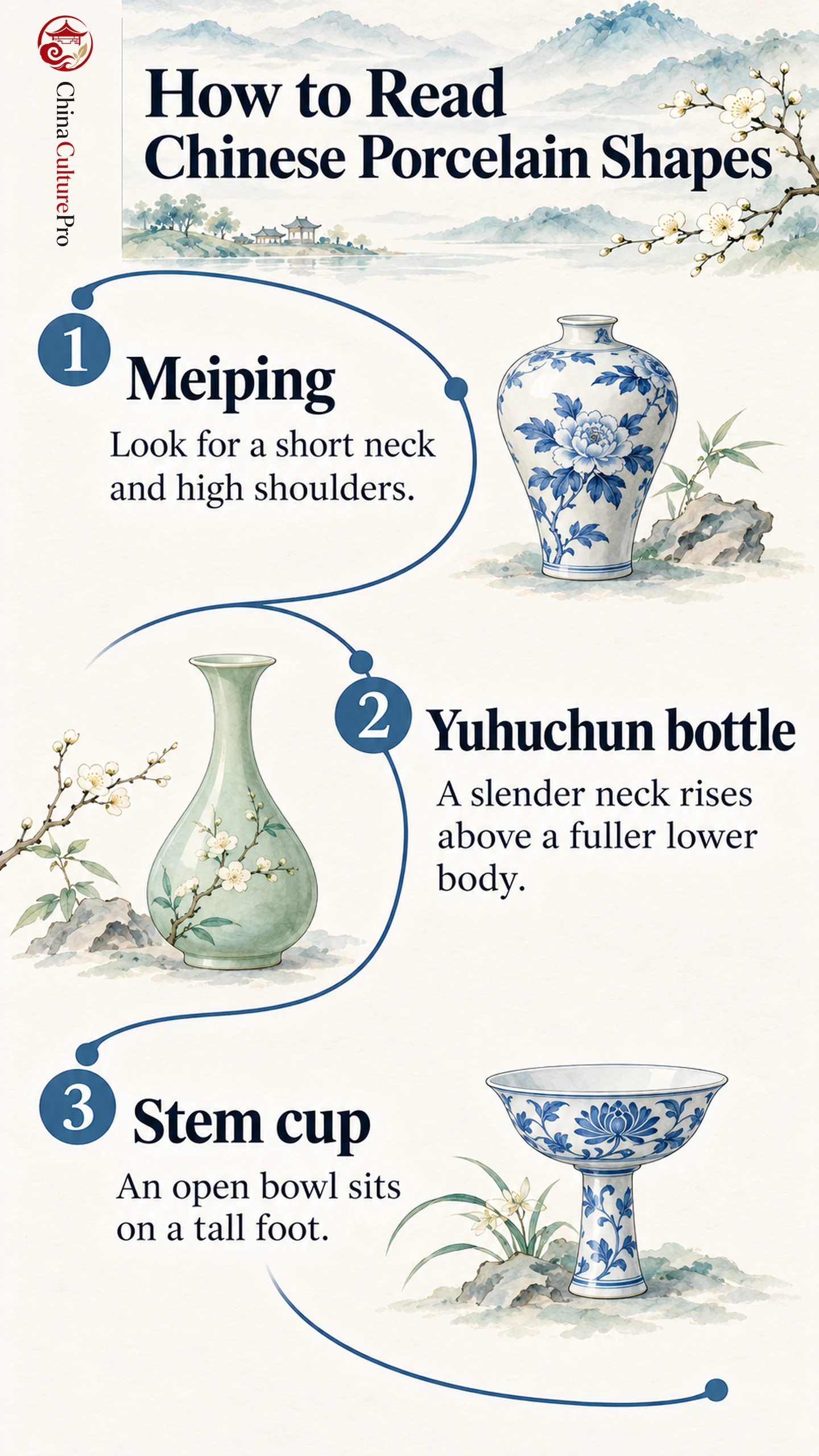
A meiping (梅瓶, méipíng) has a short neck, high rounded shoulders and a body that narrows toward a relatively small base. The name is often translated as “plum vase.” A museum example in white-glazed stoneware uses this form, while a Ming phoenix vessel in porcelain shows it in porcelain. The name does not establish what one particular vessel held.[1][2]
A pear-shaped yuhuchun bottle (玉壺春瓶, yùhúchūn píng) has a slender neck above a full lower body. An early Ming example has a flared mouth and a ring foot. Compared with a meiping, more of its width sits low on the body.[1][3][4]
A stem cup (高足杯, gāozúbēi) has a bowl above a tall support. A small Xuande-period porcelain cup with dragons illustrates the contrast between the wide open bowl and narrow foot. The tall stem distinguishes it visually from a shallow bowl on a low ring.[5]
| Форма | Feature to check first |
|---|---|
| Meiping | Short neck and wide, high shoulders. |
| Yuhuchun bottle | Slender neck and a fuller lower body. |
| Stem cup | Open bowl rising above a tall foot. |
Why Shape, Material and Date Belong in Separate Notes
The same form can appear in stoneware and porcelain. A ceramic’s glaze and surface decoration are also separate from its profile. Record the manufacturer or kiln only if the catalog supports it. The guide to Chinese porcelain explains material and kiln traditions.[1][2][3]
A reign inscription is another kind of evidence. When a vessel carries characters, record the wording separately before comparing its period in the catalog. The guide to dates on Chinese antiques explains why different date fields can point to different events.
FAQs About Chinese Porcelain Shapes
Does meiping mean the vessel always held flowers?
Meiping names a shape. Museum research also discusses possible use for beverages such as wine, so the common English name “plum vase” does not determine the use of a single object.[1]
Can two vessels with the same shape have different materials?
Yes. Museum records identify both white-glazed stoneware and blue-and-white porcelain examples in meiping form.[1][2]
Can the foot alone identify a period?
The foot is one feature to compare. Read it alongside the complete profile, material, documented marks and the catalog’s dating evidence.[1][3][5]
Источники
[1] The Metropolitan Museum of Art. Vase in Meiping Shape, Cizhou ware
[2] The Metropolitan Museum of Art. Vase in Meiping Shape with Phoenix
[3] National Palace Museum. Longquan Yuhuchun vase with incised floral design
[4] British Museum. Room 95: Chinese Ceramics, large-print guide
[5] The Metropolitan Museum of Art. Stem cup with dragons