

Quick Answer: How Do You Read Chinese Jade Motifs?
Start with the object’s shape and the way it was carved, then check the museum’s date and description. A round disc can carry a cloud pattern, while a pendant can be shaped like an animal. The same motif can carry different associations in different settings.[1][2][3]
- Form. Identify the entire object before naming the decoration.
- Motif. Look at both faces and see whether details are incised, raised or cut through.
- Meaning. Check whether the record offers an interpretation for that particular object.[1][2][3]
Keep descriptions of what you can see separate from interpretations of what the image might have meant.

A curled line on jade may be part of a cloud design. A hole may belong to the shape of the object or have served to suspend it. Begin with those visible features before deciding what the carving expresses.
Read the Carving in Four Steps
- Identify the object as a whole. Record its outline, openings, thickness and scale. Compare your observation with the form named in the catalog.
- Describe each motif on its own. Look for repeated curls, wings, leaves or a recognizable body. Compare both faces and record whether the motif is a line, raised design or cutout.
- Check the date and material fields. Record the assigned period and the exact stone name if the museum provides one. Color alone is a weak guide to material.
- Record the interpretation with its evidence. Note the object’s date and any motif combination that supports the reading. Keep the catalog’s qualifiers when an identification is uncertain.
The format of an object label can help keep these fields separate. Save the museum and the inventory number so you can return to the same photographs.
Three Examples of Form and Motif
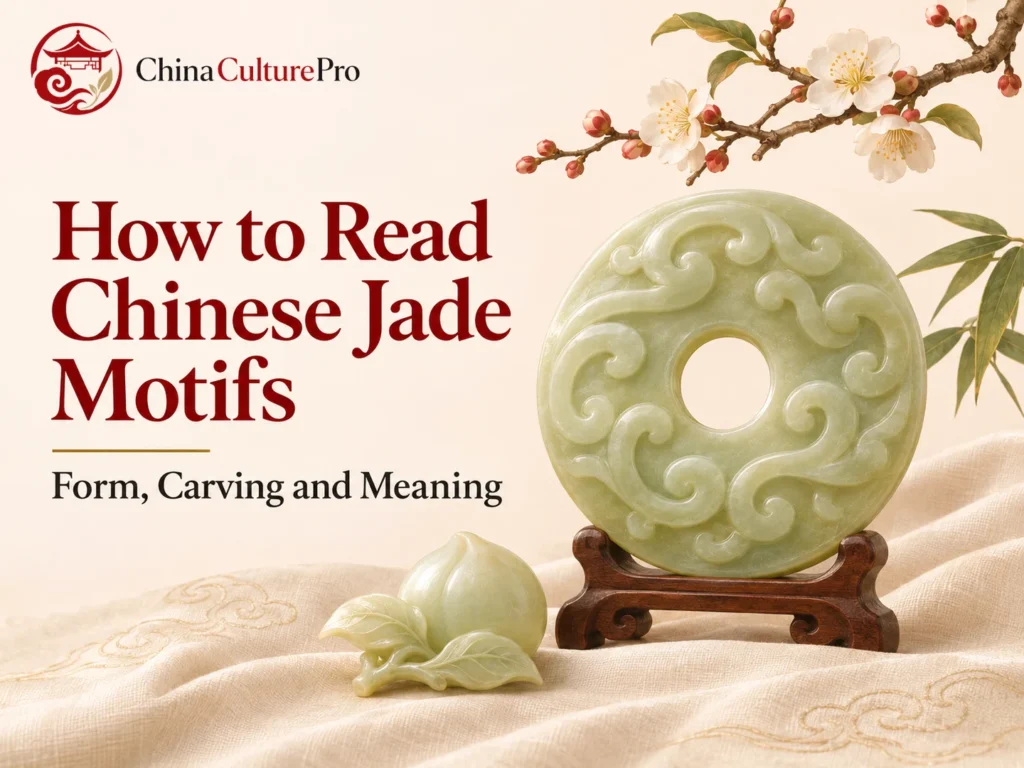
A small pendant cataloged as a bi (璧, bì) disc has a central hole and paired rounded cloud designs. The museum dates it to the late Warring States or early Western Han period. Here the disc is the form, the clouds are decorative features, and the catalog date provides historical context. None of those observations alone establishes a single symbolic meaning.[1]
An Anyang pendant has spread wings and incised lines following its outline. The catalog suggests a bat (蝠, fú) from the jagged wing profile and describes the material as nephrite with traces of cinnabar. Record the attribution as a proposed identification. It is evidence of how the object looks, rather than a reason to assign later Chinese bat symbolism to this early object.[2]
A Qing jade peach in the Hebei Museum has five bats carved in relief on its surface. The published object account reads the combination as a wish for five blessings and longevity. The fruit and the group of bats work together. The combination supports a longevity reading for this piece.[3]
| Объект | What the example lets you say |
|---|---|
| Cloud-patterned disc pendant | Name the disc shape and cloud pattern separately. |
| Anyang bat-shaped pendant | Keep the suggested identification and the catalog’s material field. |
| Qing jade peach | Read the five bats and peach together in a documented auspicious combination. |
FAQs About Chinese Jade Motifs
Does a bat always mean good fortune on Chinese jade?
A bat can represent a blessing in an auspicious design. Date, placement and companion motifs matter. The Qing peach offers such a documented combination, while the Anyang object’s catalog focuses on identification.[2][3]
Is bi the name of a motif or a shape?
Bi names a disc form with a central opening. Clouds or other decorative elements can appear on the disc’s surface.[1]
Can a motif identify the stone used?
A motif describes the carved subject or pattern. For the material, check the museum’s identification, such as nephrite in the Anyang pendant record.[2]
Источники
[1] National Palace Museum. Jade bi disc pendant with cloud pattern
[2] Smithsonian National Museum of Asian Art. Pendant in the form of a bat
[3] Collection of Ancient Chinese Cultural Relics. Volume IX: Hebei Museum Qing jade peach