
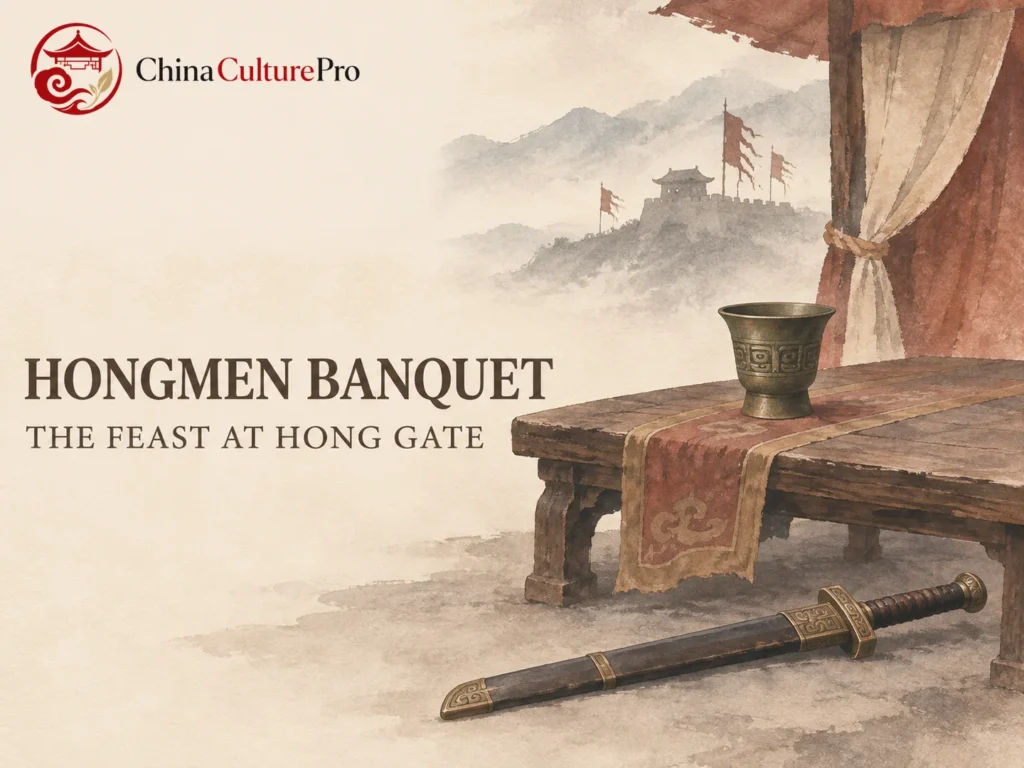

Quick Answer: What Was the Hongmen Banquet?
The Hongmen Banquet (鸿门宴, Hóngmén Yàn), also called the Feast at Hong Gate, was a meeting between Xiang Yu (项羽, Xiàng Yǔ) and Liu Bang (刘邦, Liú Bāng) in the struggle that followed Qin’s fall, usually dated around 206 BCE. In Sima Qian’s account, an adviser tried to have Liu killed during the feast. Liu escaped. [1][2][5][8][9]
- Dispute: Liu Bang had entered the former Qin capital region before Xiang Yu.
- At the feast: A sword dance created an opportunity to attack Liu Bang.
- Afterward: Liu Bang returned to his camp. The question of who would rule remained open. [1][2][4]
The best-known account comes from an ancient history written after the event. [1][6]

The danger to Liu Bang began before anyone drew a sword. Two commanders had fought the same enemy and had different claims to the territory it left behind.
Why Liu Bang Went to Xiang Yu’s Camp
As the Qin dynasty collapsed, Liu Bang reached the former imperial center first and accepted the surrender of Ziying, the last Qin ruler. In Sima Qian’s account, the king of Chu had promised the right to rule that region to the commander who reached it first. Xiang Yu led a more powerful coalition. When he found the pass guarded and heard that Liu intended to claim the region, the rivalry nearly became a battle. [1][2][8]
The pass was Hangu, one of the approaches to the former Qin heartland. In the annals, Cao Wushang, an officer under Liu Bang, sent Xiang Yu a report claiming that his commander wanted to rule the region. Sima Qian presents the report as a trigger for Xiang Yu’s threatened attack. It does not establish that every detail of Cao’s allegation was true. [1][2]
Fan Zeng (范增, Fàn Zēng), Xiang Yu’s adviser, pressed for action. Xiang Yu’s uncle Xiang Bo (项伯, Xiàng Bó) went to see Zhang Liang (张良, Zhāng Liáng), an adviser serving with Liu Bang. Zhang Liang’s account says that he had once sheltered Xiang Bo. A personal obligation gave him a connection inside the rival camp. Zhang warned Liu and helped arrange the next day’s meeting, giving both camps a way to talk before they fought. [1][2][3]
What Sima Qian Says Happened at the Feast
In the Annals of Xiang Yu, Liu Bang came to the camp to explain his actions and stayed for the feast. Fan Zeng repeatedly raised a jade object to signal to Xiang Yu, who gave no response. Fan then arranged for Xiang Zhuang (项庄, Xiàng Zhuāng) to dance with a sword and strike Liu. Xiang Bo joined the dance and kept himself between the blade and the guest. [1][4]
Liu Bang’s follower Fan Kuai (樊哙, Fán Kuài) forced his way past the guards with a shield and spoke in defense of his commander. Liu then left the gathering under the pretext of going to relieve himself. He returned to his camp by a side route, leaving Zhang Liang behind to present gifts. According to the annals, Xiang Yu accepted the jade discs, while Fan Zeng smashed the jade vessels intended for him. [1][4]
How the Other Accounts Change the Emphasis
The biography of Fan Kuai puts his intervention at the center. The life of Zhang Liang gives more attention to the conversation with Xiang Bo before the meeting, then refers readers to Xiang Yu’s account for the rest. The Annals of Gaozu condense the encounter. These are different perspectives in the same work by Sima Qian. Read together, the chapters show how Sima Qian gave different participants responsibility for the same outcome. [1][2][3][4][6]
The detailed account says Xiang Yu and Xiang Bo faced east, Fan Zeng faced south, Liu Bang faced north and Zhang Liang attended while facing west. Ying-shih Yü reads the arrangement in light of early seating customs, treating it as a clue to the rank and relationships being performed at the feast. Yü’s interpretation starts with what the text records. The seating order alone gives little access to what each guest intended. [1][5][6]
What the Banquet Changed and How It Is Remembered
Liu Bang’s departure let him keep command of his army. Xiang Yu subsequently made him king of Han while assigning the former Qin heartland to other rulers. Later campaigning and shifting alliances gave Liu Bang the victory that allowed him to found the Han dynasty. The banquet left him in a position to take part in that later struggle. [1][2][8]
The sword dance became the basis of the expression Xiang Zhuang dances with a sword while aiming at the Lord of Pei. The Lord of Pei was Liu Bang. The idiom is used when an outward action conceals another purpose. That later usage comes from the narrated episode, regardless of how precisely its gestures can be recovered. [1][7]
FAQs About the Hongmen Banquet
Is the Hongmen Banquet the same as the Feast at Hong Gate?
Yes. The Feast at Hong Gate is another English name for the Hongmen Banquet. Hongmen identifies the site of Xiang Yu’s camp in the account. [1][5]
Is the sword dance recorded in an ancient source?
Yes. The sword dance appears in the Annals of Xiang Yu and the biography of Fan Kuai. Both are chapters of the same ancient work, so the two versions are part of one transmitted historical tradition. [1][4]
Why did Xiang Yu let Liu Bang leave?
Sima Qian says Xiang Yu did not respond to Fan Zeng’s signals. In the story Xiang Bo shields Liu, Fan Kuai intervenes and Liu leaves before the gathering ends. These actions are recorded more clearly than Xiang Yu’s private reasons. [1][3][4][5]
Источники
[1] Sima Qian. Records of the Grand Historian, Chapter 7: Annals of Xiang Yu
[2] Sima Qian. Records of the Grand Historian, Chapter 8: Annals of Gaozu
[3] Sima Qian. Records of the Grand Historian, Chapter 55: Hereditary House of the Marquis of Liu
[4] Sima Qian. Records of the Grand Historian, Chapter 95: Biographies of Fan Kuai, Li Shang, Xiahou Ying and Guan Ying
[5] Ying-shih Yü. The Seating Order at the Hong Men Banquet
[6] Lei Yang. Building Blocks of Chinese Historiography: A Narratological Analysis of Shi Ji
[7] Education Encyclopedia of Chinese Idioms, Ministry of Education, Taiwan. 項莊舞劍 (Xiang Zhuang Dances with a Sword)
[8] Michael Loewe. The Former Han Dynasty, in The Cambridge History of China
[9] Orion Lethbridge. The Record of the Citadel of Sorrows: A Case Study in Joseon Dynasty Literature