


Quick Answer: What Is Four Poems Attributed to Zhang Xu?
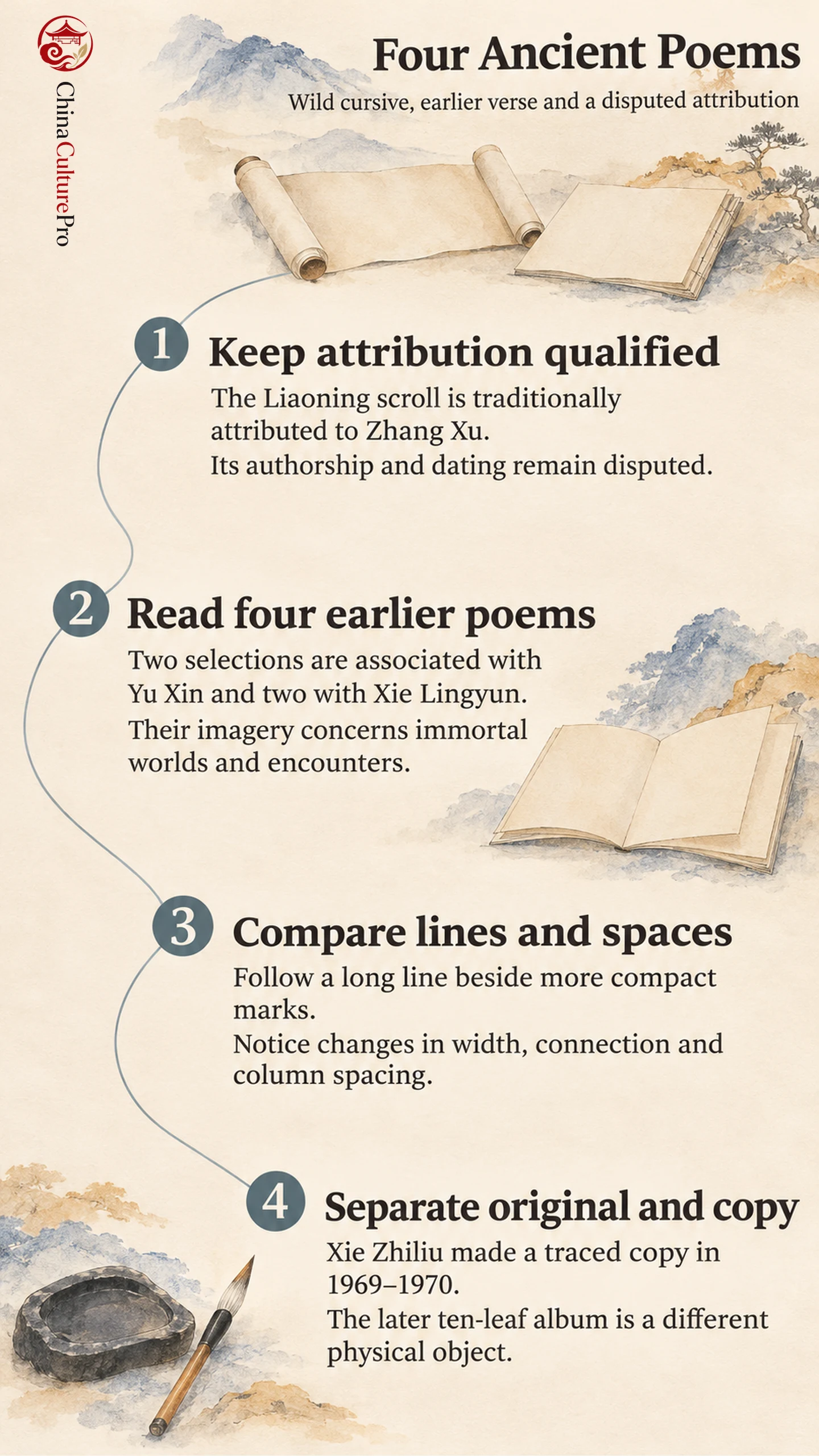
Four Ancient Poems (古诗四帖, Gǔ Shī Sì Tiè), commonly called Four Poems, is a handscroll traditionally attributed to Zhang Xu (张旭, Zhāng Xù), in the Liaoning Provincial Museum.
- Form: Wild cursive (狂草, Kuáng Cǎo) transforms the shapes and connections of written characters.
- Material: Ink on colored paper; published measurements give 29.5 × 195.2 cm.
- Attribution: The scroll is unsigned, and its authorship and dating remain disputed.
The four poems are earlier literary texts. Their authorship is a separate question from the identity of the person who wrote this scroll.
A thin line can descend through a large interval before folding into another turn. Beside it, compact black marks can pack several changes of direction into a much smaller area.
Compare the visible marks first, then use the poem texts and attribution history to ask different questions about the same scroll.
Identify the Liaoning Scroll and Its Attribution
The work is an ink-on-colored-paper handscroll, published as 29.5 cm high and 195.2 cm long. Its traditional attribution has supporters, while other scholars have argued for a later writer, including a Northern Song date. [1]
The dispute concerns evidence such as textual variants, brushwork, seals and the relation between the ink manuscript and later engraved versions. It cannot be settled simply by repeating the familiar artist’s name. [1]
The Chinese-calligraphy guide helps place the object within a larger visual tradition. Attribution asks who made it; close looking asks what its surviving marks do.
Neither task needs to disappear into the other. A viewer can describe a long, narrow line accurately while retaining uncertainty about the hand responsible for it.
Read the Earlier Poems of Immortal Worlds
Yu Xin (庾信, Yǔ Xìn) is represented by two Pacing the Void (步虚词, Bù Xū Cí) selections; two praise poems associated with Xie Lingyun (谢灵运, Xiè Líng Yùn) follow. [2]
| Text | Earlier poet | Subject to keep in mind |
|---|---|---|
| Pacing the Void, first selection | Yu Xin | Cloud travel and encounters in an immortal realm |
| Pacing the Void, second selection | Yu Xin | Celestial palaces, clouds and sacred writing |
| Praise of Prince Jin (王子晋赞, Wáng Zǐ Jìn Zàn) | Xie Lingyun | Princely status contrasted with ascent beyond ordinary life |
| Praise of an Old Man and Four or Five Youths beneath a Cliff (岩下一老公四五少年赞, Yán Xià Yī Lǎo Gōng Sì Wǔ Shào Nián Zàn) | Xie Lingyun | A herb gatherer’s encounter with a hidden group |
These brief descriptions paraphrase the poems’ situations. They identify verbal images, rather than painted scenes on the scroll. [2]
The Chinese-poetry guide develops the relation between compact language and imagined worlds. Here, movement beyond ordinary surroundings recurs across the four texts.
Read a short passage in transcription before returning to its cursive forms. Knowing the expected words makes it easier to distinguish an altered character from a purely abstract mark.
Follow Long Lines and Changing Spaces
Wild cursive can greatly alter familiar character structures, and the visual movement extends between neighboring columns. [3]
In the opening detail, compare the large descending line toward the right with the denser cluster at lower left. The line travels through open space; the cluster repeatedly changes direction within a tighter area.
Next, compare a broad black segment with a hairline curve. Follow each until it stops or changes direction, rather than assuming that every nearby mark belongs to one continuous stroke.
The cursive-script guide explains the conventions behind abbreviated forms. Recognizing those conventions offers a firmer basis for reading than treating the whole surface as unstructured motion.
The guide to reading calligraphy also clarifies vertical order. Follow the text from right to left, then return to compare the spaces left around neighboring columns.
The energetic appearance directs attention across the page. It does not, by itself, establish the writer’s exact speed, mood or drinking circumstances.
Distinguish the Scroll from Later Copies
Xie Zhiliu (谢稚柳, Xiè Zhì Liǔ) made a traced copy in 1969–1970, now preserved as a ten-leaf album at the Metropolitan Museum of Art. It reproduces collector seals as well as brush forms. [4]
That album also includes additional poems at its beginning and end. It is a later study of the Liaoning work, rather than the ancient handscroll itself. [4]
When comparing reproductions, check the maker, date and format before comparing dimensions. A modern album leaf cannot supply the physical size of the older scroll.
The inscriptions-and-seals guide explains why red marks need their own reading. A seal reproduced by a later copyist belongs to the copy’s evidence, even when its design follows an older collection mark.
FAQs About Four Poems Attributed to Zhang Xu
Did Zhang Xu compose the four poems?
The scroll transcribes earlier poems associated with Yu Xin and Xie Lingyun.
Is Zhang Xu’s authorship certain?
It is a traditional attribution with an ongoing history of scholarly disagreement.
Is the Metropolitan Museum’s album the ancient scroll?
No. It is Xie Zhiliu’s twentieth-century traced copy, in a different format.
Источники
[1] Wang Naidong, Peking University Institute of Calligraphy. Examining the Attribution of Four Ancient Poems
[2] Guo Ping, Liaoning Daily, interviewing curator Dong Baohou. Reading Four Ancient Poems
[3] University of Washington. Chinese Civilization: Individualist Styles
[4] Metropolitan Museum of Art. Xie Zhiliu: Copy of Zhang Xu’s Cursive Calligraphy of Four Ancient Poems