
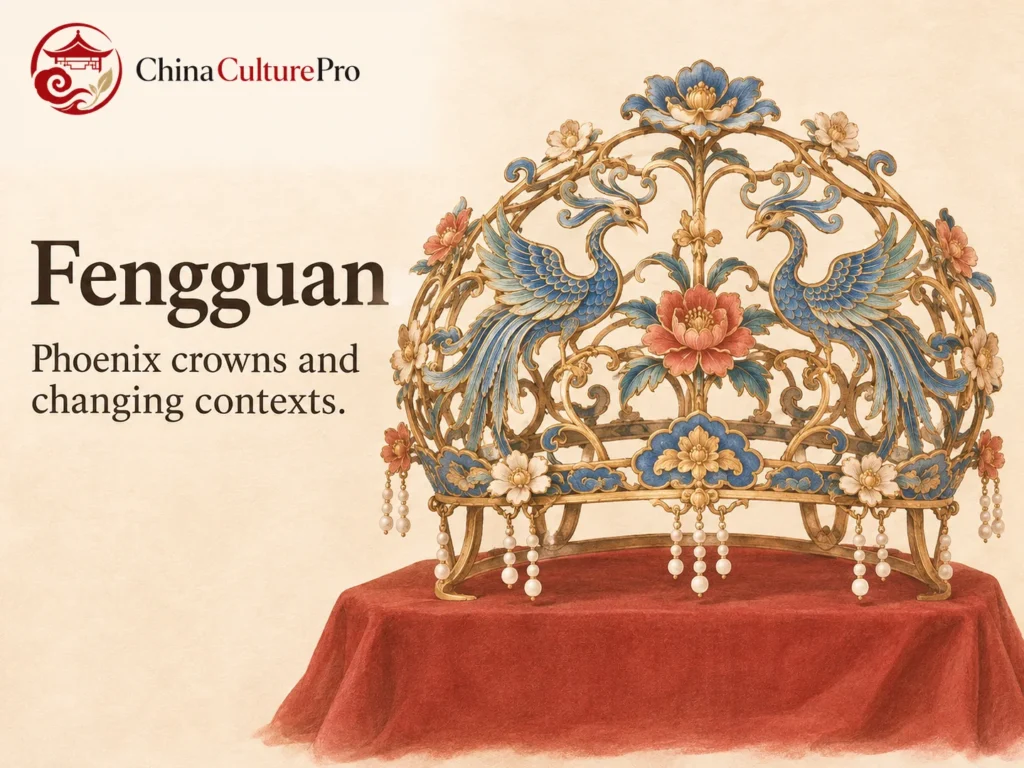

Quick Answer: What Is a Fengguan?
Fengguan(凤冠,fèngguān)means phoenix crown, a name used for elaborate Chinese headdresses associated with court ceremony and, in later contexts, bridal dress and performance. Surviving Ming imperial crowns provide especially well-documented examples.[1]
- The structure: A supporting frame carries layers of ornament.
- The decoration: Phoenixes can appear with dragons, flowers, beads and pendants.
- The context: An imperial crown, a bridal headdress and a stage crown require different explanations.
The name does not identify one fixed number of birds or a single construction used throughout Chinese history. An object’s period, materials and documented use matter more than its silhouette alone.
Blue ornament, gold-colored metalwork and hanging beads can make a phoenix crown visually striking. The details invite closer questions: what supports the decoration, who wore it, and on what occasion? Within Chinese clothing history, fengguan is best approached through particular objects and settings rather than one timeless model.
A Supporting Frame and Decorative Layers
An ornate exterior conceals a supporting structure. The National Museum of China describes Empress Xiaoduan’s crown as having a lacquered bamboo framework covered with silk, carrying goldwork, gems, pearls and other ornament.[1] The frame and decorative layers perform different jobs.
Kingfisher feather inlay(点翠,diǎncuì)creates the blue surface on parts of that historical crown. It is distinct from the metal framework, gemstone settings and threaded pearl decoration. Different techniques contribute different effects: structure, fine outlines, reflective color and movement.
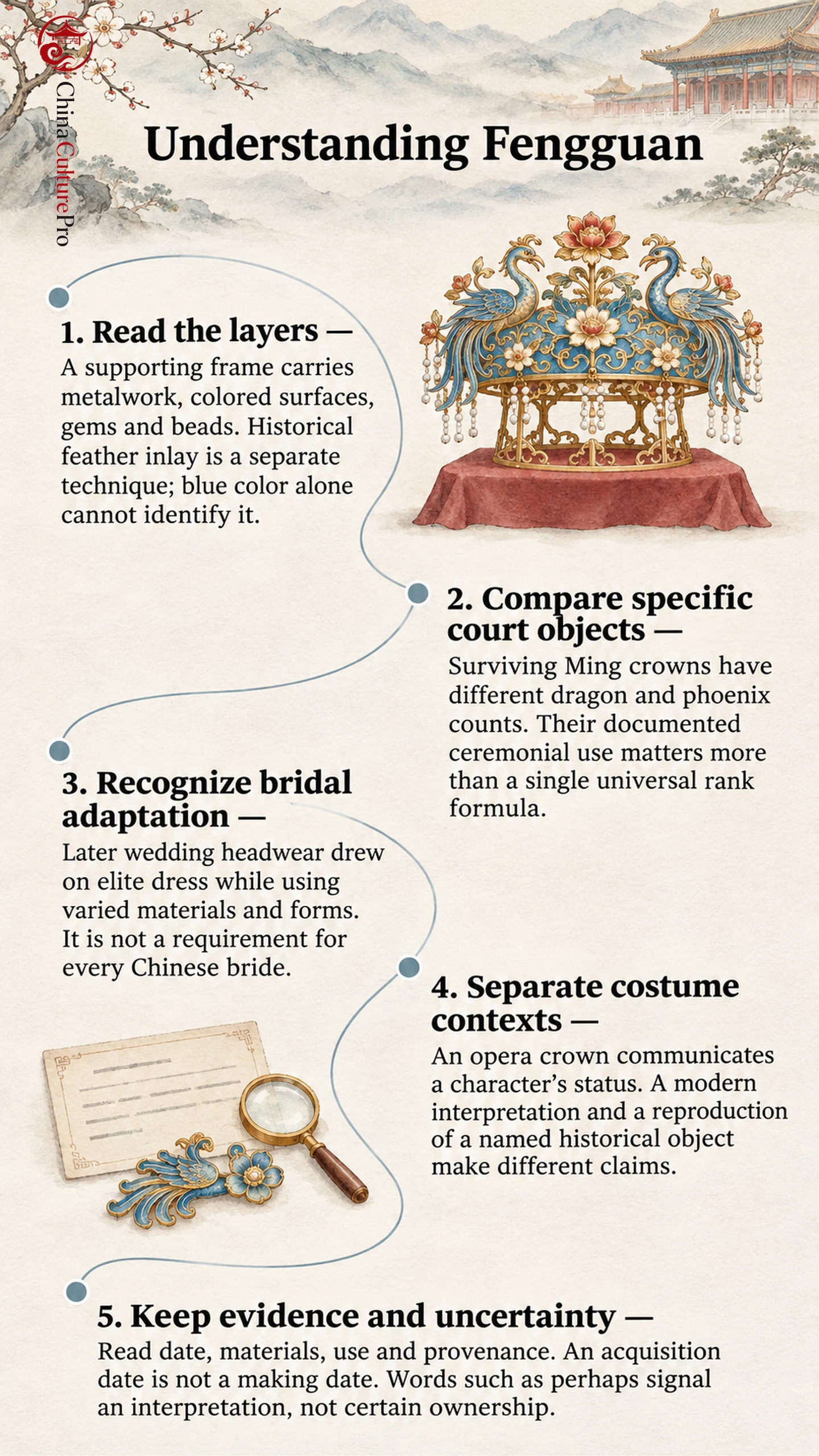
Material descriptions must remain object-specific. A modern blue decoration cannot be identified as historical feather work from its color alone. Likewise, a gold-colored surface does not by itself establish solid gold. Reading the medium is part of understanding the craftsmanship.
Ming Empresses and the Dingling Crowns
The Palace Museum identifies its crown with three dragons and two phoenixes as belonging to Empress Xiaojing. Its description places the imperial crown within formal uses such as investiture, ancestral worship and court audiences.[2] These are ceremonial settings, rather than evidence that such headwear was an everyday accessory.
The National Museum’s Xiaoduan example has nine dragons and nine phoenixes. Both come from Dingling, the tomb associated with the Wanli emperor and his consorts.[1] Their different combinations show why the name does not imply one fixed bird count.
Written regulations and surviving objects also need to be compared carefully. The Palace Museum records an earlier prescribed nine-dragon, four-phoenix form alongside its later surviving crown.[2] A rule from one date is not a reliable decoder for every later example. Rank, occasion and historical change belong in the explanation.
Bridal Adaptations and Local Customs
Bridal use developed its own meanings and forms. Historian Zhao Yaodan describes how later Ming and Qing wedding dress drew creatively on elite ceremonial clothing. Her discussion also distinguishes early permission to borrow ranked clothing from an explicit rule requiring the familiar crown-and-cape combination.[3]
Bridal headwear adapted the prestige of court dress through varied materials, forms and scale. An early twentieth-century wedding headdress in the Guimet collection includes gilded cardboard, metallic thread, silk pompons, mirrors and glass among its materials.[4] The impressive effect depended on assembled ornament, not only precious metal.
The British Museum’s exhibition guide documents elaborate headdresses worn for Qing formal occasions including weddings, with variation among the examples.[5] Such evidence supports a range of practice. It does not establish a requirement for every Chinese bride. The guides to Chinese wedding dress и regional wedding customs place these choices in a wider context.
Stage Crowns and Contemporary Interpretations
A stage crown has a theatrical job. The Palace Museum’s catalogue includes a Guangxu-period phoenix crown decorated with glass beads, described as fan-shaped and worn by a noblewoman character in opera.[6] It is evidence for performance costume, not proof that an imperial consort wore that particular object.
TaipeiEYE’s own headdress guide explains how opera headwear communicates a character’s identity and status.[7] The audience reads the costume within the performance. The guide to Chinese opera costumes explains that larger visual system.
The same distinction helps when looking at contemporary bridal styling or historical drama. A piece may be an interpretation, a stage object or a reproduction of a named artifact. Those are different claims. For a claimed reproduction, ask which historical object or documented style it follows. A decorative interpretation can be appreciated through its own materials and design.
Reading a Collection Label
Begin with the object’s date and medium, then read its provenance and use. A museum acquisition date tells you when the object entered a collection; it is not automatically the date it was made. An inscription or a dragon motif may add evidence, but neither supplies a complete ownership history by itself.
Cambridge’s Museum of Archaeology and Anthropology records a late nineteenth-century fengguan with beads, wire, feather decoration and glass. Its catalogue preserves a bridal description alongside later labels tentatively associating it with a noblewoman.[8] The uncertainty should remain visible when discussing the object.
Distinguish an observed feature from an interpretation. “Glass beads” identifies a material; a tentative attribution to a court woman proposes an owner. Keeping those levels separate lets the crown’s craftsmanship remain impressive while its historical identity is described accurately.
FAQs About Fengguan
Is every fengguan an empress’s crown?
No. The term also appears in bridal and theatrical contexts. Identify the particular object and its documented use.
Does a fengguan always have nine phoenixes?
No. Surviving Ming imperial crowns themselves have different combinations of dragons and phoenixes.
Are all blue decorations kingfisher feathers?
No. Blue color alone does not identify a material or technique. Check the object’s description.
Must a Chinese bride wear a fengguan?
No. Bridal headwear varies by region, period and personal choice; it is not a universal requirement.
Источники
[1] National Museum of China. Empress Xiaoduan’s Nine-Dragon, Nine-Phoenix Crown
[2] Palace Museum. Empress Xiaojing’s Crown: Materials, Motifs and Ceremonial Context
[3] Zhao Yaodan, republished by Zhejiang Normal University. Changes in Ritual and Custom in Ming and Qing Bridal Dress
[4] Musée Guimet. Wedding Headdress: Early Twentieth-Century Materials and Ornament
[5] British Museum. China’s Hidden Century: Exhibition Guide, Elaborate Headdresses
[6] Zhang Shuxian, Palace Museum. Glass-Bead Phoenix Crown: An Opera Costume Object
[7] TaipeiEYE. Headdresses in Peking Opera
[8] Museum of Archaeology and Anthropology, Cambridge. Phoenix Headdress, E 1911.104.1–2: Catalogue and Label History