


Quick Answer: Who Was Faxian?
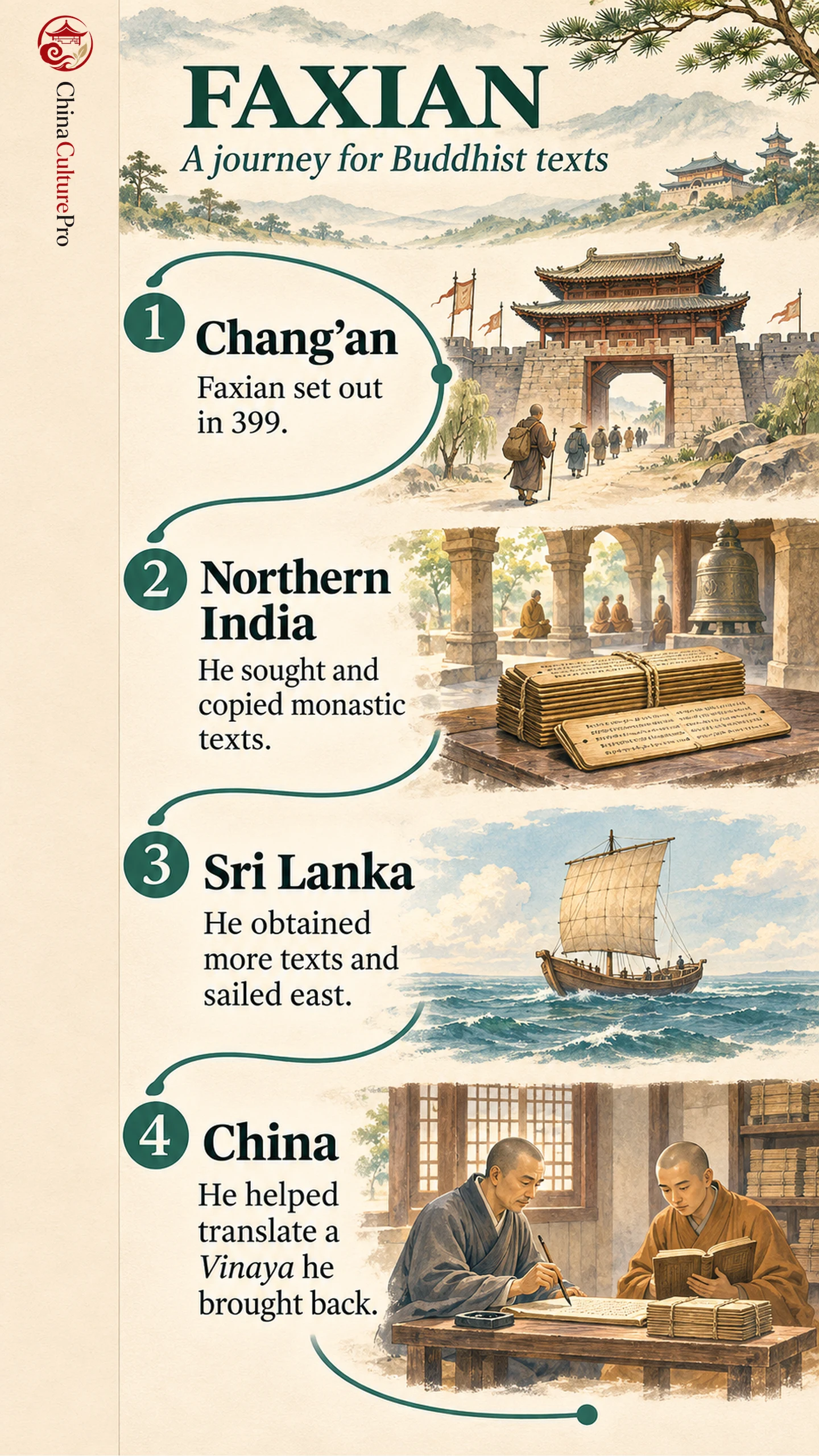
Faxian (法显, Fǎxiǎn) was a Chinese Buddhist monk who left China in 399 to seek texts on monastic discipline. He traveled overland to India, went on to Sri Lanka and returned by sea. The account of the journey survives as the Record of Buddhist Kingdoms (佛国记, Fóguó Jì).[1][2]
- Purpose: He sought versions of the Vinaya (律, lǜ), the texts governing Buddhist monastic life.[1]
- Journey: He traveled from Chang’an (长安, Cháng’ān) through Central Asia to India, then took a maritime route home.[1][6]
- Afterward: He helped translate a monastic code he obtained in India.[4][5]
The record of his travels and the manuscripts that he carried back are different works with different purposes.
Faxian (法显, Fǎxiǎn) was already an older monk when he set out. His search for rules used in Buddhist monasteries took him across Central Asian deserts and aboard merchant ships. What survives includes an account of what he encountered and translations that show what happened to some of the texts after he returned.[1][5]
From Chang’an to India and Sri Lanka
Faxian left Chang’an (长安, Cháng’ān) in 399. His party traveled past Dunhuang and through Central Asian Buddhist communities, including Khotan. The route crossed areas often discussed in histories of the Silk Road. In Pataliputra, Faxian found a copy of the Mahāsāṃghika Vinaya (律, lǜ). His search for written texts took him farther east to the port of Tamralipti, where he embarked for Sri Lanka.[4][6]
The record places him in Sri Lanka for two years. He obtained additional texts there and boarded a merchant ship. The voyage back was hazardous. His account records storms as well as the encounters at monasteries that motivated his journey.[3][4]
What His Record Preserves
The Record of Buddhist Kingdoms (佛国记, Fóguó Jì) describes shrines, monasteries and acts of devotion. At Abhayagiri in Sri Lanka, the account says that Faxian saw a merchant offer a white silk fan near a Buddha image. The sight brought him to tears after years away. The offering links a remembered object from home with the experience of Buddhist pilgrimage.[3]
The book also records stories that local people told about sacred sites. Read its description of an offering alongside these narratives, with attention to what the narrator observed and what he reports hearing.[3]
What Faxian Brought Back
In China, Faxian worked with Buddhabhadra on a Chinese translation of the Mahāsāṃghika Vinaya, completed around 418. The original copy from Pataliputra and the resulting Chinese text connect an episode of the journey with later work in a monastery. Faxian’s concern with monastic discipline also provides a point of comparison with the later pilgrims Xuanzang и Yijing.[4][5]
FAQs About Faxian
What was Faxian looking for in India?
He was seeking copies of the texts that lay out the rules of Buddhist monastic life. He also obtained other kinds of Buddhist texts on his travels.
Did Faxian return by the route he used to go to India?
He went to India by land. On the return he traveled by sea, sailing east from Sri Lanka on merchant vessels.
Is Fa-Hien the same person as Faxian?
Yes. Fa-Hien is an older romanization of Faxian’s name, used in some English translations of his travel record.
Источники
[1] Columbia University, Asia for Educators. Tansen Sen, The Travel Records of Chinese Pilgrims
[2] University of Vienna, Bibliotheca Sinica. Faxian/Giles: Record of the Buddhistic Kingdoms
[3] James Legge, translator. A Record of Buddhistic Kingdoms
[4] Hamburg Buddhist Studies. Faxian and the Transmission of Vinayas
[5] Bukkyō Dendō Kyōkai. Lives of Great Monks and Nuns
[6] University of Washington, Silk Road Seattle. The Journey of Faxian to India