
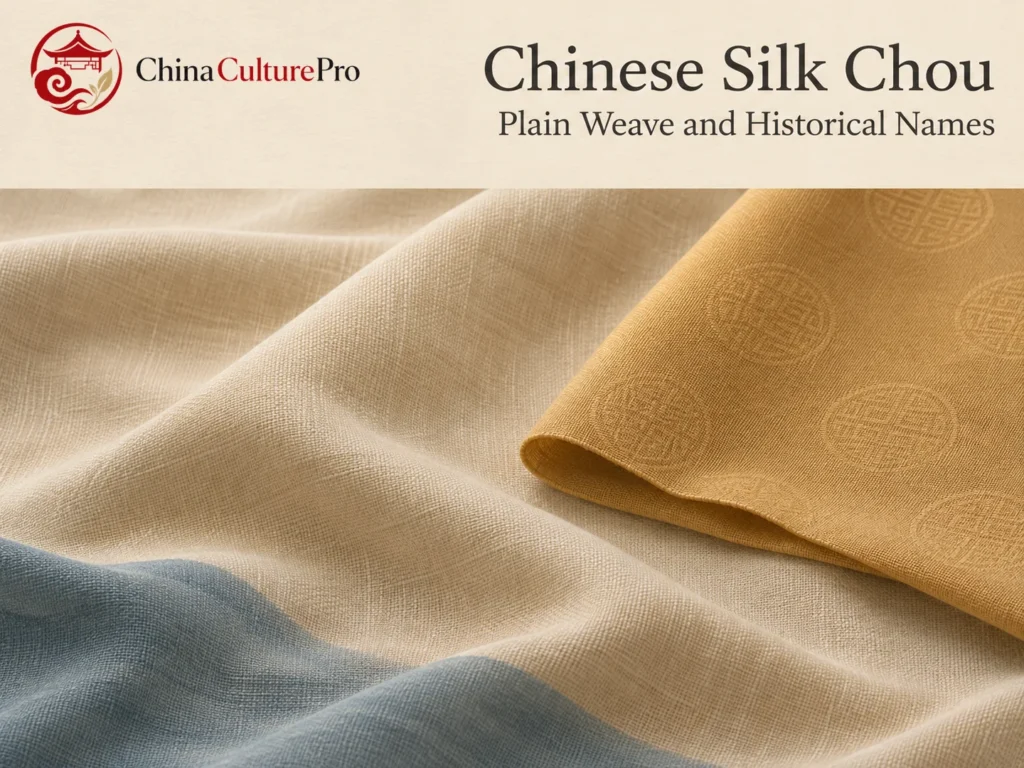

Quick Answer: What Is Chinese Silk Chou?
Chou (绸, chóu) is a Chinese term for silk cloth. It can describe plain-woven silk in modern museum explanations. Some historical varieties also had woven patterns, and the older form 䌷 had an association with spun silk.[1][2]
- Older distinction: The China National Silk Museum contrasts spun-silk chou with juan (绢, juàn) woven from reeled filament silk.[1]
- Plain weave: A basic example alternates the crosswise thread over and under individual lengthwise threads.[6]
- Garment uses: Qing catalogs name chou as an outer garment fabric and as a lining.[3][5]
Check the date and the weave description beside the name to see how narrowly chou is being used.

Two museum labels can use chou for fabrics with different surfaces. One may be explaining a basic weave. Another may name a historical variety with a subtle woven pattern. The date and the garment’s construction help explain the difference.
Read the Name in Its Period
The China National Silk Museum describes an older distinction in yarn. Silk reeled from an intact cocoon gives a long filament. Fibers from pierced cocoons can be spun. In this distinction, plain-woven silk made with reeled thread was called juan, while cloth made from spun silk could be called chou and written 䌷.[1]
The museum records a wider usage by the Ming and Qing, covering plain-woven and subtly figured twill silks. Examples include Lu chou (潞䌷) and Jiang chou (江䌷). The museum dates the shift to the written form 绸 and its broader use for ordinary silk fabrics to the Qing.[1]
What Plain Weave Tells You
Plain weave alternates each crosswise thread over one lengthwise thread and under the next. On the following pass the order reverses. The China National Silk Museum catalogs a yellow-brown silk fragment as juan and gives this one-over-one construction. Its weave description identifies the structure directly.[6]
The same museum uses chou when introducing a plain-woven silk category in its exhibition materials. That introductory description gives one common use of chou. For a named historic cloth, check whether its record specifies the yarn or the weave.[2]
How Qing Garments Used Chou
A bright yellow Tongzhi-period robe in the Palace Museum is a summer garment for an empress. The catalog names jiangchou (江绸, jiāngchóu) as its main fabric. The surface carries a subtle woven pattern of roundels built around the character for longevity. The dark satin around the neck is a separate trim.[3]
On a later pale purple garment, the museum identifies a plain-weave figured chou ground and separately describes embroidery of plum branches. In another robe, the outer fabric is figured ling and the lining is chou. Read the record by garment layer. The outer fabric, embroidery and lining can carry separate names.[4][5]
Compare Chou With Other Silk Names
Begin with the catalog’s structure and surface description. Silk gauze luo describes open structures made by crossing selected lengthwise threads. Silk crepe zhou draws attention to the fine crinkling created by yarn and finishing. Silk damask ling can name figured twill examples with a pattern in the weave.
For a chou garment with additional needlework, inspect its base fabric and the visible stitches separately. The Chinese satin stitch guide explains how a stitch can add a filled design over already patterned silk.
FAQs About Chinese Silk Chou
Does chou always mean plain weave?
The label can describe plain-woven silk. Historical uses also include figured fabrics, so look for a weave specification alongside the name.[1][2]
What was the difference between chou and juan?
In one older distinction, chou used spun silk yarn and juan used reeled silk filament.[1]
Can chou describe an embroidered garment?
Yes. The Palace Museum records a Guangxu-period garment with figured chou beneath its embroidered plum branches.[4]
Источники
[1] China National Silk Museum. What Are Ling, Luo, Chou and Duan? Part Two
[2] China National Silk Museum. The Story of Chinese Silk
[3] The Palace Museum, Beijing. Bright Yellow Jiangchou Informal Robe
[4] The Palace Museum, Beijing. Pale Purple Chou Gown with Embroidered Plum Branches
[5] The Palace Museum, Beijing. Pink Figured Ling Padded Robe
[6] China National Silk Museum. Yellow-Brown Juan