

Quick Answer: What Was a Chinese Seed Drill?
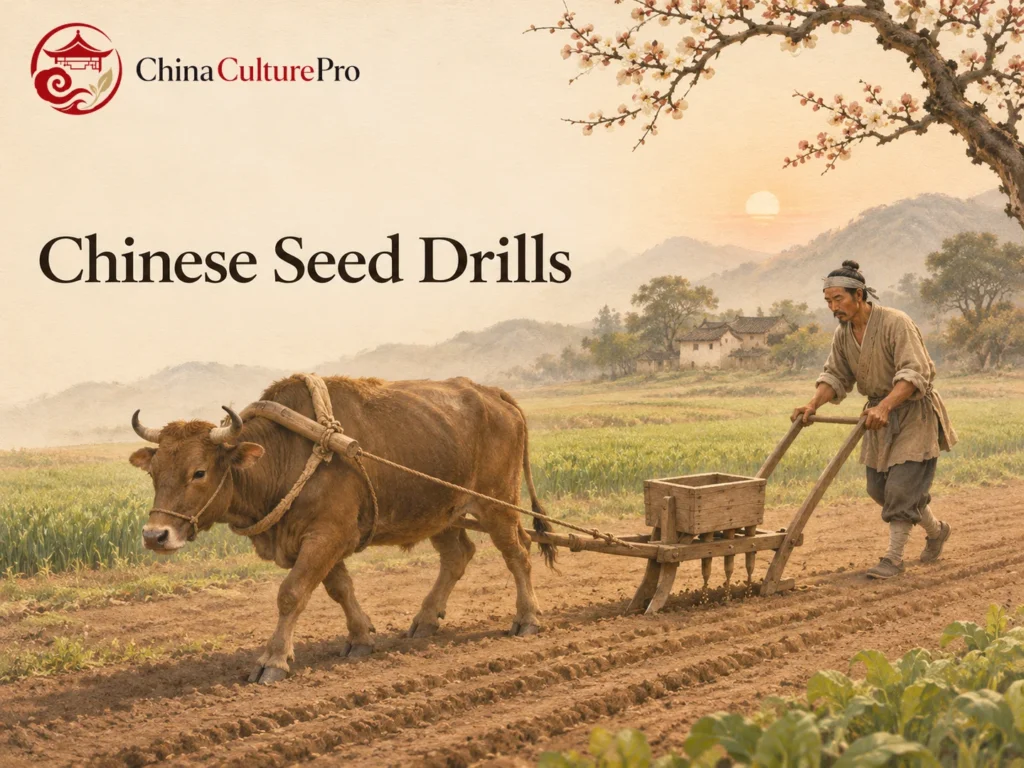
The louche (耧车, lóuchē) was a Chinese seed drill that placed seeds in furrows as it moved. A hopper fed seeds down through openings toward the soil. Designs with several legs could sow more than one row in a pass.[1][2]
- How it helped: The implement combined making furrows with placing seeds in them, reducing the need for separate work.[1][2]
- An early association: Later texts connect Zhao Guo (赵过, Zhào Guò), an official under Emperor Wu of Han, with promoting this kind of sowing.[1]
- A detailed description: Wang Zhen (王祯, Wáng Zhēn) recorded different versions in his agricultural treatise Nongshu (农书, Nóngshū) in 1313.[1][5]
The historical records describe several designs. The familiar three-legged example represents one form.[1]

A plough and a seed drill can look similar in an old image. Both may have wooden frames pulled by an animal. The clue that matters most is the path of the seed. A seed drill has a way to carry seed and release it as the tool passes through the field.[1][2][4]
How a Louche Planted Rows
In the two-legged design described by Wang Zhen, the farmer placed grain in a central hopper. Openings from that container led down through the hollow legs. As an ox drew the implement forward, the person behind the drill guided and shook it. The seed fell into the lines opened by the implement.[1]
That arrangement brought the opening of furrows and the placement of seed together. Some descriptions also credit the drill with covering the seed in the same pass. Wang Zhen describes a separate rolling tool that could press the soil after sowing. The presence of a follow-up tool helps distinguish the work done by the drill from all the work needed to prepare the planted rows.[1][2]
Row planting made the spacing of the furrows more regular than scattering seeds over the soil. The exact results depended on the implement, the field and the people using it. This kind of change in field labor is one reason the drill appears in histories of Chinese inventions.[1][2]
Why Zhao Guo Is Associated With the Seed Drill
Zhao Guo worked under Emperor Wu in the Western Han. A passage attributed to the Eastern Han writer Cui Shi (崔寔, Cuī Shí) connects Zhao with an arrangement in which one ox drew three soil-working elements as part of a method for planting. The account appears in Wang Zhen’s much later work, where the comparison is made to a three-legged drill.[1]
The passage shows that a tradition linked an official with the spread of an agricultural method. It does not give an eyewitness description from the official’s own lifetime or establish that he made the first such tool. The distinction matters when the story is used to date changes in agriculture during the Han dynasty.[1]
What Wang Zhen Recorded in 1313
The Yuan dynasty treatise describes one-, two- and three-legged forms. It also reports a four-legged version west of the passes and describes the two-legged drill as common in the regions it calls Yan, Zhao, Qi and Lu. That regional detail helps explain why later illustrations do not all look alike.[1][5]
Wang Zhen’s agricultural work also includes a design that delivered fine manure while sowing. Its appearance in the text gives the idea a documented place in Yuan agricultural writing. A later study argues that a Song poem may point to earlier use of a fertilizing drill. Dating the first surviving detailed account and dating the first use are different questions.[1][2][5]
What a Tomb Painting Can Establish
A Han tomb at Zaoyuan in Pinglu, Shanxi, preserves an agricultural scene widely read as an ox pulling a seed drill. The tomb is often dated around the transition from Western to Eastern Han. A published discussion notes that a hopper is hard to identify in the image. That feature matters because an image of an ox-drawn implement can be read in more than one way.[3][4]
A Jin-period tomb painting from Songcun in Shanxi offers another point of comparison. Its agricultural implements have been compared with the drill and roller described in Wang Zhen’s book. Read the pictures beside the text. The pictures record how tools were represented, while the descriptions make particular features and regional variants easier to identify.[1][4][5]
FAQs About Chinese Seed Drills
Was a seed drill the same as a plough?
A seed drill placed seed in the furrow as it moved. A plough primarily worked the soil. The hopper and channels that let the seed reach the ground distinguish the drill.[1][2]
Did all Chinese seed drills have three legs?
Wang Zhen describes several forms, including single-, double- and three-legged designs. The three-legged example is one version of the broader tool family.[1]
Did a seed drill spread manure as well?
Some historical designs combined seeding with the application of fine manure. The Nongshu describes a separate compartment for it on one version.[1][2]
Источники
[1] Chinese Text Project. Wang Zhen’s Nongshu, Volume 12
[2] Zeng Xiongsheng. A Study of the Fertilizing Seed Drill in the Song Dynasty
[3] Shanxi Department of Culture and Tourism. Agricultural Scenes in the Pinglu Zaoyuan Han Tomb
[4] Institute for the History of Natural Sciences. Agricultural Tools in the Jin Tomb Murals at Songcun, Shanxi