


Quick Answer: What Are Chinese Peanut and Sesame Candies?
Chinese peanut candy, huasheng tang(花生糖,huāshēng táng), and sesame candy, zhima tang(芝麻糖,zhīma táng), are families of sweets in which nuts or seeds are combined with a sugar binder.
- Main ingredients: Peanuts, white sesame, black sesame or mixtures provide the body and toasted character.
- Structure: Syrup holds the ingredients together in pieces that may be thin, chunky, crisp or chewy.
- Occasions: They appear as everyday snacks, tea accompaniments and festive sweets for sharing or gifting.
There is no single compulsory formula. A peanut candy can include sesame, and a sesame bar may contain other nuts. Check the actual ingredients. [1]
A thin shard of sesame candy snaps differently from a thick piece packed with chopped peanuts. Both belong within the broad world of traditional Chinese desserts, but their names alone reveal little about the bite. The useful questions are what fills the piece, what binds it, and how it was formed.
Nuts, Seeds and the Sugar Binder
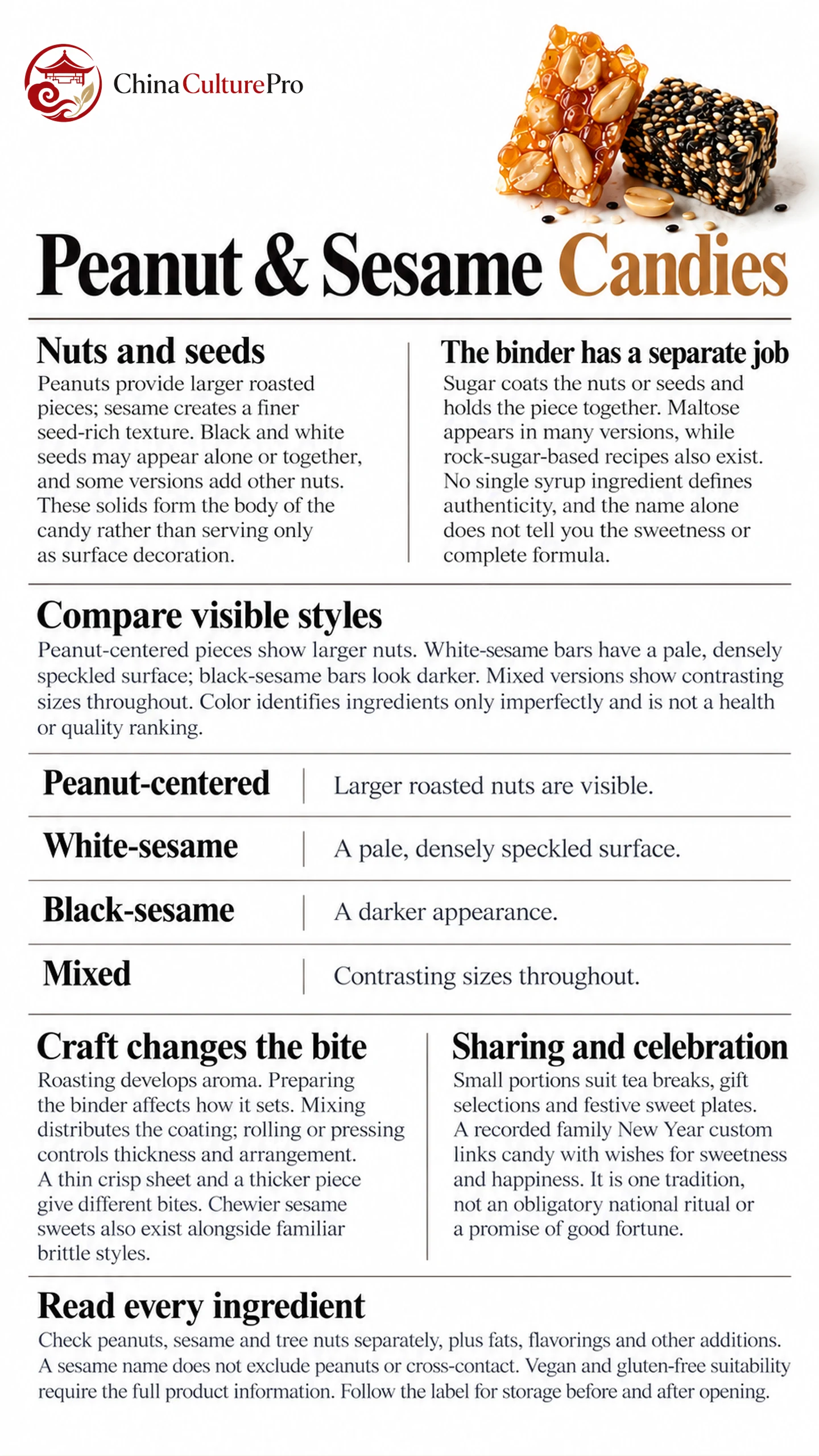
The nuts or seeds are the main solid ingredients, rather than merely decoration. Peanuts contribute larger pieces and a distinctive roasted flavor. Sesame produces a finer-grained surface and a different toasted aroma; white and black seeds can be used separately or together. Some versions add walnuts, cashews or other nuts. [1][2]
The binder has another job: it coats the solids and holds them in a shape that can be portioned. Sugar with maltose is one familiar combination. A rock-sugar-based version also exists, so maltose should not be treated as a universal authenticity test. The finished texture depends on the whole preparation, not the presence of one named syrup. [3]
The amount of visible sugar also changes the experience. Some pieces look like nuts barely joined together; others show a clearer amber matrix between them. Neither appearance tells you how every maker balances sweetness. “Sesame candy” describes a broad ingredient family, rather than guaranteeing a particular sugar content or formula.
How Roasting, Binding and Shaping Change Texture
The craft can be understood as separate stages. Preparing and roasting the nuts or seeds develops their aroma and bite. Making the sugar binder determines how the mixture will set. Combining the components distributes the coating, while rolling or pressing establishes the final thickness and arrangement. [1][3]
These stages explain why texture can vary even when the ingredient names look similar. Larger peanut pieces interrupt a bite differently from closely packed sesame seeds. A thin sheet gives a different bite from a thick slab, and the syrup’s final state affects whether the piece snaps or yields.
The familiar brittle style is crisp, but that does not make every Chinese nut or seed sweet identical. Chewier sesame sweets also exist, alongside familiar crisp versions. Choose a stated texture rather than expecting every piece to behave like clear hard candy. [2]
This is a description of craft, not a boiling-sugar tutorial. A tested confectionery method is needed to reproduce a particular texture; a photograph of an amber syrup cannot supply that method.
Peanut, Sesame and Mixed Styles
A useful comparison starts with the main ingredient:
| Вид | Main solid component | Характерный внешний признак |
|---|---|---|
| Peanut-centered candy | Whole, halved or chopped peanuts | Clearly visible nut pieces in the binder |
| White-sesame candy | Mostly pale sesame seeds | A densely speckled, light-colored surface |
| Black-sesame candy | Mostly dark sesame seeds | A dark, seed-rich cross-section |
| Mixed nut-and-seed candy | Peanuts or other nuts combined with sesame | Contrasting seed and nut sizes throughout |
These are descriptive styles, not mutually exclusive recipes. A dark bar can contain white sesame and chopped nuts as well as black sesame. A peanut-centered piece may have sesame scattered through it, rather than sitting only on its surface. [2]
Compare the structure with sachima: there, fried dough ribbons provide the body and syrup binds them together. In nut or seed candy, the body is the nuts or seeds themselves. A rectangular shape does not make the sweets equivalent.
Festive Sharing and Everyday Snacks
These candies have a natural place on a shared sweet plate. Their small portions can be offered with tea, put in gift selections or eaten as ordinary snacks. A recipe associated with one household can also preserve memories of who roasted, mixed or shaped the sweets.
One published family-making account describes a New Year brittle learned through an older generation, with a specialist once brought into the home to prepare it. In that account, candy expresses hopes for sweetness and happiness in the coming year. This is a documented family custom, rather than proof that every Chinese household follows one candy-making ritual. [3]
Within Chinese New Year food traditions, such meanings accompany the food; they do not prescribe an obligatory ingredient or guarantee good fortune. Peanut and sesame candies can be enjoyed well beyond the holiday.
Serving and Ingredient Checks
Choose the texture you want before choosing a decorative box. For a shared plate, offer manageable pieces and identify which contain peanuts, sesame or other nuts. Keep different varieties recognizable rather than mixing everything into an unlabeled bowl.
Peanuts, sesame and tree nuts require separate checks. A sesame-only name does not guarantee the absence of peanut ingredients or cross-contact, and a peanut candy can contain additional nuts. Read the full ingredient and allergen information, including the fat, flavorings and other additions. [4]
For vegetarian or vegan choices, a simple plant-based version is possible, but the name alone does not establish the complete recipe. The same applies to gluten avoidance: examine all components and production information. Follow each product’s storage instructions, including after opening, instead of applying one homemade-candy shelf life to every package.
FAQs About Peanut and Sesame Candy
Are all Chinese peanut and sesame candies brittle?
No. Crisp brittle is familiar, but the binder and making method can produce different degrees of firmness or chew. Look for the stated texture.
Does sesame candy always contain peanuts?
No, but some versions do. Check ingredients and cross-contact information rather than assuming the word “sesame” excludes peanuts or tree nuts.
Is maltose essential?
No. It appears in many recipes, while other versions use different sugar binders. One syrup ingredient does not define the entire category.
Are these candies vegan or gluten-free?
Some may meet those requirements. Check the complete formula, added ingredients and relevant production information; nuts and seeds alone do not establish the finished product’s suitability.
Источники
[1] China Sichuan Food. Peanut Candy
[2] China Sichuan Food. Sesame Candy
[3] The Woks of Life. Homemade Chinese Sesame Peanut Brittle
[4] U.S. Food and Drug Administration. Food Allergies: What You Need to Know