


Quick Answer: What Can Represent Friendship in Chinese Culture?
Chinese friendship symbols include written words, plant motifs and images connected with shared understanding. Youyi(友谊,yǒuyì)means friendship: the bond rather than the person.[1] Visual associations need more context than a word’s dictionary meaning.
- Writing: Characters can state friendship directly, but “friend” and “friendship” are different words.
- Plants: Pine, bamboo, plum and orchids can convey qualities valued between friends.
- Stories and objects: Listening, shared words and a painting’s dedication can make a relationship explicit.
There is no single image that must mean friendship whenever it appears. The combination, inscription and occasion help establish the meaning.
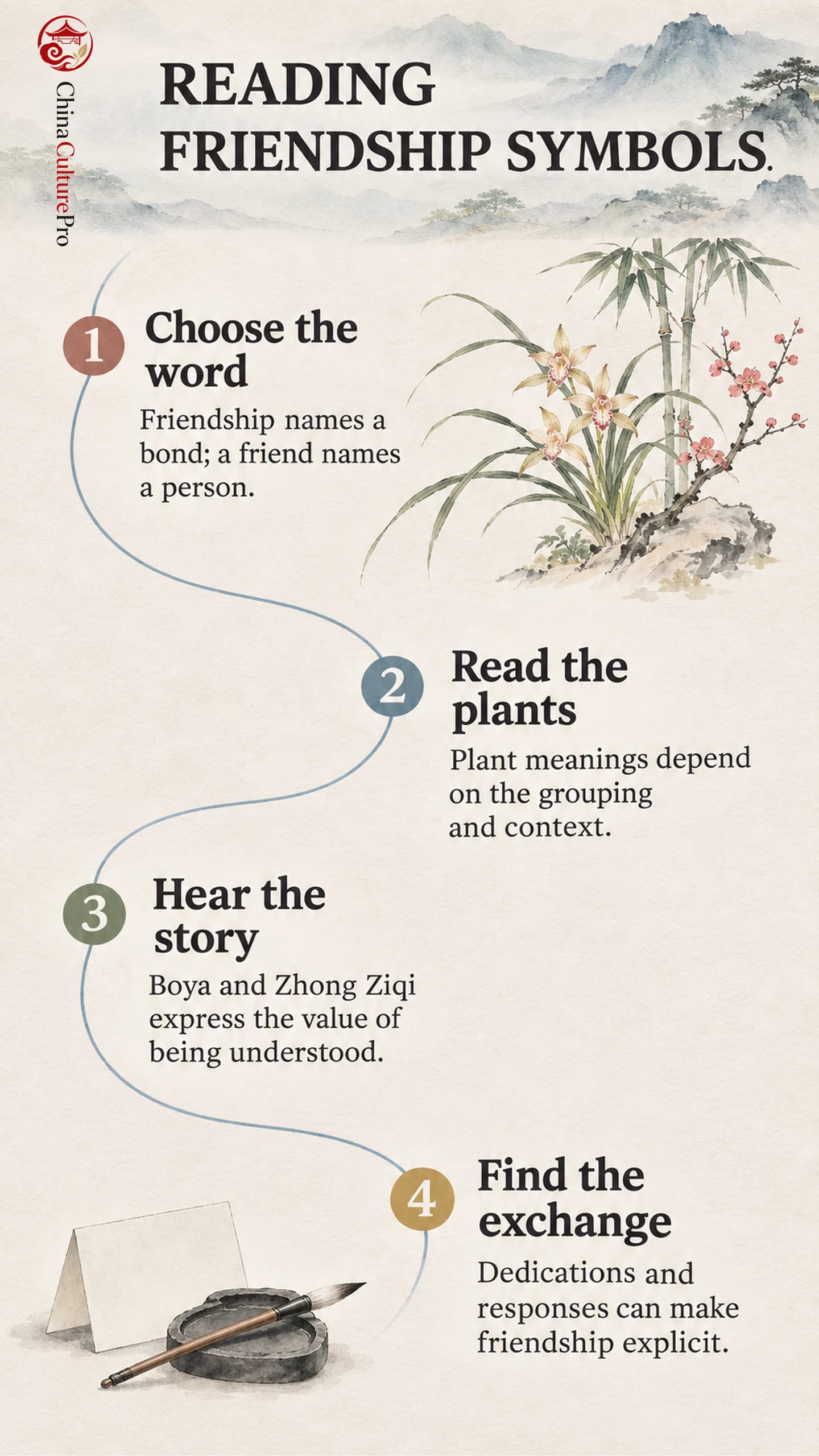
A word written on a card can state a feeling directly; a painted orchid leaves more to interpretation. Chinese friendship imagery draws on both language and cultural associations. This guide connects familiar motifs with particular texts and objects, helping readers distinguish a shared value from evidence of a particular friendship.
Writing Friendship: You, Youyi and Pengyou
Start with the intended word. These related forms describe different things.
| Термин | Значение |
|---|---|
| youyi(友谊,yǒuyì) | Friendship: the relationship or bond between friends. |
| pengyou(朋友,péngyǒu) | A friend or friends: the person or people in that relationship. |
| you(友,yǒu) | Friend, or a friendly relationship, depending on how the character is used. |
The first two entries distinguish an abstract bond from its participants.[1][2] The single character also appears within words and can have several grammatical uses.[3] It is a written character, not a pictorial logo with one meaning independent of language.
The traditional form 友誼 and simplified form 友谊 write the same word. A different script form does not indicate a stronger or weaker friendship. When choosing wording, Chinese characters should remain legible as language; a decorative font does not remove the need for the intended word.
Plants That Evoke Steadfastness and Affinity
The Three Friends of Winter(岁寒三友,Suìhán sānyǒu)are pine, bamboo and flowering plum. Their endurance or flowering in cold conditions makes them images of steadfast character.[4] The grouping can evoke companionship under adversity, while its associations also extend beyond friendship to moral character and auspicious wishes.
A solitary pine should therefore not automatically be translated as “best friend.” Look at whether the other plants appear, what the title says and whether a dedication identifies a relationship. The group’s name supplies one layer of interpretation, not a complete account of every object carrying it.
Orchid fragrance offers another literary route. A passage associated with the *Book of Changes*(易经,Yìjīng)compares two people united in purpose with a force that can cut metal, and their harmonious words with the fragrance of an orchid. A Song commentary explains the comparison through sincerity and shared intention.[5]
Here, the important association is the quality of communication. The fragrance gives an image to words exchanged by people whose minds agree. Reading the passage alongside friendship and farewell poetry reveals how a natural image can carry an interpersonal meaning without becoming an exclusive friendship emblem. The Book of Changes supplies a particular textual setting for this comparison.
Zhiyin: Friendship as Understanding a Sound
Zhiyin(知音,zhīyīn)literally suggests knowing or understanding a sound. A story in the *Liezi*(列子,Lièzǐ)makes that idea vivid through music. Boya(伯牙,Bóyá)plays with mountains or flowing water in mind; Zhong Ziqi(钟子期,Zhōng Zǐqī)recognizes the intention through what he hears.[6]
The passage continues with a storm. Boya plays music evoking prolonged rain and a collapsing mountain, and the listener again grasps its meaning. The musician marvels that his imagined feelings have found such an attentive hearer.
The passage expresses their relationship through the act of being understood. A scene of playing and listening can draw on that association when its title, inscription or narrative identifies the figures.
The distinction matters when looking at guqin imagery. An instrument alone may refer to music, cultivated leisure or another story. A player and listener suggest a relationship, but identifying them as these named characters still requires contextual evidence. The literary example explains a model of intimacy rather than documenting every musical meeting in ancient China.
Dedications, Gifts and the Meaning of an Image
Zheng Xie(郑燮,Zhèng Xiè)offers a concrete example in *Orchids and bamboo*, dated 1742, now in the Metropolitan Museum of Art. He dedicated the painting and poem to his friend Cheng Duo. The recipient added an inscription and invited three friends to contribute further inscriptions.[7]
In a detail of the painting, long orchid leaves sweep across open paper while dark and pale ink marks create different weights of foliage. Several blocks of writing and red seals share the surface with the plants. Looking at the plants alone would omit part of the object’s social history.
The dedication and responses make friendship explicit. They identify an exchange among people; the vegetation gives that exchange an expressive language. These are complementary kinds of evidence, not interchangeable clues.
For a personal card or gift, wording can make an intended association clearer: name the relationship or explain why a plant’s qualities suit the occasion. Gift-giving etiquette provides the wider social context. The people and occasion give the motif its particular meaning.
FAQs About Chinese Friendship Symbols
Does youyi mean a friend?
No. It means friendship, the bond. Pengyou refers to a friend or friends.[1][2]
Are the Three Friends of Winter three historical people?
No. The name identifies the plant grouping of pine, bamboo and flowering plum.[4]
Does every orchid image mean friendship?
No. An inscription, dedication or literary setting can establish that association; the plant alone is insufficient to identify it.
Источники
[1] Ministry of Education, Taiwan. Revised Mandarin Chinese Dictionary: youyi
[2] Ministry of Education, Taiwan. Revised Mandarin Chinese Dictionary: pengyou
[3] Ministry of Education, Taiwan. Revised Mandarin Chinese Dictionary: you
[4] Tokyo National Museum. Chinese paintings with auspicious subjects: Three Friends of Winter
[5] Shidianguji. Zhouyi Kouyi: shared intention and orchid fragrance
[6] Shidianguji. Liezi: Boya plays and Zhong Ziqi listens
[7] Metropolitan Museum of Art. Zheng Xie, Orchids and bamboo, 1742