


Quick Answer: What Did Historical Chinese Earrings Look Like?
Chinese ear ornaments survive in forms ranging from slit stone rings to hooked gold earrings and pearl drops. The fitting shows how the piece could be worn. Excavation records, dress rules and portraits give other kinds of evidence.[1][3][6]
- Slit rings: Some early jade rings have been found by the ears in burials.[1]
- Hooked ornaments: A Ming pair combines long gold hooks and white jade gourds.[3]
- Court sets: A Qing set contains six gold ornaments with two pearls each.[5]
Check the object’s attachment and the evidence of how it was worn before naming its use.
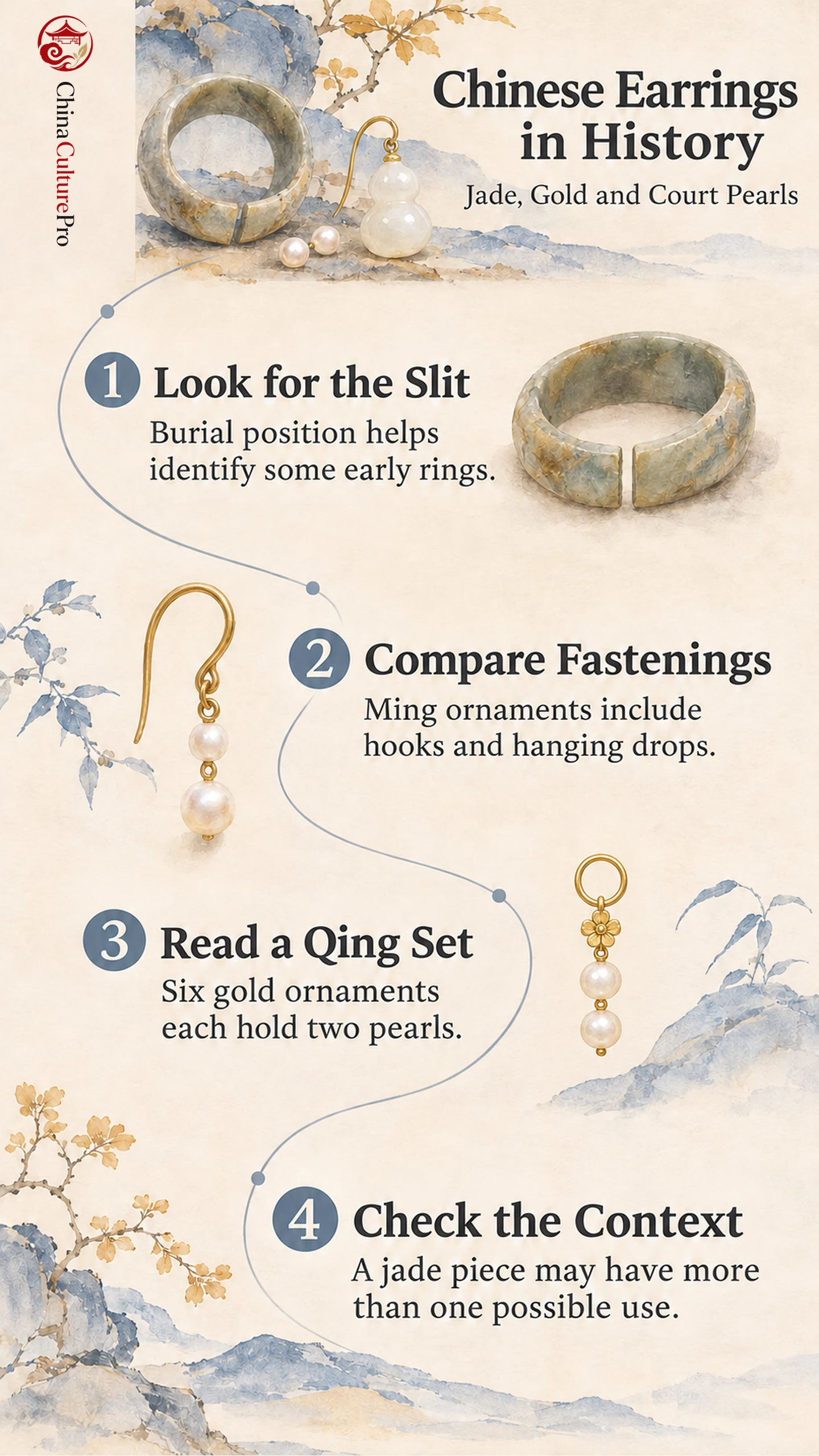
Look at the part nearest the ear before focusing on a jewel’s most decorative feature. A slit, a long hook or a small ring can tell you as much about its use as the material below it.
Read the Ear Position and the Slit
A jue (玦, jué) is a ring with a break in its rim. A jade example attributed to the Neolithic Xinglongwa culture measures 4.1 centimeters across. Similar objects often appear by the ears of people in early burials, which supports an interpretation as ear ornaments. One ring in an eye socket at Xinglongwa shows why find position matters for each piece.[1]
Compare Tang Gold and Ming Hooks
A pair of Tang dynasty gold earrings measures 3.5 centimeters high without the pins. When comparing this pair with another, check whether its measurement includes the attachment. The pair provides evidence for one design in use during the period, while leaving its wider popularity open.[2]
A pair excavated from a Ming dynasty tomb in Shanghai uses long curved hooks. Each earring is 5.5 centimeters long. Two rounded jade pieces form a small gourd against gold fittings. Compare this shape with Ming drops that suspend a separate moving ornament from a ring, or with small studs that sit closer to the ear.[3][4]
How Qing Court Pearl Sets Were Assembled
A Qing court set has six gold earrings, each 4.3 centimeters long. Below each circular loop sits a small gold filigree flower fitting. Below it, two Eastern pearls (东珠, dōngzhū) form the drop. A screw fitting joins the upper and lower parts. The group survives with separate jade and wooden boxes.[5]
The empress’s court dress regulations prescribed three ornaments per side. The rule helps explain why a set could include six pieces, while an individual set still needs its own provenance. Chinese court necklaces provide a related example of how material and dress rules apply to one kind of ornament at a time.[6]
Identify Ear Ornaments With Context
A small Qing jade object is cataloged as either an earring or a bonnet pendant. Its listing leaves the position of wear open. In this case the catalog records both possibilities, and the jade shape alone leaves them unresolved.[7]
Start with the surviving fastener. Then compare the object with excavated positions, dated illustrations or named groups in a collection. The Chinese jade pendants guide shows how stones can be strung elsewhere on the body. Chinese enamel jewelry compares enamel on earrings and other wearable objects.
FAQs About Chinese Earrings in History
Were jade slit rings always earrings?
Some were found near the ears. Other positions are documented, so use the archaeological evidence for the particular ring.[1]
How do a hook and a drop differ?
A hook is a fitting used to attach the ornament. A drop is a part suspended below a fitting. Ming jewelry includes long curved hooks, along with designs with moving drops.[3][4]
Who wore three earrings in each ear?
Three ornaments per side were specified for the Qing empress’s court dress. Read that number in the context of the dress rules for that wearer and occasion.[6]
Источники
[1] The Palace Museum. Neolithic Jade Slit Ring
[2] The Metropolitan Museum of Art. Tang Pair of Gold Earrings
[3] Shanghai Museum. Pair of Ming Gold Earrings With Jade Inlay
[4] Wuxi Museum. Ming Gold Earrings in the Collection
[5] The Palace Museum. Gold Earrings Set With Eastern Pearls
[6] The Palace Museum. Introduction to Qing Court Women’s Jewelry
[7] The Metropolitan Museum of Art. Jade Earring or Bonnet Pendant