


Quick Answer: What Are Chinese Cloud Shoes?
Chinese cloud shoes, or yunlü (云履, yúnlǚ), feature a cloud form at the front. The toe itself may curl like a cloud, or a raised ornament can supply the motif. Historic examples include a Tang rolled brocade toe and Ming satin shoes with raised cloud decoration.[1][2][3]
- Shape: Some toes curl upward and back like a cloud scroll.[2]
- Decoration: A raised textile ornament may outline a cloud at the front.[3]
- Fit: On a modern pair, check toe room and heel hold with the intended socks.
The cloud toe is one part of the long history of Chinese clothing and footwear.
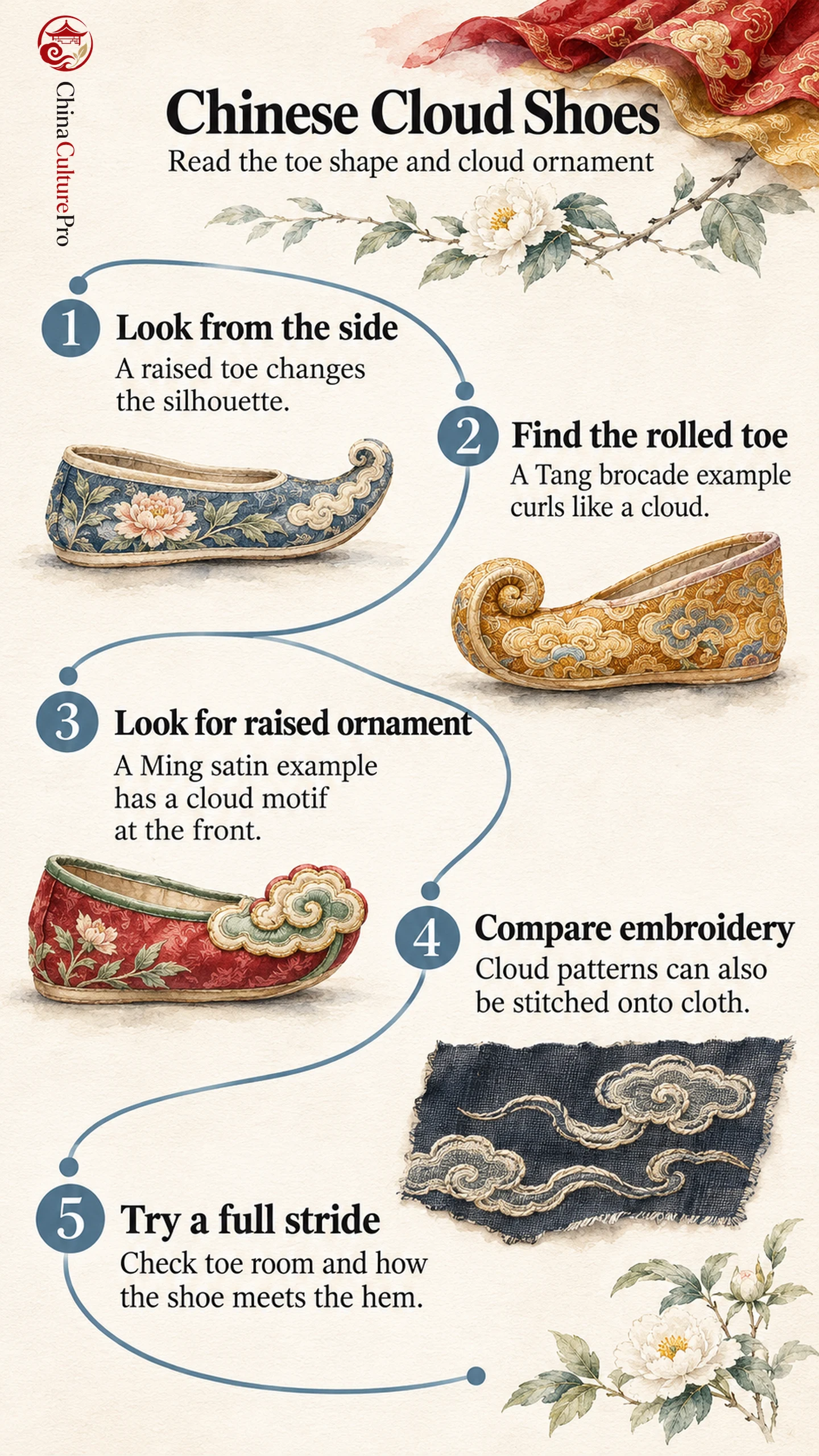
Start by looking at the shoe from the side and then from above. These two views show whether the toe itself rises, and whether the cloud comes from its shape or from the ornament on top.
Cloud Motifs and Upturned Toes
The phrase yun tou (云头, yúntóu), or cloud head, points to a cloud shape or pattern at the toe. A qiao tou (翘头, qiàotóu) is a raised toe. Studies of Ming footwear distinguish the two features, although one shoe can have both.[1]
A cloth upper can also bear embroidered clouds. The Museum of Ethnic Cultures at Minzu University of China documents cloth shoes worn by Tu men with embroidered clouds and plum blossoms. This is an example of the cloud motif in Chinese embroidery.[6]
Tang Brocade and Ming Satin Examples
A pair of Tang brocade shoes from Astana (阿斯塔那, Āsītǎnà) has a toe rolled upward into a scroll. The maker used matching brocade for the roll and filled it with palm fibre.[2]
A Ming pair in the Shandong Museum collection uses red satin and green edging. Raised cloud-shaped ornaments run from the front towards the sides, with another at the heel.[3]
A Palace Museum study identifies cloud shoes in a painted scene showing Xu Xianqing (徐显卿, Xú Xiǎnqīng) and his brother. Each wears a daopao (道袍, dàopáo) robe in the scene.[4] Gu Yanwu quotes a county gazetteer that compares earlier restrictions with later use among local attendants and servants.[5]
What to Check in a Modern Pair
An ornamental front can look longer than the space inside the toe. Check the fit with the intended socks and walk a few steps to see whether the heel lifts. If the outfit includes a long skirt or robe, watch whether the raised front brushes the hem. Compare the sole and upper with those of Chinese cloth shoes if you want to understand which parts of a modern pair borrow from older forms.
FAQs About Chinese Cloud Shoes
Are All Upturned-Toe Shoes Cloud Shoes?
A raised toe describes a profile. A cloud toe has a cloud-like shape or decoration.[1]
Can a Cloud Motif Be Embroidered on a Cloth Shoe?
Yes. The Museum of Ethnic Cultures records a pair with embroidered clouds and plum blossoms.[6]
Were Cloud Shoes Only Worn at Court?
A county gazetteer quoted by Gu Yanwu describes later use among local attendants and servants.[5]
Источники
[1] Jiang Yuqiu. Shoe Relics and Literature Records of the Ming Dynasty of China
[2] Artron. Xinjiang Exhibition and the Tang Cloud-Toe Brocade Shoes
[3] Shandong Radio and Television. Ming Dress Exhibition and the Red Satin Cloud-Toe Shoes
[4] Palace Museum. Ming Dress in the Portrait Record of Xu Xianqing
[5] Gu Yanwu. Record of Daily Knowledge, Volume 28
[6] Museum of Ethnic Cultures, Minzu University of China. Shoes of China’s Diverse Ethnic Cultures