


Quick Answer: What Does Bing Mean in Chinese Food?
Bing (饼, bǐng) is a broad Chinese food name, often translated as pancake or flatbread. Neither English word describes every form. Four overlapping clues help you recognize the foods:
- Griddle breads: Shaped dough cooked on a flat surface, with varied thickness and texture.
- Baked breads: Dough cooked in an oven, sometimes with seeds or a filling.
- Batter pancakes: A liquid mixture spread thinly onto a cooking surface.
- Filled and wrapping forms: Dough enclosing a filling, cooked bread split for stuffing, or thin pancakes wrapped around food.
The word also appears in sweet pastries such as mooncakes (月饼, yuèbǐng). This guide focuses on staple flatbreads and pancakes, rather than every food bearing the name.[1]
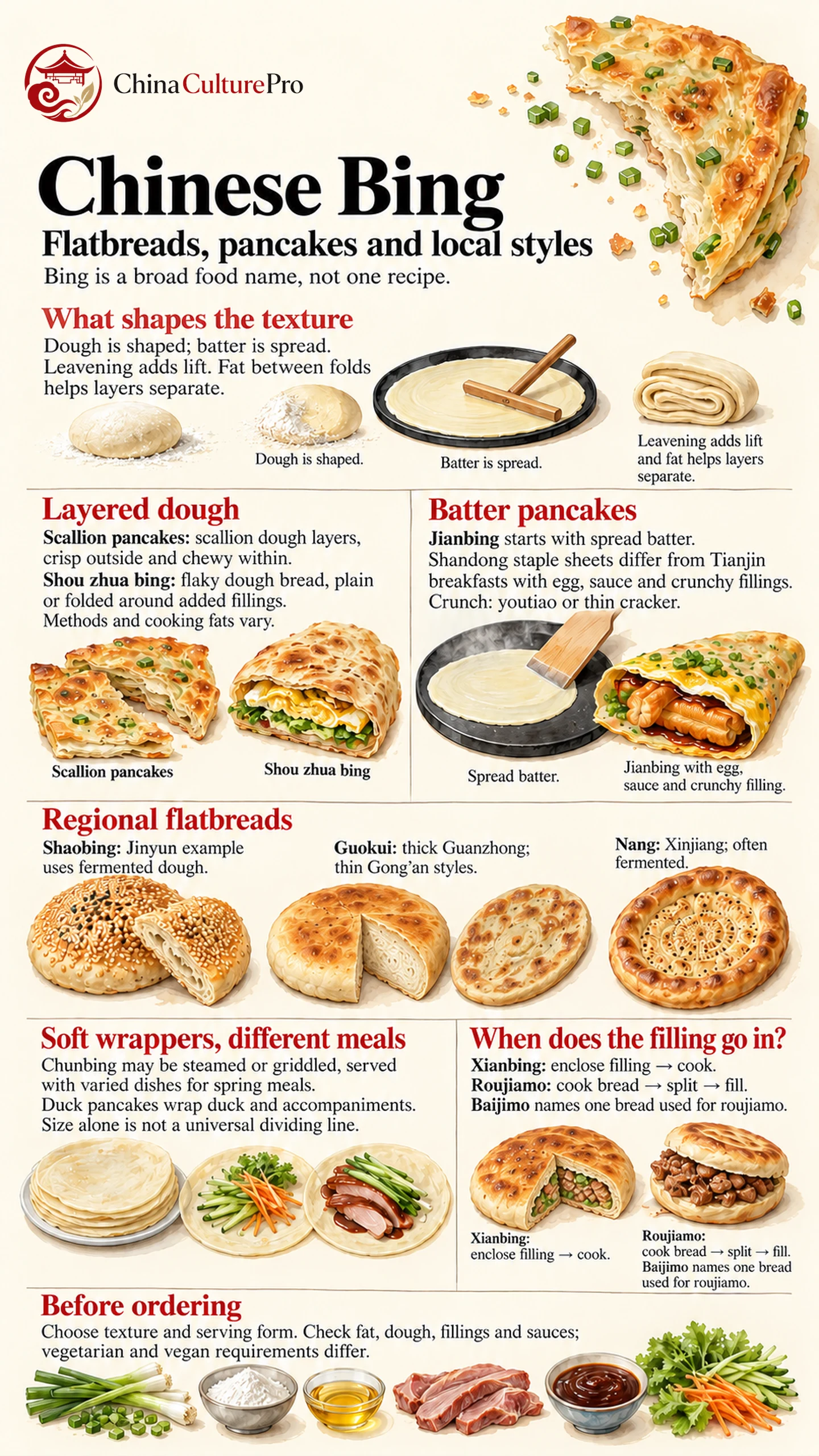
English menus use “Chinese pancake” and “Chinese flatbread” for foods that can look and taste quite different. Understanding their bases, shapes and serving styles makes it easier to explore Chinese food and choose the bread, snack or wrap you actually want.
Dough, Batter and Leavening: Why Bing Textures Differ
Dough is a mixture firm enough to be shaped and rolled. It can become a thick bread, a layered round or a very thin wrapper. Batter is a pourable or spreadable mixture that takes shape on a cooking surface. Thinness alone therefore does not tell you which base was used.
Leavening is the process that gives dough lift. Fermentation is one way to achieve it, as in fa mian bing (发面饼, fāmiànbǐng), a name for leavened dough pancakes or breads. Unleavened dough is prepared without a raising step, but it can still blister or puff during cooking. Thickness, water content and handling also affect the bite.
Layering is a different feature. Rolling or folding dough with fat between the folds helps keep layers separate as they cook. The result can combine a crisp outside with a chewy or tender interior. Fermentation, layering and cooking method can coexist: they are separate questions to ask about a bread, not competing categories.
Layered Griddle Breads: Scallion Pancakes and Shou Zhua Bing
Лепёшки с зелёным луком (葱油饼, cōngyóubǐng), also written cong you bing, use dough rather than a poured crepe batter. A familiar method incorporates fat and chopped scallions into rolled or coiled dough, which is flattened before cooking. The exposed surface browns while the folded interior retains layers and a softer, resilient bite.
Thickness and finish vary. Some versions are comparatively thin and crisp; others are thicker and chewy. Pan cooking is familiar, but baking or a combination of methods also occurs. A Shanghai example has a fragrant scallion-and-lard interior, illustrating why the word “scallion” does not identify the cooking fat.[2]
Shou zhua bing (手抓饼, shǒuzhuābǐng) is another layered dough preparation. Cooking and loosening the bread separates its flaky strands. A vendor may serve the base alone or fold it around egg, vegetables, meat and sauce. Preformed or frozen dough rounds are also used; seeing a round placed on the griddle does not establish how it was made.
Grab-style scallion breads have a familiar place in Taiwanese food culture, with many possible added fillings.[3] They share layering ideas with scallion pancakes, but the names do not guarantee identical dough, fat quantity or serving arrangement. Compare the base separately from the ingredients added to it.
Shaobing, Guokui and Nang: Regional Flatbread Styles
Regional names can describe foods with markedly different shapes and cooking methods. The following examples belong in a flatbread comparison, while retaining their own local names; not every one must be called bing on a menu.
| Name and example | Form and cooking | Что может различаться |
|---|---|---|
| Шаобин (烧饼, shāobǐng) | A baked flatbread family, often with a browned exterior. | Seeds, fillings, shape and fermentation vary. Jinyun’s version uses fermented dough and a pork-and-dried-greens filling.[4] |
| Guokui (锅盔, guōkuī): Guanzhong example | A thick, round wheat bread cooked in a shallow pan. | Its substantial form differs from thin, filled versions found elsewhere.[5] |
| Guokui: Gong’an example | A thinner, shaped, often filled bread baked against an oven wall. | Savory and sweet fillings occur; it is not the same form as a thick Guanzhong round.[6] |
| Nang (馕, náng): Xinjiang examples | Commonly a round bread baked in a nang pit, often from fermented dough. | Flour, size, seasoning and additions vary; sesame, onion, milk, egg or meat may appear in different kinds.[7] |
These names do not establish one dough formula. Even a crisp exterior can surround a hollow, layered, dense or soft interior; sesame seeds alone cannot identify the whole preparation.
Guokui has a prominent place among the breads of Shaanxi cuisine, but its name should not erase the differences between regional versions. A thick bread cut into portions and a thin filled bread can offer very different eating experiences.
Nang is important in Xinjiang cuisine, particularly in Uyghur daily life and food traditions. It may accompany other foods or be eaten on its own. Its distinctive name and local uses matter more than forcing it into a single English pancake label.
Batter-Based Pancakes: Jianbing and Regional Styles
Jianbing (煎饼, jiānbǐng) identifies batter-based pancakes. The mixture is spread over a heated surface and sets into a thin sheet. Its grain ingredients, moisture and serving style vary, so the name does not by itself promise an egg-filled breakfast parcel.
In Linshu, Shandong, pancakes made from wheat or mixed-grain batter are an everyday staple. They can be served as sheets for wrapping vegetables or other accompaniments, rather than being assembled into a complete breakfast by the cook.[8] This is one strand of Shandong food culture, not a fixed recipe for the whole province.
Tianjin-style jianbing guozi (煎饼馃子, jiānbǐng guǒzi) is a different serving arrangement. A familiar version uses a mung-bean-based pancake with egg, sauces and a crisp addition: youtiao (油条, yóutiáo), the fried dough stick, or a thin fried cracker.[9]
Elsewhere, stalls offer their own batters and additions. Read the full name and look at the base: a batter sheet folded around food differs from a layered dough bread, even when both orders contain an egg, greens and sauce.
Thin Wrapping Pancakes: Chunbing and Duck Pancakes
Chunbing (春饼, chūnbǐng), or spring pancakes, provide thin wrappers for a shared meal. They are associated with Личунь (立春, lìchūn), the Start of Spring solar term, when pancakes may be wrapped around stir-fried vegetables and other foods. Both griddled and steamed preparations exist; local forms are not all identical.[10]
Thin pancakes served with Peking duck have a similar wrapping role. Diners add slices of duck, sauce and accompanying vegetables, then fold or roll the pancake. The useful distinction is the meal and what accompanies the wrapper, rather than a nationwide rule about its diameter.
A spring-pancake meal may offer several dishes to combine, while a duck restaurant supplies wrappers suited to its duck service. Size, thickness and dough treatment can overlap between kitchens. “Spring pancake” and “duck pancake” are therefore useful menu descriptions, but they do not establish two completely separate dough formulas or restrict a wrapper to one possible filling.
Stuffed Bing and Split Flatbread Sandwiches
Xianbing (馅饼, xiànbǐng) means a filled pancake or pie. In a familiar pan-cooked version, the filling is enclosed in the dough before cooking. The sealed surface browns while the filling heats inside. Meat, vegetables or a combination can be used; the name does not specify one filling or a universal shape.
A split flatbread sandwich reverses the assembly order. Baijimo (白吉馍, báijímó) is a bread used in a well-known Shaanxi version of roujiamo (肉夹馍, ròujiāmó). The bread is cooked, opened and filled with separately prepared meat, commonly chopped braised pork in this version. Baijimo names the bread; roujiamo names the assembled food.[11]
The filling’s timing distinguishes the two arrangements. Other breads and meats appear in regional roujiamo styles, so baijimo is an example rather than a rule for every serving. Added sauces and vegetables describe the finished meal as well as the bread itself.
How to Choose and Order Bing
Use the complete Chinese food name first, then confirm what is included in the order:
- Base and texture: Look for layered dough, a thick bread, a thin batter pancake or a soft wrapper. A pancake translation alone is not enough.
- Assembly: Check whether you receive a plain bread, a filling cooked inside it, a filled wrap or accompaniments to add yourself.
- Ingredients: Ask about the cooking fat, egg or milk in the base, and the contents of fillings and sauces.
For vegetarian food, a vegetable filling does not establish what went into the dough or pan. Lard, meat additions or seafood seasonings need separate checks. Egg and dairy may fit some vegetarian diets but are excluded from vegan food. Confirm the whole preparation, rather than judging only the visible filling.
FAQs About Chinese Bing
Is bing the same as jianbing?
No. Bing is a broad Chinese food name used for different pancakes, flatbreads and some pastries. Jianbing is a specific batter-based branch. Calling a food bing does not establish that it has the thin spread batter or serving arrangement associated with jianbing.
Are all bing unleavened?
No. Some use fermented dough, including particular shaobing and thicker bread styles. Others use unleavened dough or batter. Fermentation, layers and thickness are separate features, so “flatbread” should not automatically be read as “unleavened bread.”
Are all bing made from wheat flour?
Many staple breads in this guide use wheat, but the word does not guarantee one flour. Jianbing can use mixed grains or mung-bean-based batter, and other foods called bing use different ingredients. Check the named preparation rather than inferring its recipe from the shared word.
Can bing be vegetarian?
Yes, depending on the preparation and the particular diet. Check fat, dough ingredients, filling and sauces together. A meat-free center does not rule out lard, while egg or milk may be acceptable to some vegetarians but not to vegans.
Источники
[1] Taiwan Ministry of Education dictionary. 餅
[2] Shanghai Government. Morning delights: Explore Minhang’s breakfast gems
[3] Taipei City Market Administration. 站前地下街・忠將蔥抓餅
[4] China Intangible Cultural Heritage Network. 传统面食制作技艺(缙云烧饼制作技艺)
[5] Shaanxi Normal University, historic-city resource. 锅盔
[6] Hubei Daily. 公安非遗:公安锅盔制作技艺
[7] China Intangible Cultural Heritage Network. 传统面食制作技艺(馕制作技艺)
[8] Linshu County local record, archived Shandong gazetteer. 临沭文化概览:(二)饮食
[9] Tianjin Culture and Tourism Bureau, official account. 津津有味|看完天津菜版《报菜名》,口水流了一地~
[10] Nanjing Local Gazetteers Office. 南京记忆:春之节气与金陵习俗(上)
[11] People’s Daily Overseas Edition, first-person food account. 肉夹馍(食话)