
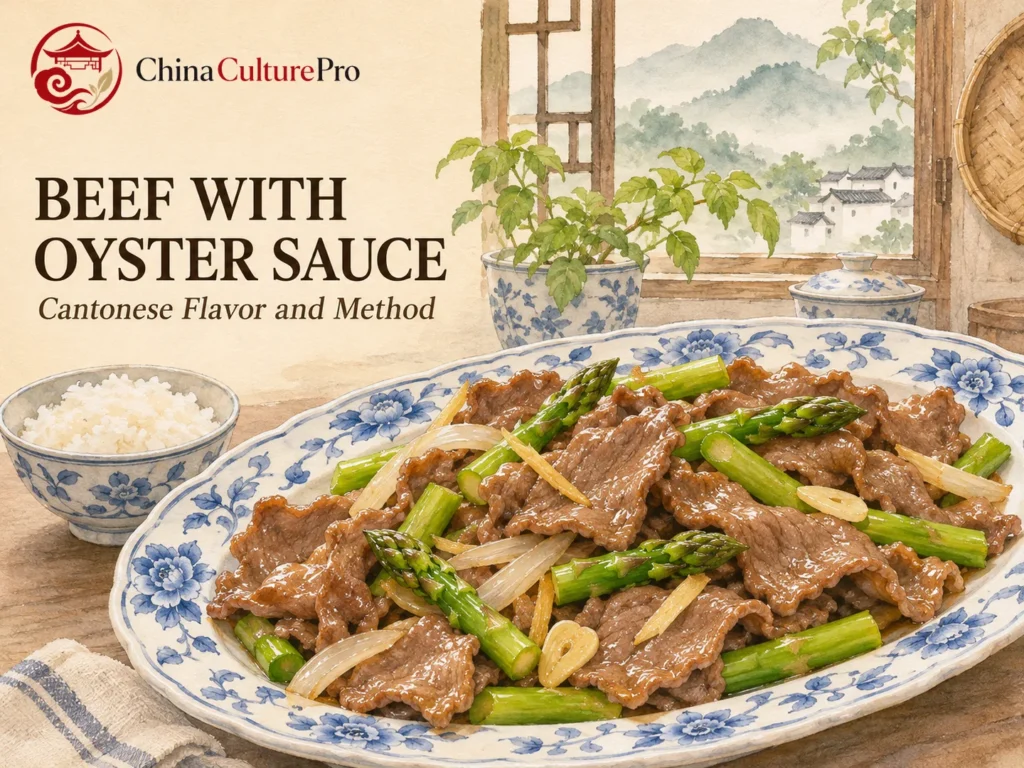

Quick Answer: What Is Chinese Beef with Oyster Sauce?
Chinese beef with oyster sauce (蚝油牛肉, háoyóu niúròu) is a stir-fry of sliced beef in a savory brown sauce built around oyster sauce. The vegetables and exact sauce formula vary.[2]
- Meat: Thin slices and a light coating prepare beef for quick cooking.
- Sauce: Oyster sauce works with liquid and seasonings rather than always going straight from bottle to plate.
- Vegetables: Mushrooms, asparagus or leafy greens can accompany the beef.[2][3][4]
The home version below uses asparagus and onion; it is not a fixed recipe for every restaurant.

Tender slices and a glossy coating are the aim, rather than a large pool of bottled sauce. Prepare the vegetables and sauce before heating the pan so the beef can finish quickly. The dish name identifies its main seasoning, leaving room for several vegetable combinations.
The Cantonese Oyster-Sauce Flavor Profile
In Cantonese cuisine, oyster sauce (蚝油, háoyóu) can form the center of a wider sauce: stock or water loosens it, soy supplies additional seasoning, sugar adjusts the balance, and a little starch gives the desired coating. The same broad flavor profile also appears with vegetables and noodles.[2]
For beef, the result should still taste like a finished dish. The marinade prepares the meat, while the separately mixed sauce controls the final seasoning and consistency. Dark soy can deepen the color, but extra darkness alone is not a measure of flavor.[1]
Ingredients for Beef and Asparagus
For about four shared portions with rice, use the following home formula. A tablespoon is 15 ml, a teaspoon is 5 ml, and ½ cup of broth is about 120 ml.
- Beef coating: 450 g flank or skirt steak, ½ teaspoon baking soda, 1 tablespoon light soy sauce (生抽, shēngchōu), 1 teaspoon neutral oil and 2 teaspoons cornstarch.[3]
- Sauce: 120 ml chicken broth, 2 tablespoons oyster sauce, 1 tablespoon light soy, 1 teaspoon dark soy sauce (老抽, lǎochōu), 2 teaspoons sugar, 2 teaspoons cornstarch and 1 teaspoon sesame oil.[3]
- Vegetables and aromatics: 450 g asparagus, ½ sliced white onion, 3 sliced garlic cloves, a thumb-sized piece of sliced ginger and 2 tablespoons neutral oil for the pan, divided.[3]
The light and dark soy sauce guide explains the two sauce types. Keep the measured beef coating separate from the sauce mixture so their quantities do not get confused.
How to Cook Beef with Oyster Sauce
Use a sharp knife, mixing bowls, a wide skillet or wok, a clean plate and a food thermometer.
- Slice and prepare: Cut beef thinly across the grain and mix with its coating ingredients. Trim tough asparagus ends and cut the stalks into bite-sized pieces. Mix the sauce in another bowl.[3]
- Sear the beef: Heat 1 tablespoon pan oil over medium-high heat. Spread beef in an uncrowded layer, browning both sides; work in batches if needed. Transfer to the clean plate before cooking the vegetables.[1]
- Cook the vegetables: Add the remaining oil, onion, ginger and garlic. Stir-fry until fragrant and the onion begins to soften. Add asparagus and cook until it starts to become tender.[3]
- Finish in sauce: Restir the sauce, add it to the pan and simmer until thickened. Return beef and its juices, tossing to coat. Verify beef reaches at least 145°F/63°C; allow three minutes before eating. Serve with rice.[2][5]
The initial sear is not the final safety check. Use a thermometer rather than judging doneness only by the color of the surface.[5]
Vegetable Variations
The sauce profile supports several combinations; prepare each vegetable for its own cooking time.
- Asparagus and onion: Cut away tough asparagus ends and cook the pieces with onion after searing the beef.[3]
- Mushrooms: Sliced shiitake or a mixture of Chinese mushrooms brings another texture. Dried shiitake must be soaked and trimmed before cooking.[1][2]
- Gai lan: Chinese broccoli, or gai lan (芥蓝, jièlán), can be blanched with stems entering before leaves, then drained before the final stir-fry.[4]
For the familiar floret-based dish, see beef and broccoli. That variation should not be confused with the leafy Chinese-broccoli preparation.
Fixing Tough Beef and Uneven Sauce
- Chewy slices: Check the grain direction first. A light starch-and-liquid coating and controlled cooking are part of the velveting meat approach; they do not make thick, uneven pieces cook identically.[1][4]
- Watery results: Drain washed or blanched vegetables. Excess water changes the sauce balance and makes browning harder.[1]
- Patchy thickening: Restir the mixed sauce before pouring, because its cornstarch settles. Let it thicken over heat rather than adding more bottled sauce as the first fix.[3]
If the dish is too heavily seasoned, increasing oyster sauce will not solve it. Keep the ingredient amounts and vegetable moisture under control before adjusting the next batch.
FAQs About Chinese Beef with Oyster Sauce
Which beef cut works well?
Flank or skirt steak works; slice across the grain.[3]
Can I use hoisin instead of oyster sauce?
It changes the flavor: hoisin is a different, sweeter condiment. Compare oyster sauce and hoisin sauce before choosing a substitute.[1]
Can I use a mushroom-based sauce?
A vegetarian mushroom-based stir-fry sauce is an alternative to the condiment, with a different flavor. Check its ingredients for your dietary needs; changing the sauce does not make the beef dish vegetarian.[1]
How do I store and reheat leftovers?
Refrigerate in shallow containers within two hours, or one hour above 90°F/32°C. Keep at 40°F/4°C or below, use cooked beef within three to four days, and reheat to 165°F/74°C.[5][6]
Источники
[1] Chung Sun Lau / Made With Lau. Beef with oyster sauce
[2] Chinese Cooking Demystified. Cantonese oyster sauce flavor profile and beef stir-fry
[3] Maggie Zhu / Omnivore’s Cookbook. Beef with oyster sauce and asparagus
[4] Elaine / China Sichuan Food. Oyster beef with Chinese broccoli
[5] Centers for Disease Control and Prevention. Preventing food poisoning
[6] USDA Food Safety and Inspection Service. How long to keep meat in the refrigerator