

Quick Answer: Who Was Chen Ping?
Chen Ping (陈平, Chén Píng) was an adviser to Liu Bang (刘邦, Liú Bāng) in the war that brought the Han dynasty to power. He helped undermine Xiang Yu (项羽, Xiàng Yǔ) and rose to the office of chancellor in the new empire.[3]
- War: He exploited distrust between the rival commander and his senior advisers.
- Court: He served under successive Han rulers and helped settle a disputed succession.
- Evidence: The surviving biography attributes six unusual plans to him but leaves some details undisclosed.[1]
The court offices and outcomes give his career a clear outline. The surviving accounts leave parts of the private exchanges and operations unresolved.
Chen Ping’s career connects the campaigns of Liu Bang with the problems of governing the early Han dynasty. The same career that began with a risky change of patron ended at the head of the imperial administration.
How Chen Ping Entered Liu Bang’s Inner Circle
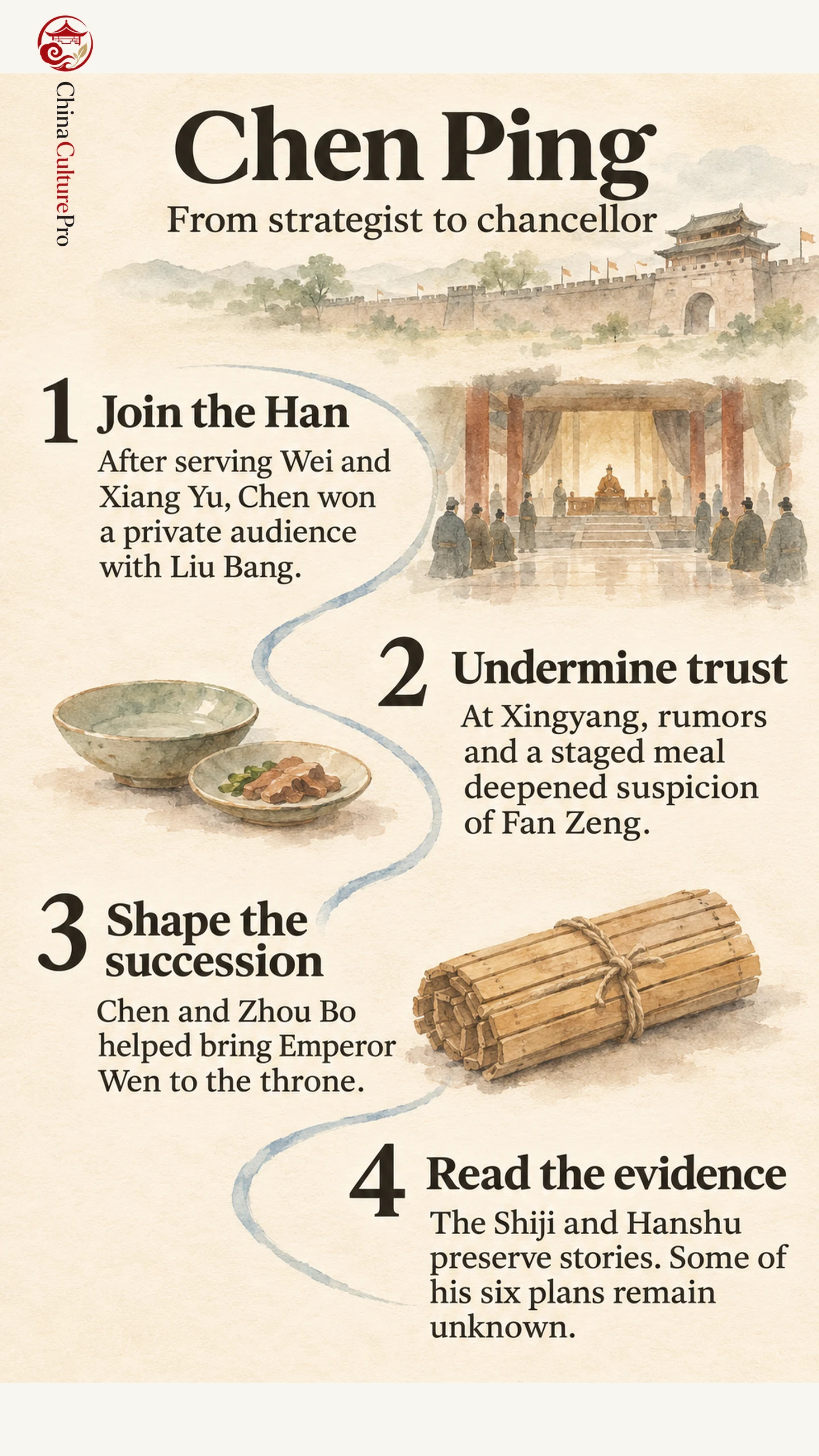
Chen served the king of Wei and then Xiang Yu before joining the Han side. A sponsor gained him an audience with Liu Bang. Chen pressed for a private conversation that day and received an appointment with access to the ruler. His quick promotion angered commanders who had been with Liu longer.[3]
Liu Bang’s coalition included old local companions and newcomers who won personal access by offering advice. Chen belonged to the latter group. The record does not preserve what he said at the first interview.[3]
The Xingyang Ruse and the Limits of the Six Strategies
When Chu besieged the Han forces at Xingyang (荥阳, Xíngyáng), Chen used funds from Liu Bang to spread rumors about Chu commanders. In the same account, the Han camp offered a Chu envoy a fine meal and replaced it with poorer food, pretending the feast had been meant for a messenger from Fan Zeng (范增, Fàn Zēng).[1]
The envoy reported the reception to Xiang Yu, who distrusted Fan Zeng and rejected his advice to press the siege. Fan Zeng asked to leave. The ruse used the envoy’s routine report as its channel.[1]
The histories also connect Chen with Liu Bang’s escape from the Xiongnu siege near Pingcheng. They mention the Xiongnu ruler’s consort and explicitly leave the details secret. An exact account of the bargain goes beyond this evidence.[2]
From Wartime Adviser to Chancellor
Chen became left chancellor under Emperor Hui and later right chancellor under Empress Lü (吕后, Lǚ Hòu). After her death he joined Zhou Bo (周勃, Zhōu Bó) in the violent removal of the Lü faction and the installation of Emperor Wen (汉文帝, Hàn Wéndì). Zhou Bo brought military power to the coalition.[2]
Under Wen, Chen first deferred to Zhou Bo for the senior post, then served as sole chancellor. A court exchange portrays him directing questions on judgments and revenues to the responsible officials. He died in Wen’s second regnal year.[2]
How to Read Chen Ping’s Historical Record
The Shiji (史记, Shǐjì), chapter 56, is the starting point. Its story of a young man dividing sacrificial meat evenly anticipates the praise of a capable chancellor in the closing appraisal. The anecdote gives the biography a narrative arc.[1]
The Hanshu (汉书, Hànshū), chapter 40, groups Chen with other ministers. Its Xingyang account closely follows the earlier text. Their agreement shows how the story was transmitted.[1][2]
FAQs About Chen Ping
Did Chen Ping and Zhang Liang do the same work?
Both advised Liu Bang. Zhang Liang (张良, Zhāng Liáng) receded from active politics while Chen continued as a court official and rose to the chancellorship.[3]
What did Chen Ping do to Han Xin?
Chen proposed a pretext for summoning and arresting the general Han Xin (韩信, Hán Xìn). The king of Hann mentioned in the separate Xiongnu campaign was another man with the same written personal name.[2]
Can all six of Chen Ping’s strategies be identified?
The biography gives the number but says that some plans were kept secret. Famous surviving episodes explain his reputation without yielding a complete checklist.[1]
Источники
[1] Sima Qian. Shiji, chapter 56, Hereditary House of Chancellor Chen
[2] Ban Gu and collaborators. Hanshu, chapter 40, Biographies of Zhang, Chen, Wang and Zhou
[3] Aihe Wang. Creators of an Emperor: The Political Group behind the Founding of the Han Empire