


Quick Answer: Who Was Cao Zhi?
Cao Zhi (曹植, Cáo Zhí, 192–232) was a prince and poet, the son of Cao Cao (曹操, Cáo Cāo) and younger brother of the founding Wei emperor Cao Pi (曹丕, Cáo Pī). His work includes the Rhapsody on the Goddess of the Luo River (洛神赋, Luòshén Fù), about a traveler’s encounter with a river deity.[1][2][3]
- Court: Cao Zhi was considered a possible heir to his father, and Cao Pi inherited the position.[1][2]
- Writing: His surviving poetry includes a farewell to a brother and an account of its circumstances.[8]
- Reception: The famous Seven Steps Poem (七步诗, Qībù Shī) comes down with a later anecdote and in more than one version.[6][7]
Use the biography for his titles, the poems for his writing and the anecdote for the story that grew up around him.
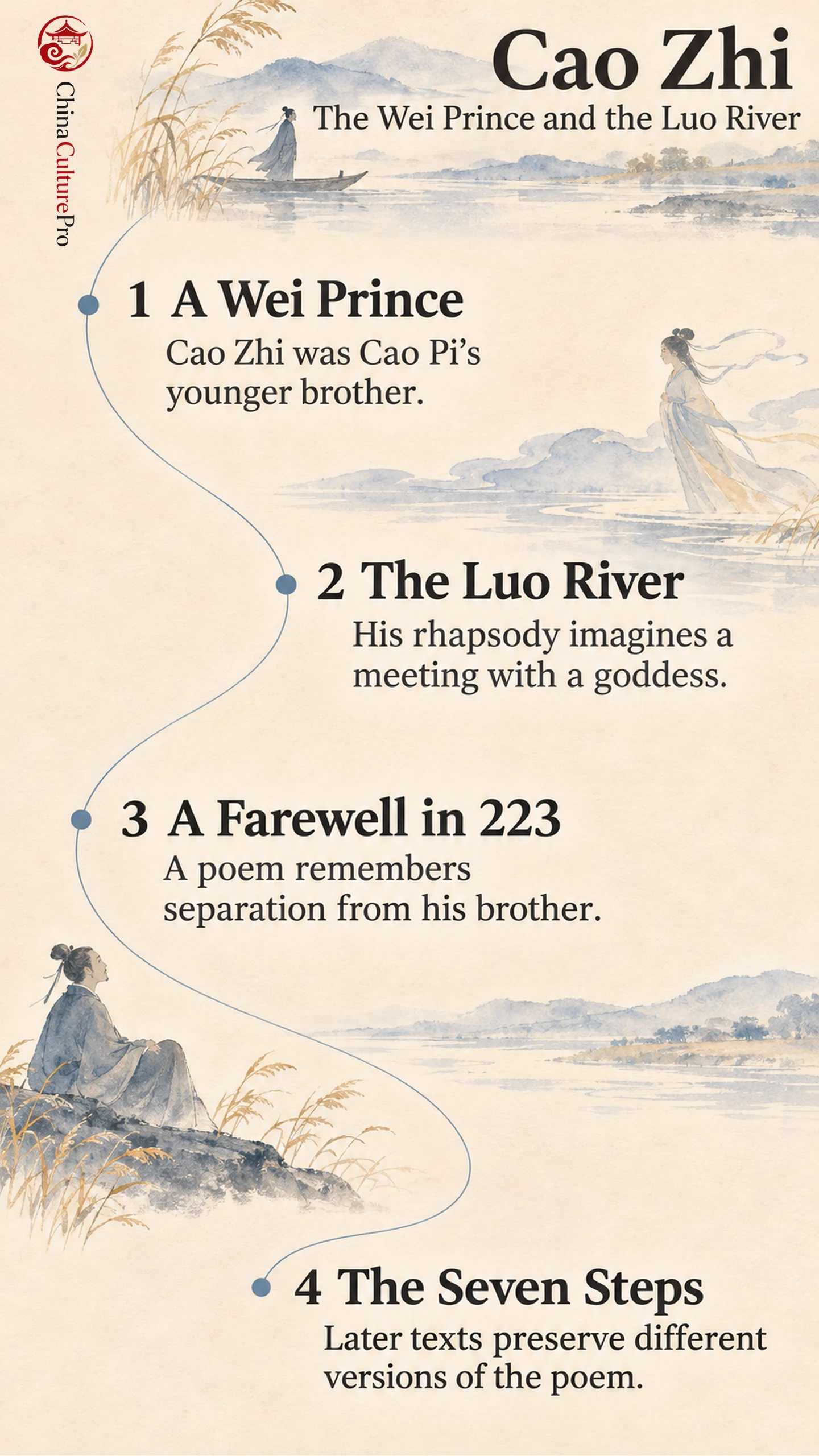
Cao Zhi is often introduced through a story about how quickly he could compose a poem. A better way to understand what he wrote is to put two kinds of departure next to each other. In one, a traveler cannot bring himself to leave a river after meeting its goddess. In another, two princes are separated on the road home. The first belongs to a literary encounter with the supernatural. The second has a preface that names the circumstances of a farewell.
A Literary Prince in the Wei Succession
The Records of the Three Kingdoms (三国志, Sānguó Zhì) portrays Cao Zhi as precocious and describes Cao Cao valuing his writing. He belonged to the literary world associated with the Jian’an era (建安, Jiàn’ān), when members of the Cao family and other writers worked in overlapping circles.[1][2]
Cao Pi became his father’s heir and then took the Wei throne in 220. Cao Zhi lived on as a member of the ruling house, with titles and changes of fief that the biography records in detail. He is also known as Prince Si of Chen (陈思王, Chén Sī Wáng), the title by which the history identifies him. His efforts to obtain a greater public role appear in memorials preserved in the same chapter.[1]
The Three Kingdoms period offers context for the succession. The biography and memorials also show how different a prince’s standing could be from his ability to decide where he went or what public work he did.
What Happens in the Rhapsody on the Luo River
The rhapsody is a fu (赋, fù), a literary form that can develop a subject through patterned description and shifts between prose-like passages and verse. Cao Zhi’s preface places the traveler’s crossing in 222 and names an older goddess story as an inspiration. In the rhapsody, a traveler and his driver stop by the river. The traveler sees a figure he takes to be the river goddess.[3][4]
Watch how his description keeps her in motion. Birds, clouds and light help him describe the movement of someone he struggles to approach. The encounter ends with a separation between human and divine worlds. The traveler continues to look for her after she vanishes.[3]
A later story identifies the goddess with a woman at court. The Palace Museum points out that the story occurs in a note missing from some editions and that details of it clash with other records. The piece also has a long visual afterlife, including a painting tradition linked to Gu Kaizhi (顾恺之, Gù Kǎizhī). These are two forms of reception, with different kinds of evidence.[4][5]
What a Farewell Poem Records About His Life
The preface to To Biao, Prince of Baima (赠白马王彪, Zèng Báimǎ Wáng Biāo) locates the poem in 223. Cao Zhi describes visiting the capital with two brothers, losing one there and learning that officials expected the two surviving brothers to lodge separately on the way home. The preface gives the sequence a particular political and family setting.[8]
The poem begins with departure from the capital. Rivers, rain, uneven roads and a tired horse give the speaker time to think about the separation before the final farewell. Read the preface once, then look at which details the poem adds. The landscape is part of how he communicates grief, frustration and the prospect of seeing his brother again.[8]
Cao Zhi’s writing continued to circulate in other forms. A later calligrapher’s handscroll of four Cao Zhi poems gives another way to see what it means for a poem to survive beyond the book in which you first encounter it.
How to Read the Story of the Seven Steps
A New Account of Tales of the World (世说新语, Shìshuō Xīnyǔ) attaches the seven steps to a story in which Cao Pi demands an immediate poem. Beans and the stalks from which they grew become the poem’s image for a conflict between people of the same family. The collection was compiled generations after the brothers lived. It shows how the story was told well after their lifetimes.[6][7]
The six-line form associated with the anecdote differs from the shorter four-line version found in the Romance of the Three Kingdoms. A reader can compare what each version does with the same image. The Chinese poetry guide gives wider context for reading such a short poem alongside Cao Zhi’s longer work.[7]
FAQs About Cao Zhi
Did Cao Zhi become emperor?
No. Cao Pi inherited his father’s position and became emperor of Wei. Cao Zhi held princely titles under Wei.[1][2]
Is the Seven Steps Poem a verified event?
It is preserved in later anecdotal and literary sources. The surviving versions show how the story was transmitted, but do not verify the scene as a contemporary record.[6][7]
Which English edition of Cao Zhi should you look for?
Robert Joe Cutter’s The Poetry of Cao Zhi, published in 2021, pairs a complete English translation of the poems and fu with Chinese texts and notes.[2]
Источники
[1] Chen Shou. Records of the Three Kingdoms, Volume 19
[2] Robert Joe Cutter, De Gruyter Mouton. The Poetry of Cao Zhi
[3] Cao Zhi. Rhapsody on the Goddess of the Luo River
[4] Palace Museum. Rhapsody on the Luo River
[5] Metropolitan Museum of Art. Nymph of the Luo
[6] A New Account of Tales of the World. Literature
[7] Wikisource. Seven Steps Poem: Two Textual Versions
[8] Cao Zhi. To Biao, Prince of Baima