


Quick Answer: What Does Calming the Waves Mean?
In Calming the Waves, Su Shi (苏轼, Sū Shì) turns a rainy walk into a meditation on composure. The speaker walks slowly, feels a little cold, meets clearing sunlight and finally looks beyond both storm and fair weather.
- Start with the preface: The rain gear has gone ahead when the group encounters rain.
- Keep the bodily detail: Feeling slightly cold does not undo the speaker’s steadiness.
- Read the final pair: The ending releases sunshine as well as wind and rain.
This is a lyric’s crafted response to difficulty, rather than evidence that its author never felt pain or anxiety.
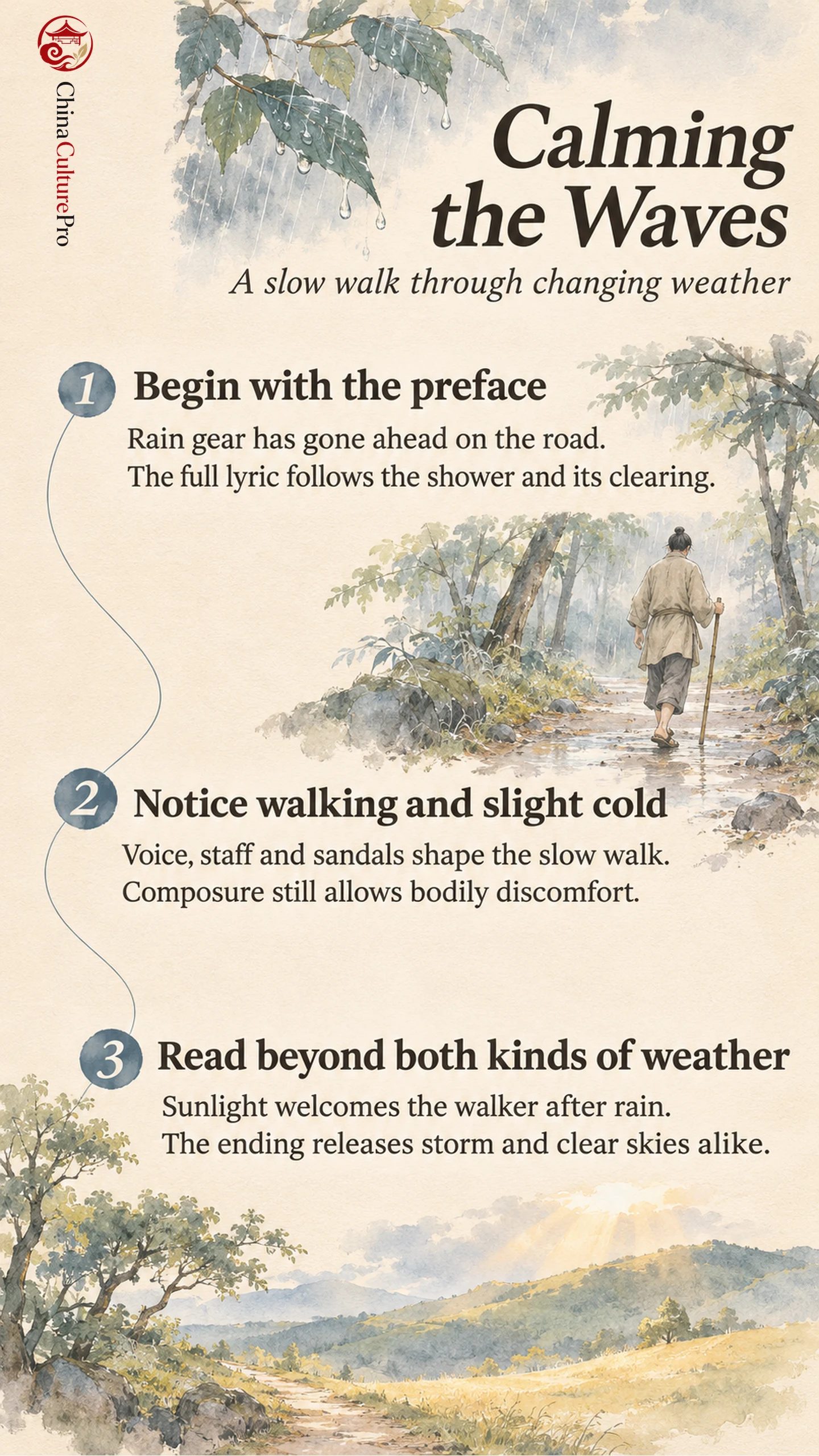
The last line can sound like a promise that good weather will replace bad. Its wording asks something subtler: what happens when the speaker no longer makes either kind of weather the measure of his freedom?
Read the Preface and Complete Lyric
Ding Feng Bo (定风波, Dìng Fēng Bō), translated here as Calming the Waves, is a tune pattern for ci (词, Cí), not a statement that this scene takes place at sea. This particular lyric has sixty-two Chinese characters. [2]
The preface places the walk on the road at Shahu (沙湖, Shā Hú), on the seventh day of the third month. The year is 1082, during Su Shi’s exile in Huangzhou (黄州, Huáng Zhōu). The traditional-calendar date should not automatically become March 7 on a modern calendar. [1][2]
The preface reads: 三月七日,沙湖道中遇雨,雨具先去,同行皆狼狈,余独不觉。已而遂晴,故作此。
In an original English rendering: “On the seventh day of the third month, we met rain on the Shahu road. The rain gear had gone ahead. My companions were all discomfited; I alone felt untroubled. After a while it cleared, so I wrote this.” [1]
| Chinese text | Original English rendering |
|---|---|
| 莫听穿林打叶声,何妨吟啸且徐行。 | Pay no heed to the sound passing through the woods and beating on leaves; why not chant and call out, walking slowly on? [1] |
| 竹杖芒鞵轻胜马,谁怕?一蓑烟雨任平生。 | Bamboo staff and straw sandals feel lighter than riding a horse. Who is afraid? A straw cape amid misty rain—let such weather accompany a whole life. [1] |
| 料峭春风吹酒醒,微冷、山头斜照却相迎。 | The sharp spring wind blows away my tipsiness. A little cold; yet slanting sunlight on the hill comes out to greet me. [1] |
| 回首向来萧瑟处,归去、也无风雨也无晴。 | I look back toward the place of that earlier rustling wind. Homeward I go: neither wind and rain, nor clear skies. [1] |
The unusual character 鞵 is an older form of the word for shoes. Here the footwear is humble straw sandals. [1]
For the author’s broader writing, see the Su Shi guide; the Song ci guide explains the relationship between lyrics and tune patterns.
Notice the Slow Walk and the Slight Cold
The first response to rain is a change of attention. The speaker does not deny the sound on the leaves. He chooses not to be governed by it, pairing his own voice with an unhurried walk. The movement is deliberate, not simply a person slowed down against his will. [1]
The staff and sandals then become a comparison of felt freedom. They need not make him faster than a horse. Their apparent disadvantage in wet weather becomes lightness in the speaker’s account.
The straw cape expands the scene into the imagined weather of a lifetime. It should not be used to contradict the preface by proving that he physically wore a cape during the shower. The preface says the rain gear had gone ahead; the lyric supplies an image through which to meet difficulty. [1]
Then “a little cold” interrupts any reading of the speaker as invulnerable. Wind sobers him, his body registers discomfort, and sunlight arrives afterward. The calm is compatible with sensation. It does not require pretending that unpleasant weather feels pleasant.
This sequence also keeps the poem moving. Rain, voice, walking, chill and light each change the experience. It is not a single frozen emblem of a man who cannot be affected.
Read Beyond Both Storm and Sunshine
At first, the welcoming sunlight might seem to provide the solution. The final line prevents that simple exchange. It names both storm and clear weather, then steps beyond their opposition. The speaker’s freedom is no longer entirely dependent on the next favorable change. [1]
Reading the weather as an image of political adversity and good fortune is well established. The exile context supports that larger resonance, though it does not turn every leaf or gust into a code for one named enemy. [2][3]
The backward glance matters as much as the final declaration. He looks again at where the disturbance occurred. The poem changes his relation to that scene without claiming that the walk never happened.
Nor does “homeward I go” prove a permanent decision to abandon all public life on that day. Within the lyric, it completes the walk and its reflection. The ending remains persuasive because it grows from these small physical particulars.
Compare the use of landscape in the Chinese nature poetry guide, or place the lyric among other forms in the Chinese poetry guide.
FAQs About Calming the Waves
Does the title describe calming a storm at sea?
No. It is the name of a tune pattern. The preface describes a rainy walk on a road.
Was Su Shi definitely wearing a straw rain cape?
The lyric uses that image, but the preface says the rain gear had gone ahead. The poetic image alone does not establish what he wore during the shower.
Is the final line a literal weather report?
The preface already says the weather cleared. The lyric’s final refusal of both storm and sunshine extends the scene into a reflection on how to meet changing circumstances.
Источники
[1] Su Shi, via Wikisource. Ding Feng Bo: Mo Ting Chuan Lin Da Ye Sheng, Preface and Lyric
[2] Feng Qingcheng, China Soong Ching Ling Foundation via Xinhua. Future Classroom: Su Shi’s Ding Feng Bo
[3] Taiwan Cultural Memory Bank. Huang Qunying: Calligraphy of Su Shi’s Ding Feng Bo