


Quick Answer: Who Was Cai Yuanpei?
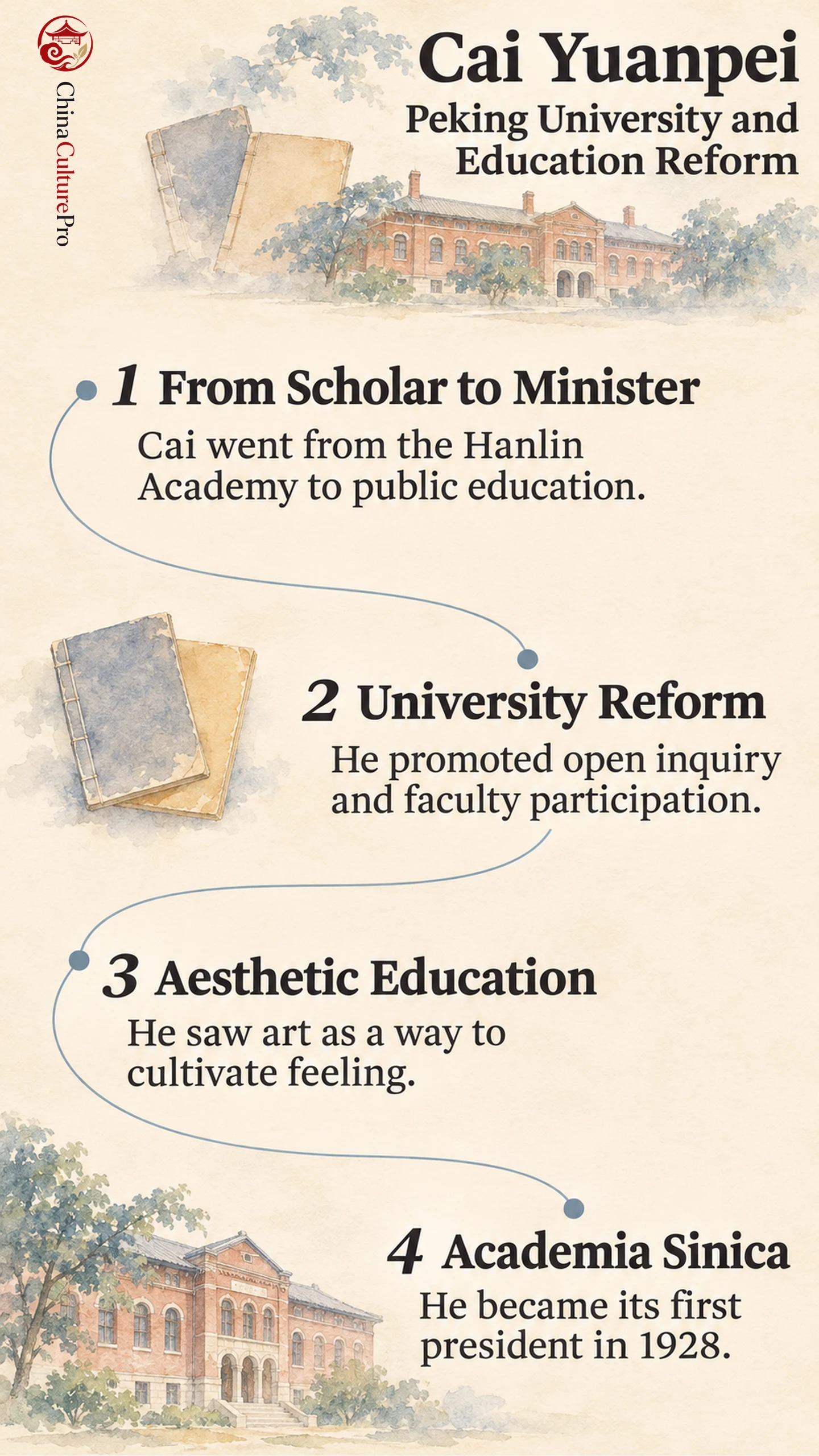
Cai Yuanpei (蔡元培, Cài Yuánpéi, 1868–1940) was a late Qing scholar and Republican-era education reformer. He served in the Hanlin Academy (翰林院, Hànlín Yuàn), led Peking University (北京大学, Běijīng Dàxué) and became the first president of Academia Sinica (中央研究院, Zhōngyāng Yánjiūyuàn).[1][2][8]
- University: He encouraged intellectual diversity, expanded academic programs and gave professors a larger role in university governance.[1][3]
- Education: His case for aesthetic education (美育, měiyù) gave art and the cultivation of feeling a place in a broader theory of learning.[5][6]
- Research: In 1928, he took the presidency of a new research institution whose work extended beyond a single university.[8]
His speeches describe what he hoped education would do. The university and academy records show how particular changes took institutional form.
When Cai Yuanpei addressed Peking University students in January 1917, he asked why they had come to a university. His answer included the kind of study they should pursue and how they should treat teachers and classmates. He also had plans for lecture outlines and new library books. The lecture outlines and books mattered because he expected students to pursue questions on their own.[4][6]
From the Hanlin Academy to Republican Education
Cai was born in Shaoxing, Zhejiang, and gained the jinshi (进士, jìnshì) degree through the late imperial examination system. He entered the Hanlin Academy in 1892 and later worked as a compiler. That training gave him experience of the scholarly institutions of the Qing dynasty.[2]
He subsequently worked in schools and education associations. In 1907 he went to Leipzig, where his studies included philosophy and ethics. After the 1911 Revolution, he served as education minister in the provisional government of the Republic of China. The ministry put him in a position to work on education beyond a single school.[2]
His inaugural address gives a sense of how he applied that experience. He urged students to study their subjects seriously even if the degree could open a route to official work. He expected them to develop their conduct and take responsibility for how they treated others. More books in the library would give them material to pursue questions independently.[4]
What Changed at Peking University
Peking University dates Cai’s appointment to December 1916. In the years after his January 1917 address, the university reorganized teaching, widened the subjects available and established bodies in which professors shared responsibility for university decisions. Its history records the admission of women beginning in 1920.[1][4]
He recruited scholars whose ideas could conflict. Chen Duxiu (陈独秀, Chén Dúxiù) became dean of letters, and Hu Shi (胡适, Hú Shì) was among the scholars who taught there. The campus became a center of the New Culture Movement (新文化运动, Xīn Wénhuà Yùndòng) through teaching, journals and student associations.[1][3]
The May Fourth Movement (五四运动, Wǔsì Yùndòng) brought a different problem to the university in 1919. Students took to the streets over the diplomatic settlement at Versailles. A Peking University account describes Cai trying to discourage the protest over concerns about student safety, then supporting efforts to secure the release of detained students. The campus’s role in the protests and Cai’s response are separate parts of the episode.[7]
What Cai Meant by Aesthetic Education
Cai gave a speech on replacing religion with aesthetic education in 1917. The speech was delivered in April and published later that year in New Youth (新青年, Xīn Qīngnián). He asked how people might cultivate feeling through beauty and art, and discussed how music, architecture and images could move an audience.[5][6]
His subject was the purpose of aesthetic experience. When he describes buildings or music, consider what happens to a person paying attention to them. In Cai’s argument, the experience could develop the feelings people brought to their relations with others. This is a way to read his approach to Chinese art alongside his views on ethics and education.[5]
Keep the settings of the two 1917 texts in view. The inaugural address tells students what to do with their time at a particular university. The aesthetic speech advances a wider argument about how feelings develop and what place education can have in that process.
From University Reform to Academia Sinica
Cai became the first president of Academia Sinica in 1928. Its founding record describes a separate research organization with an initial group of institutes devoted to fields such as physics, social sciences, astronomy, history and philology. The institutes began work in several cities, with a main office in Nanjing.[8]
The academy adds another dimension to Cai’s career. A university can change how students learn and how professors govern their work. A dedicated academy gives researchers institutional support for projects across disciplines. Reading about both helps explain why Cai’s legacy belongs to the institutional side of Chinese history, as well as to the history of educational thought.
FAQs About Cai Yuanpei
When did Cai Yuanpei become president of Peking University?
The university dates his appointment to December 1916. He delivered his inaugural address in January 1917.[1][6]
What was Cai Yuanpei’s role in the May Fourth Movement?
He was president of Peking University when the 1919 protests began. The university records his involvement in efforts to get detained students released.[7]
What did Cai Yuanpei mean by freedom of thought?
At Peking University he supported room for competing intellectual views. Hiring scholars with different ideas gave that principle a practical form.[3]
Источники
[1] Peking University. Peking University Before and After May Fourth
[2] Peking University Library. Cai Yuanpei
[3] Peking University. Passing of Cai Yuanpei
[4] Cai Yuanpei. Inaugural Address at Peking University
[5] Cai Yuanpei. On Replacing Religion With Aesthetic Education
[6] Brill. Cai Yuanpei: Selected Writings on Education
[7] Peking University. Cai Yuanpei: Legacies of the May Fourth Movement
[8] Academia Sinica. Institutional History